
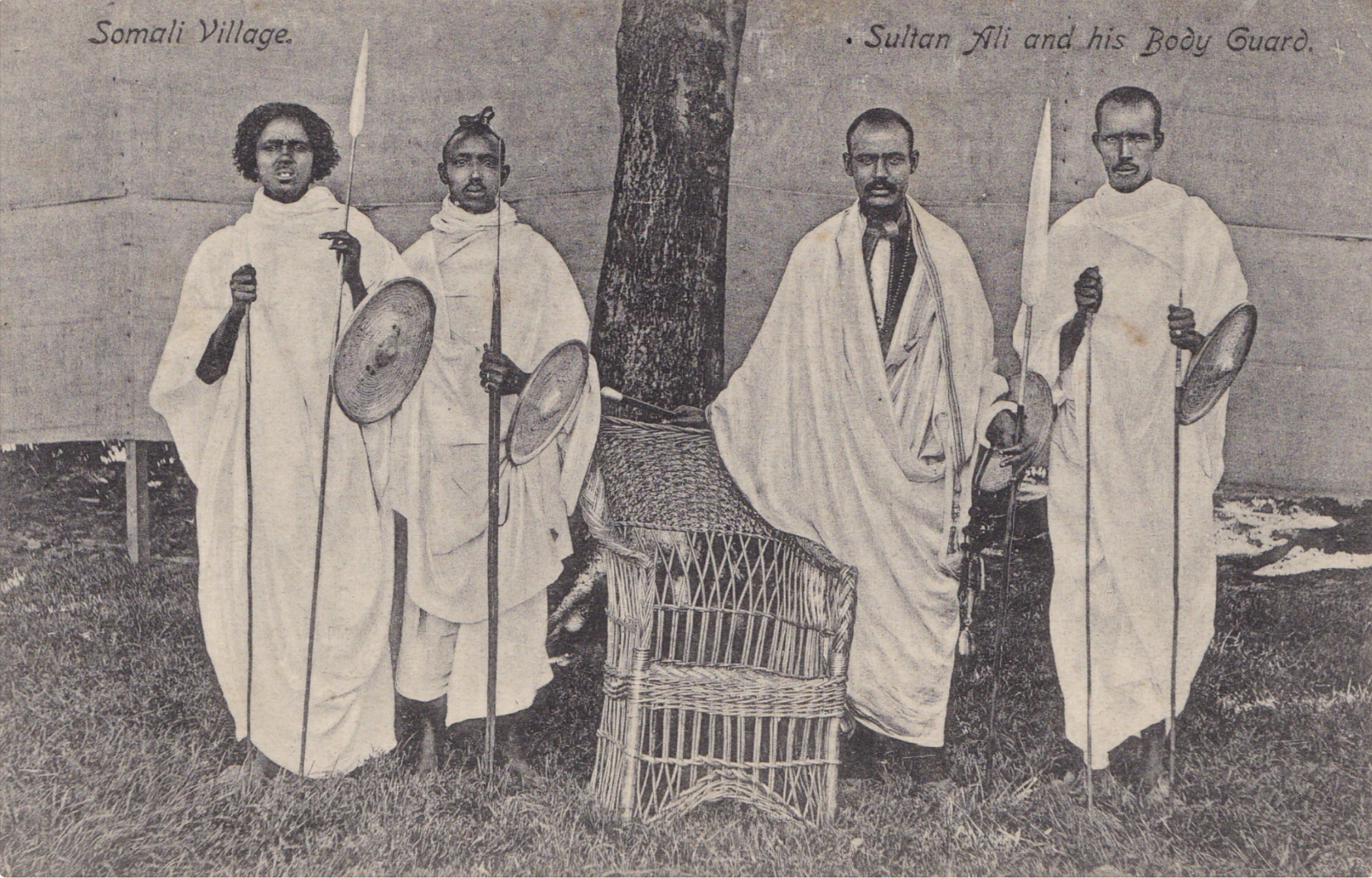
In 1904, Bradford’s Great Exhibition included a staged Somali Village in which 57 people from British Somaliland were put on display to the viewing public. The attraction drew hundreds of thousands of paying visitors, and profits from the exhibition helped fund the art collection at Cartwright Hall, the municipal art gallery and museum that opened that year.
More than a century later, guest curators Abira Hussein and Yahya Birt have revisited this history in A Somali Village in Lister Park: Weaving Together Industry, Culture and Empire (on until 1 November), an exhibition at Cartwright Hall that explored the connections between Bradford’s textile industry, imperial power and the representation of Somali people.
Developed in partnership with Somali-led organisations with reference to archival material, archaeological research and diasporic knowledge, the exhibition examines how colonial narratives were constructed and how they might be challenged today.
The project was named Cultural Knowledge Exchange Project of the Year at the 2026 Future Icons of Culture Knowledge Exchange Awards, organised by the National Centre for Academic and Cultural Exchange (NCACE).
Museums Journal sat down with Hussein and Birt to discuss the exhibition’s development and what museums can do to address the continuing legacy of colonial museum practices.

Abira Hussein
Guest curator, A Somali Village in Lister Park

Yahya Birt
Guest curator, A Somali Village in Lister Park
Advertisement
Can you tell us a little more about the 1904 Somali Village exhibition?
Abira Hussein and Yahya Birt: Bradford’s Great Exhibition of 1904 was held between May and October in Lister Park. Like similar exhibitions in Europe and America, it was a mix of culture, industry, science and entertainment interlaced with imperial themes.
It was chiefly designed to boost Bradford as a great centre of the textile industry, given fears about rising American tariffs and increased foreign competition. Some 2.4 million people attended. For an additional fee of sixpence, 348,550 people gained entrance to what was described as “the most popular of ‘the entertainments’”: a staged ethnographic village within the exhibition grounds, which housed 57 Somalis from British Somaliland – 27 children, 19 men and 11 women – and earned a gross of £8,216.
In addition, the new purpose-built municipal art gallery and museum, Cartwright Hall, was inaugurated, and two-thirds of the exhibition’s profits, including those from the ethnographic village, were used to pay for its art collection.
How was the original village presented and how did it reflect the views and racial hierarchies of the period?
Drawing on the German Völkerschau (people show) model of a staged native village, the Viennese impresario Victor Bamberger (1864–1937) presented the Somali Village as both “authentic” and exotic. This form arose in the late nineteenth century as European audiences grew sceptical of the genuineness of native peoples shown at theatres and circuses.
Advertisement
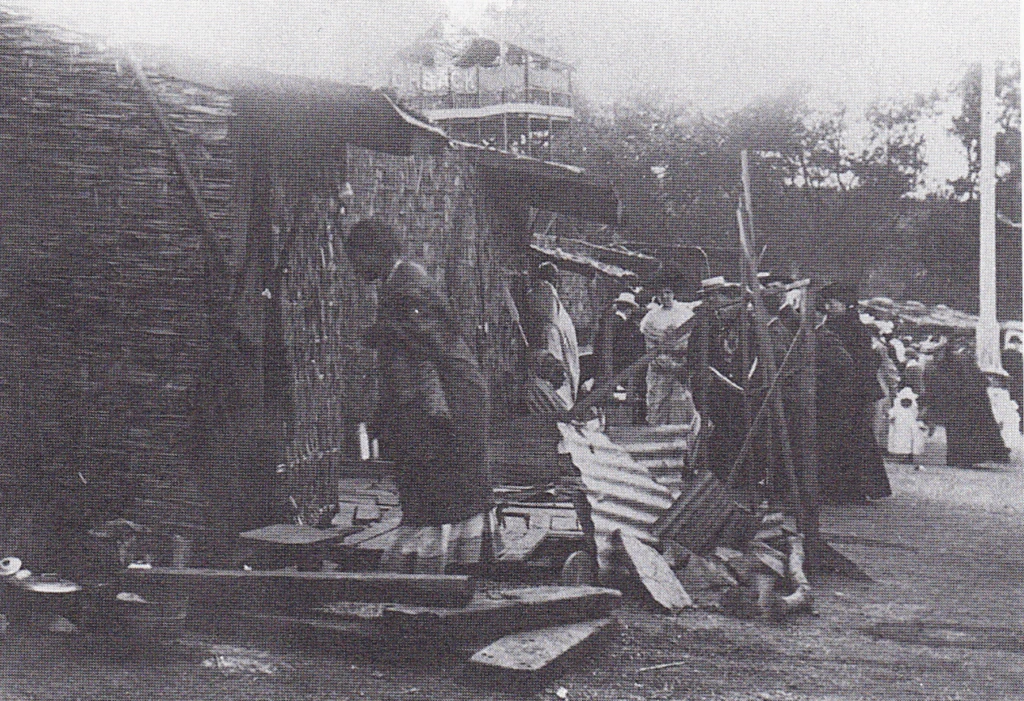
Yet performance, real life and cultural knowledge remained tightly interwoven in this new form. The core elements were what Eric Ames calls “the world of work” in the form of a market, everyday life in terms of schooling, cooking and praying, and the performance of song, dance and mock fights. Real-life events, including a divorce, a death, a birth and a fire in 1904, were also turned into marketing opportunities in close collaboration with the local press.
Advanced power looms in the Industrial Hall were deliberately juxtaposed with the “primitive” Somali handloom in the village, inviting comparisons with Britain’s pre-industrial past and fixing the Somalis within a developmental, hierarchical schema. The villagers were recruited amid the Anglo-Somali Wars and presented as good imperial subjects, in contrast to those who resisted British territorial expansion.
Bamberger’s ethnographic booklet, which we feature as a tactile object, is imperialist, Orientalist and sexualised. We also wanted to highlight that the Somalis called themselves carwo (pronounced arwo, “people of the market or fair”) and regarded this as a commercial endeavour. They worked under exploitative and extractive conditions of colonial labour and protested their treatment by mounting a picket outside Bradford City Hall on their day of departure.
What impact did the original exhibition have among the public in Bradford?
The Somali Village drew large crowds: combining concessions with paying visitors, attendance averaged 2,300 a day, six days a week. Blanket local press coverage, marked by curiosity, mockery, paternalism and racialisation, reflected sustained public fascination. Early on, council debate about cold weather prompted the public to donate blankets and clothes, visible in May 1904 photographs.
Printing, Edwardian Bradford’s second-largest industry after textiles, was central to how Somalis and other colonised peoples were represented via the new postcard medium. Bradford’s Somali Village postcards circulated across Europe for years, sometimes relabelled as “Abyssinians” for later tours.
Advertisement
One exhibited postcard shows the textile magnate Lord Masham (1815–1906), or Samuel Cunliffe Lister, Cartwright Hall’s benefactor, leading a delegation to the village. The image links the exhibition’s themes of industry, culture and empire, showing how the white gaze was trained on the “primitive other”. Counterpointing this are six Ernest Aris (1882–1963) cartoon postcards that satirically domesticate the Somalis within local class antagonisms, using Yorkshire-dialect captions.
How did you approach this subject from the lens of a modern curator?
From a contemporary curatorial perspective, partnership was central to our approach. We worked with cultural institutions in Bradford and Somali-led organisations, including Somali Village Charity, Culture House and Koor Archives, recognising that institutional research alone could not account for histories that had been fragmented or excluded.
We also drew on Sara Ahmed’s concept of orientation, asking not only what the 1904 exhibition displayed, but how it organised movement, looking and comparison. Visitors could circulate through the exhibition as observers, while Somali residents were contained within the village and made available to view. This distinction between the mobile observer and the fixed subject was part of the exhibition’s racial logic.
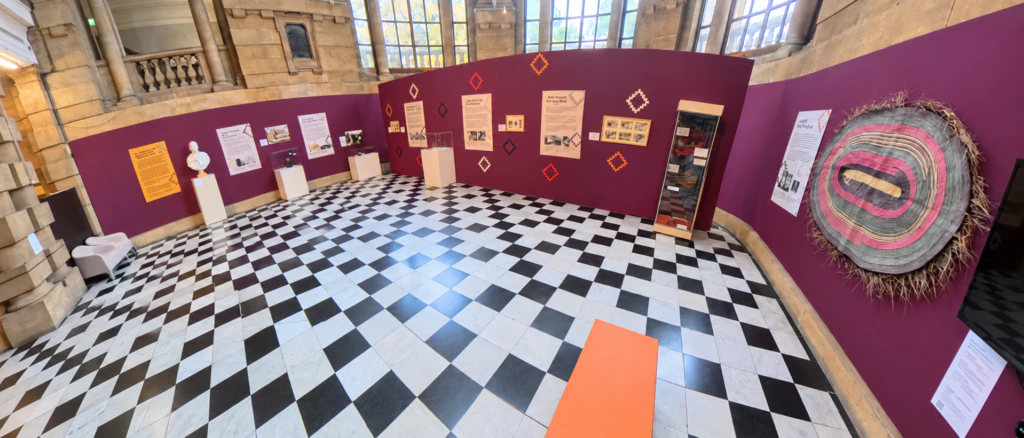
Our process therefore involved both reorientation and remediation. Reorientation shaped the exhibition’s design: colour and Somali textile motifs extended across the gallery, creating a Somali visual language and material environment rather than allowing the colonial image to remain the dominant frame. Sound and film also shifted the encounter beyond mere looking.
Remediation involved bringing museum and archival material into relation with archaeology and diasporic knowledge. A bead recovered during the 2025 excavation, for example, was recognised through Somali community knowledge as a chevron trading bead, a type of currency, connecting the archaeological fragment to wider histories of trade and movement.
What did you want your 2026 exhibition to convey?
One central mechanism we wanted to challenge was temporal fixing. The 1904 village did not simply racialise Somali people; it placed them within what has been described as an anachronistic space, positioning Somali life as belonging to an earlier stage of social development. This was particularly powerful in an exhibition devoted to Bradford’s industrial achievements, where visitors could read technological progress against the village’s apparent primitiveness. The contrast did not simply describe differences; it helped visitors construct their own sense of modernity.
The exhibition subtitle, Weaving Together Industry, Culture and Empire, became its organising metaphor because it allowed us to reconnect histories that this temporal ordering had separated. Our approach to remediation was similarly relational: rather than treating museum objects as remnants of a distant culture, we brought them into relation with forms of knowledge that revealed continuing use and transmission.
We were also interested in moments when Somali life exceeded the colonial frame itself. Performance, refusal, labour protest and everyday religious practice could not be fully contained by the meanings imposed on the village. The exhibition therefore sought not to reconstruct a complete past, but to make visible both the structures that fix Somali people in time and the forms of life that continually unsettled that fixing.
How does your exhibition explore the connection between the Somali Village and the building of Cartwright Hall?
As curators, it was not only important for us to retrieve a story that had been largely forgotten but to recontextualise it as fully as possible, because, when half-remembered, the Somali Village is dismissed as bizarre and picaresque.
Instead, the exhibition centres the village’s deep connections to Edwardian Bradford’s industrial and cultural elites. Lord Masham, the great textile manufacturer, features heavily as the sponsor of Cartwright Hall, the city’s leading art gallery and museum, who is shown visiting the Somali Village.
We explore the imperial connections Bradford’s industrialised wool trade had with settler colonialism in Australia through the expansion of mass sheep farming there. Cartwright Hall’s first director, Butler-Wood (1854–1934), and London art dealer WH Knight, who went on to manage the 1904 exhibition, devised the idea of a native village as “something more novel” to increase ticket sales.
The exhibition and the village were both highly profitable, and two-thirds of the profits, together with accumulated interest, were used to fund Cartwright Hall’s art collection between 1906 and 1928. We feature Alfred Drury’s marble bust of Lister, which was purchased by the gallery in 1906, the year the exhibition profits became available.
The idea of exhibiting people is quite shocking today. How does the new exhibition deal with this discomfort?
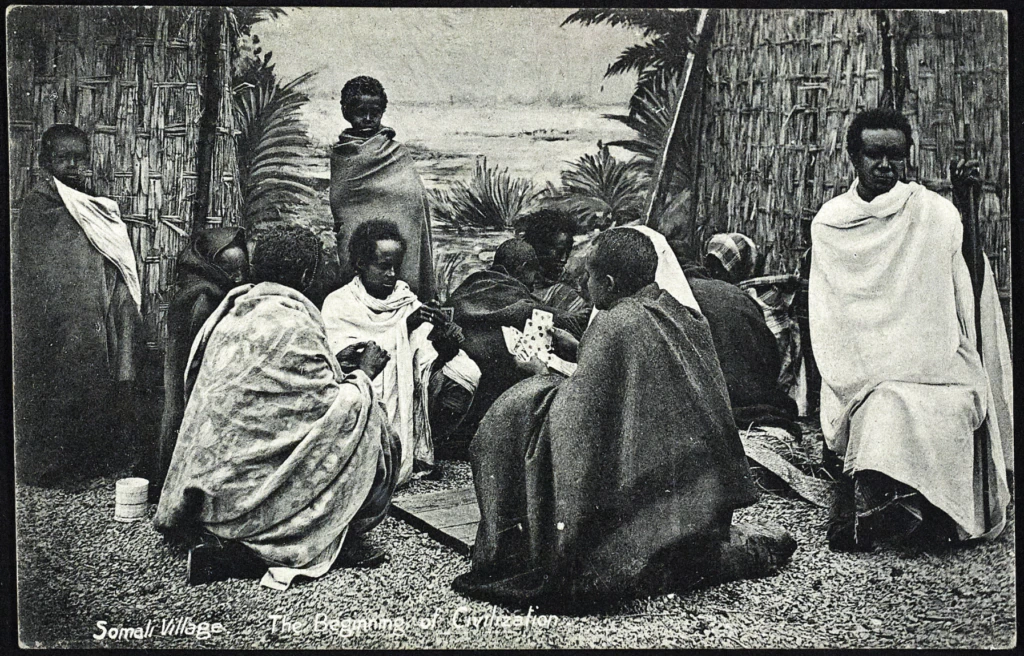
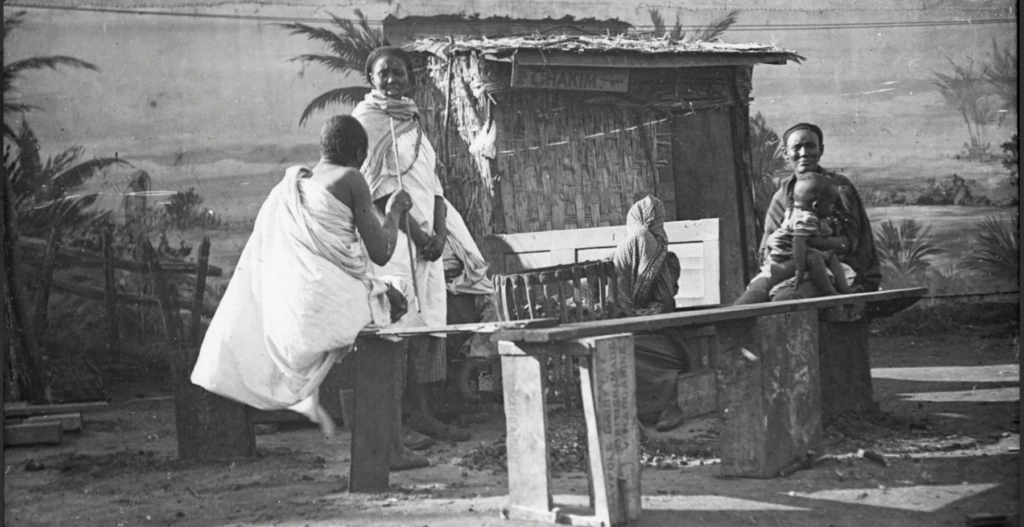
We did not want to resolve that discomfort; the exhibition cannot erase the violence of colonial display, but it can expose the mechanisms that produced and circulated that violence. The photographs were not neutral records; they emerged from a moment of rapid technological change in photography and mass printing, when postcards and the illustrated press enabled racialised images to circulate on an unprecedented scale.
In Bradford, where printing was the second-largest industry after textiles, the village became part of a wider visual economy in which staged encounters could be reproduced and consumed far beyond Lister Park. This made ethical seeing and circulation important to our approach. We used images selectively, limited our use of photographs depicting children, and carefully considered how they would circulate online and in marketing.
We reframed the images as products of an imperial visual system, not evidence of Somali life. At the same time, the archive contains moments of refusal, including a woman shielding her face from the camera; these moments interrupt the image’s apparent authority and remind us that those photographs were never simply visual types, but historical subjects who could contest the terms of their own visibility.
What do you think the museum sector should be doing to address the legacy of these past practices?
Museums need to move beyond treating exhibitions as isolated historical events. They should examine how classification and institutional translation continue to shape what becomes publicly knowable, and how this operates across museum collections and archives.
This means recognising both institutional and disciplinary enclosure. Materials that once belonged to the same cultural world are dispersed across different systems of knowledge, where objects and archival records acquire separate institutional identities. Addressing that fragmentation requires working across those boundaries rather than assuming any one disciplinary record is complete.
It also requires greater recognition of the limits of museum work itself. Christina Sharpe questions forms of memorialisation that appear to place historical violence safely in the past when its effects remain active in the present. Museums cannot resolve those histories through a redisplay or revised interpretation alone.
The task is therefore not simply to reinterpret colonial material, but to question the structures that made it knowable while creating more relational ways for different forms of knowledge to remain in conversation. We should make that approach explicit in curatorial practice.
We thank the numerous organisations and individuals who supported the Somali Village project from which this exhibition originates. We particularly thank the Somali Village Charity, the University of Leeds, the University of Bradford, Bradford District Museums & Galleries, Culture House and Koor Archives. We are also grateful for funding and in-kind support from Arts Council England, Bradford 2025 and Everyday Muslim.