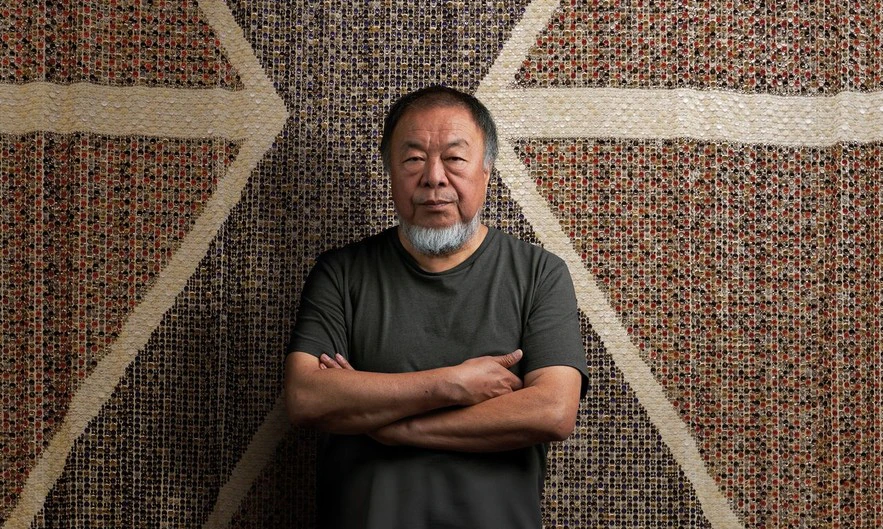
Ever one to throw the cat among the pigeons, the Chinese dissident artist Ai Weiwei has done it again, this time at Factory International in Manchester, where his new show Ai Weiwei: Button Up! opens this week.
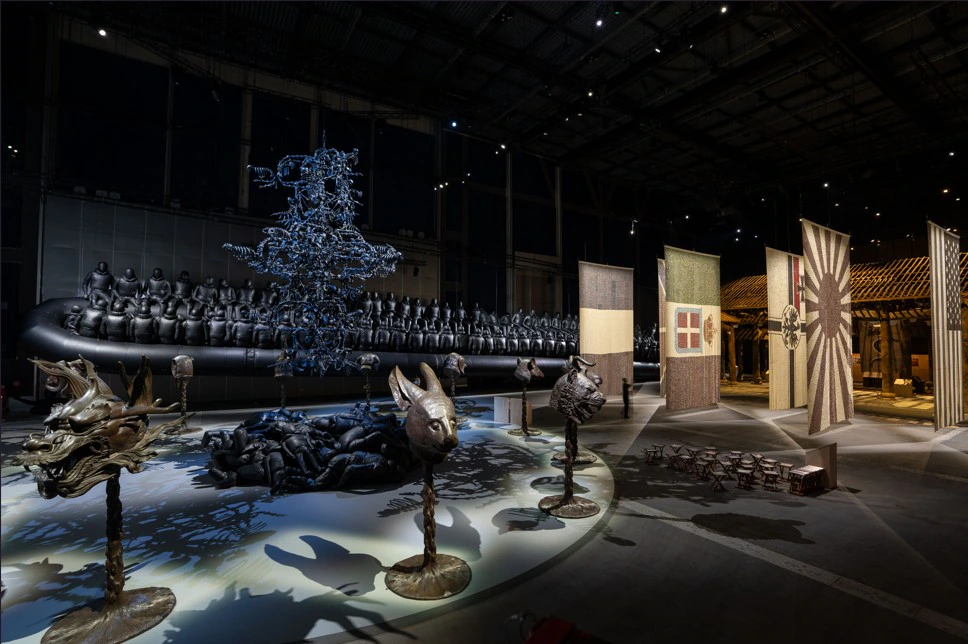
A visual orgy of bombs, bodies and bones awaits visitors on entering the enormous gallery space at the Factory: this new exhibition – his largest site-specific show to date – feels oppressive, aggressive, and very dark.
Ai has always made provocative art and continues to do so as he slowly graduates towards 70 years of age.
Earlier controversies include the photographic triptych showing Dropping a Han Dynasty Urn, 1995, where he smashed a 2,000-year old pot; a photographic series in the same year showing his middle finger up in front of politically charged sites, including Tiananmen Square; and his 2008-12 work Straight, which comprised of 100 tonnes of steel bars collected from poorly constructed school buildings from the 2008 Sichuan earthquake that left 90,000 people dead or missing, including more than 5,000 schoolchildren.
Ai’s continued prods at the establishment with these politicised artworks led to the Chinese state government arresting and secretly detaining him for 81 days in 2011, separating him from his then four-year-old son and his wife, with no notice for an unknown amount of time.
He’s had exhibitions in the UK before, with one of his most famous interventions being Sunflower Seeds, where he filled the floor of Tate Modern’s enormous Turbine Hall with 100 million individually hand-painted, life-size, ceramic Sunflower seeds, raising questions around mass production and personal identity.
Advertisement
Perhaps the biggest splash was his retrospective show at London's Royal Academy of Arts in 2015, which was such a roaring success that the organisation had to open around the clock to accommodate the visitor numbers.
His major work Lego block work, The History of Bombs, was shown at the Imperial War Museum in 2020 and the Design Museum held the first exhibition to examine Ai’s architectural and design work in 2023 – after all, he did design the "bird's nest", Beijing National Stadium, which opened for the 2008 Olympic Games in the city.
Internationally renowned for ruffling feathers, Ai shows work in major museums and galleries across the world and has studio bases in Berlin and Lisbon, since China made that very public declaration that it didn’t like having him around.
Museums Journal spoke to the artist – as wryly irreverent as ever – about his work, his intentions and his legacy.
The exhibition is strikingly dark. Do you like the world we live in today?
Ai Weiwei: Do I like the world that we live in today? I love the world. I always love even what can be the most tragic time. I still love the world because different conditions give unknown coincidence, and still give us opportunity to understand others and understand ourselves in different ways. The exhibition is pretty dark in many ways – people might think, "Oh, that's history, that's heavy,” but we have to bear the history, we have to bear our memory. Even if it is a nightmare, it should belong to us.
Advertisement
What does it mean to make political art in such a divisive world?
I never think my art is political art. My art is a dear, lovely art about love. I haven't started my political art career yet. I'm nearly 70 years old, so maybe I don't have much time, but you know, I think all art is political because it is the act to question – it is the act to find new territory, and that is very political.
Ai Weiwei: Button Up! | Focal points of the exhibition
- The monumental inflatable black dinghy, The Law of the Journey, 2017 – a commentary on the global migrant crisis.
- A new and updated The History of Bombs.
- La Commedia Ummana, 2017, a chandelier made of black Venetian Murano glass in the shape of human bones.
- A new commission, Eight-Nation Alliance Flags, comprised of eight flags sewn with nearly half a million buttons, which interrogates traditional Chinese craft and civilian work as well as the early-20th century invasion of China by the Eight Nation Alliance (Britain, France, US, Germany, Japan, Russia, Italy and the Austro-Hungarian Empire).
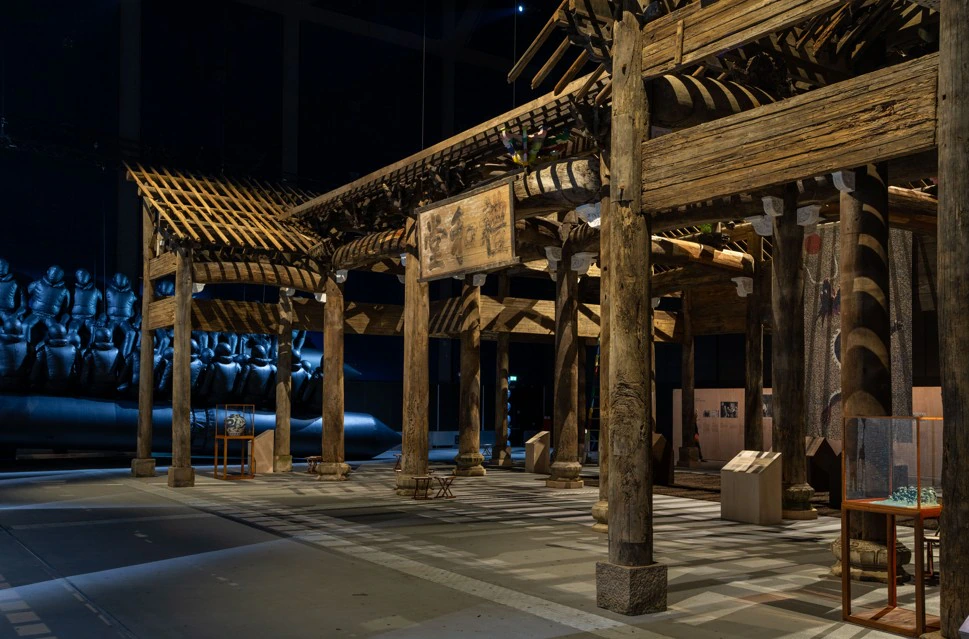
- Wang Family Ancestral Hall, 2015, a reassembled, 500-year-old Ming Dynasty wooden temple.
- A major new performance piece, Sewing a Button, due to be performed this weekend (3-4 July), where Ai will reenact his governmental detainment in a live installation over 24 hours with live interrogations.
You made Law of the Journey nine years ago. Did you expect it to still be so relevant today?
It was relevant 4,000 years ago, it is relevant now and it will be relevant in the future. I think with today's extreme power and financial divisiveness – the real money only reaches the very few – with huge property ownership created, plus with AI craziness, a lot of people will lose their old social structure. So, how will they struggle through life? There will be huge casualties, and we don't even have to go to another land to become a refugee. We can be a refugee in our own home.
Eight-Nation Alliance Flags and Law of the Journey effectively touch on exactly the same issue…
Exactly the same issue, but the result is clear: you have a chandelier of skeletons, and you have those bombs being designed, and being used. The nuclear bombs dropped on Hiroshima and Nagasaki in Japan in 1945 will be used again in the future.
Advertisement
The UK has just announced billions of pounds more spending on defence…
It's really hard to break this kind of circle. It doesn't lead to a better future.
Eight-Nation Alliance Flags creates something beautiful out of something ugly – a confrontation between China and the Eight Nations Alliance that came in to suppress the Boxer Rebellion [an anti-imperialist uprising] and killed thousands of Chinese citizens in 1899-1901. Can you tell us a bit more about the work?
The work is the most peaceful, darling work. Look at it – every single ivory button is sewn on by the hands of these Chinese ladies from a not-so-developed area in China. Only Chinese people can make work like this. Just look at it. Each flag contains thousands of buttons, I think 400,000 buttons in total across the eight flags. It's a work about love and about memory.
Do you know if any of the craftswomen or people had ancestors or relations killed in the Boxer Rebellion?
I'm sure there are many, but they don't even know. Interesting you mention that piece of history – very few people know that, and they don't even know it. People don't care, you know. It's past and what with all the conflicts happened in the past or today, we cannot just say that's China or Russia or US or Afghanistan, it happens to human, that's humanity, you know. Greediness or brutality or sadness or weakness, it's all humanity. We have to understand; we have to establish that understanding. Every damage is damage to humanity, and every struggle, like exhibition art, is in favour of humanity, you know, to protect better relations.
Your 24-hour performance piece, Sewing a Button, reenacts your 2011 detention. Will that be traumatic for you?
It's not going to traumatic; it's going to be dramatic. You know, this is just one person being detained for 81 days, and it was harsh at the time, but no longer. I have healed. I see too many things – the US just kidnapped Venezuela's president; you can just kill someone while they’re asleep, or you can kill the whole cabinet, 3,040 together, without them even knowing. Compared to these kinds of issues, what happened to me is nothing. It's almost like a comedy.
By nature, you’re an activist. Do you think galleries and museums should be activist spaces?
I don't like the word activist, because I think that's the nature of any intelligent human being. You should be activist, because you have to act your belief, otherwise you're just hypocrisy. If you don't act out what you believe or speak for, I think that is really a horrible situation. So, I don't think of myself as an activist, but I'm certainly, in a way, a believer. I believe in humanity, I believe we should survive, and I believe this is a miracle. Nobody should have any excuse to destroy it.
So, talk about museums. I think most museums, maybe 90% of museums, or 99% of museums, are living in the ruins of human understanding of art. They collect items because they are expensive or because it happened 200 years ago, or 40 years ago, you see the same kind of thing in every museum.
Museums are blind, they don't know what's going on, or they're so timid or scared, or they don't know what to do. They are posing the whole society about one artist and it's disgusting. There are still a few very good ones, but I can’t say any more about this.
Fair enough. What do you want your artistic and personal legacy to be?
My personal legacy is to be forgotten. I don't want people to remember me.
But what about your art and the archaeology of the future?
My father wrote a poem about that, clear words. I really love his poems. He said, in future archaeology, someone found my bone, but how do they know that bone was being burned by 20th century fire?
What's next for you after Factory International?
The next major secret to tell you is my death. We have to face reality. Hopefully there'll be a bit more art in between. Something may happen, a miracle, but if nothing happens, I'm totally satisfied with my life. Thank you.
Ai Weiwei: Button Up! is on at Factory International until 6 September