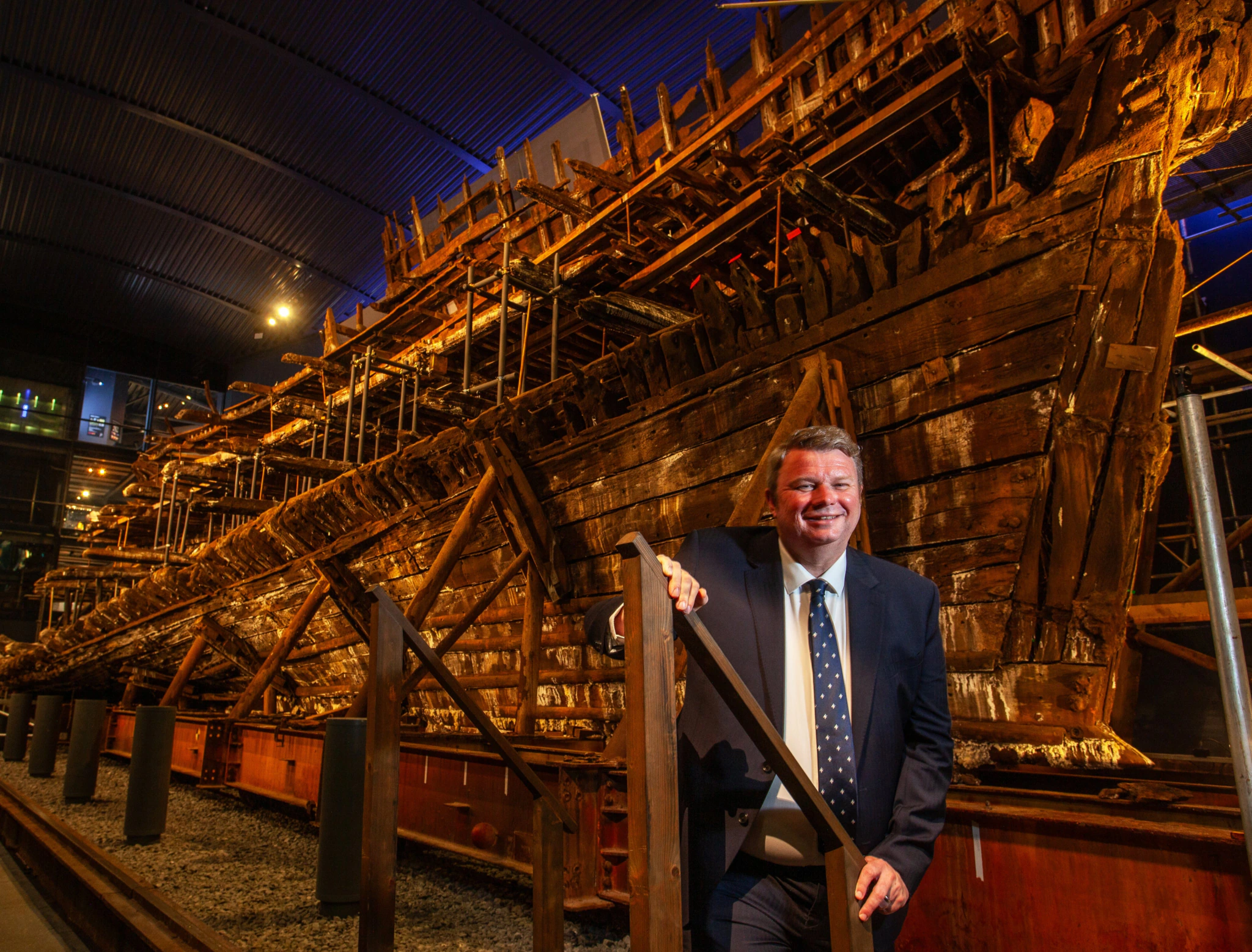
“Everyone was worried I was going to turn the place into Disneyland,” says Dominic Jones, the larger than life chief executive of the Mary Rose Trust in Portsmouth.
In fact, they did have a right to show concern because of Jones’s unconventional non-museum background, with training at Disney University and experience in running theme parks.
But Jones, who hails from north Wales and can’t wait for the Museums Association conference at St Fagans near Cardiff this year, proved them wrong from the off.
“The only time I put my foot down was on the bubbles,” he says.
He’s talking about the museum’s Dive the Mary Rose 4D immersive experience, which opened in 2023 and gives visitors a real sense of diving on the wreck from the comfort of their cinema seats, wearing 3D glasses and getting the so-called “butt buzz” at a certain point in the animation. And he’s been proven right about the animated bubbles – everyone loves them.
“Theme parks are fantastic ways of telling stories,” he says. “So are museums. We just have to find the right way to do it without losing integrity and authenticity.”
Advertisement
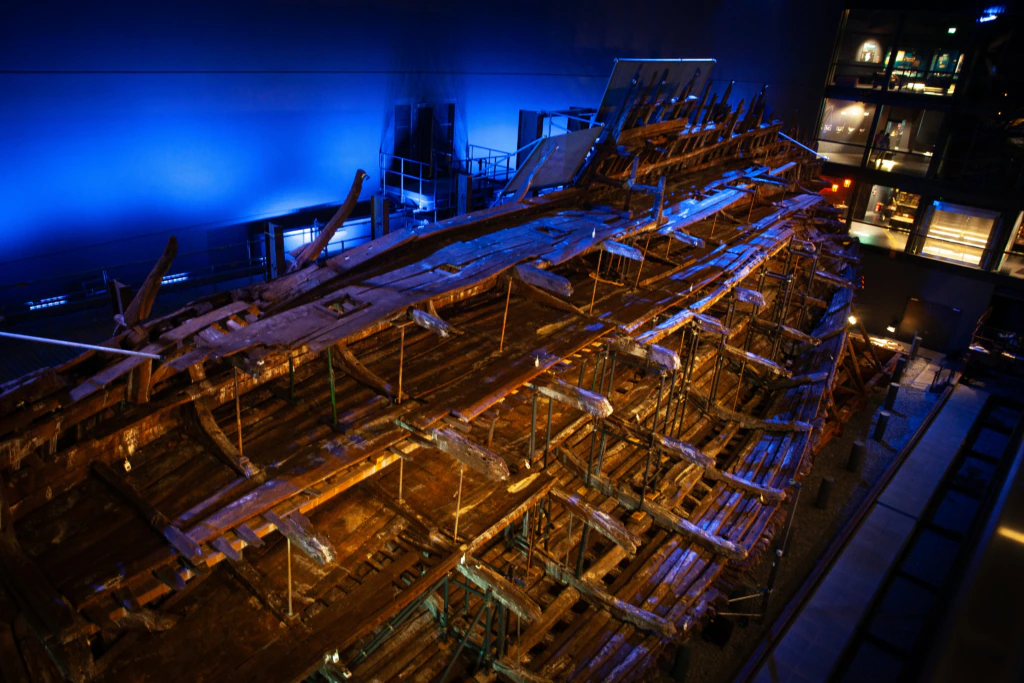
The 4D immersive at the museum tells the missing bit of the story of the Mary Rose, a Tudor warship that sank in 1545. While most of the museum is dominated with the eerily beautiful carcass of the ship – swathed in blue light in the museum’s cavernous airlocked atrium – and displays about the people who would have lived and died on board, the story that hadn’t been told was the raising of the wreck in the 1970s and 1980s.
The Mary Rose was the pride and joy of King Henry VIII and was the first battleship – along with its twin the Peter Pomegranate – that he commissioned once he had ascended the throne. In use for 34 years, from 1511 on, the vessel sank during the Battle of the Solent, against the French (they still claim they sank it, but officially no-one knows exactly why it happened), off the south coast of Britain.
Over the centuries, the wreck has been found, lost, found again, lost again and finally found and retrieved after a decade-long hunt and underwater excavation through the 1960s and into the 1970s. And it is that excavation – completed in 1982 – that the immersive delves into.
Jones says they tried using actors to create the immersive at first.
“But the film came back and just didn’t feel right because the voices were actors, and they were great actors, but they were actors, so we delayed it and recut it with real divers’ voices,” he says.
“So, every voice is authentically someone who has dived on the Mary Rose. It still gives me goosebumps.”
Advertisement
Jones joined the trust, which runs the independent museum (it receives no public funding), as chief operating officer in 2019.
“I was running Thorpe Park, commuting hours, loving being involved in that world, but I never saw my kids and my daughter was just three at the time,” he says, recalling a particularly heartbreaking moment when she said, “Dad, thanks for coming home to visit,” which snapped him into action.
“I knew I needed to find a job closer to home and there was a role advertised for chief operating officer of the Mary Rose,” he says.
“We quickly went to revisit the Mary Rose and Portsmouth Historic Dockyard and I knew straight away I had to have this job. I rang the recruiter nearly every day and said repeatedly: ‘I’m your guy’.”
Jones and his wife had tough conversations about the big pay cut he’d be taking because heritage doesn’t pay the same way that commercial business does. And he got the job.
Advertisement
“I was over the moon, and then it was the biggest learning curve I’ve ever had. As all of you in the sector know, it’s incredibly rewarding work, but it’s incredibly different to working in a commercial organisation.”
Refloating the business
Jones had a lot to get his teeth into – a hospitality business that was losing money, and that was just the tip of the iceberg. An even more urgent focus was the museum shop, cafe, ticket sales and how he could get more people through the door.
To kick things off he introduced a new exhibition (closed in 2022 but being integrated into current displays) called Many Faces of Tudor England (which came from a Channel 4 documentary in 2019 on the Many Faces of the Mary Rose) that looked at isotope and DNA analysis of the human remains from the wreck and delved into who the crew members might have been and what they might have looked like. He says that upped the under 40s visitor demographic massively.
He also introduced a kids’ trail based around all the incredible wooden chests found on board the ship. That has grown visitor numbers even more.
Dominic Jones
Hailing from Colwyn Bay in Conwy, Dominic Jones took a leisure studies course at Swansea Institute for Higher Education, but then joined the Walt Disney World International Programme in 1997, where he was a lifeguard and entertainer for the Typhoon Lagoon.
Since then, his career has built from operating a teacup ride, for £3.50 a go, to Thorpe Park rides supervisor to area team leader. He’s worked at Chessington World of Adventures in Surrey, Sea Life, Madame Tussaud’s and Merlin’s Dungeon attractions in Europe, as well as holding senior positions at Virgin Atlantic.
In 2012, Jones was made the park director of Oakwood Theme Park in Pembrokeshire, Wales. And in 2016, he became divisional director at Thorpe Park in Surrey where he was in charge of partnerships and promotions. Among other initiatives, he set up a Ministry of Sound nightclub deal.
In 2019, he became chief operating officer at the Mary Rose Trust, Portsmouth, then chief executive officer in 2021. He is also a trustee for Gilbert White’s House and Pompey in the Community.
Then he launched a city-wide marketing campaign to get the locals back on board.
“We had pictures of Henry VIII with a cannonball saying: ‘Turn around. You’ve just missed the best thing to do in Portsmouth’,” he says. “And then on the other side we had: ‘You’re about to do the best thing in Portsmouth.’
“We handed out leaflets across town all the way down to the beach. We just wanted as many people through our doors as possible. If it was a sunny day, we’d say to people on the beach: ‘I know you’re having a great time, but it’s air-conditioned in the Mary Rose, and there’s 500 years of history, and here’s a five-pound-off voucher’.
“We had deals everywhere. We did colouring-in sheets. It was a Mary Rose takeover of the whole of Portsmouth.”
An advertising campaign like that sounds pricey, time- and cost-wise, and it was, but Jones had made sure it was going to be worth it. He discontinued the museum’s expensive television advertising, and the results of the new campaign meant the business grew by an astonishing 40%.
Then on to tackle tickets. “It was that which allowed us to negotiate with the National Museum of the Royal Navy and show that we are genuinely really good at attracting visitors and prove to them that we’d be even better together,” he says. “We did the deal, and the combined ticket to our sites is extremely successful.”
Out of the blue, Helen Bonser-Wilton the then chief executive of the museum booked an ominous Teams call with Jones.
“Bear in mind that Helen used to ring me all the time, so it seemed odd that she was booking a Teams call instead of just giving me a buzz,” he says.
“I spoke to my wife, and she thought I was probably going to get fired. I’d done what I came in to do. You know, there’s this joint-venture now, the business is commercially successful, and I’m probably an expensive asset.”
Heart in mouth, Jones joined the call with Bonser-Wilton. “Dom, I’m leaving,” she said. “I’m going to be CEO of Leeds Castle. The Mary Rose board are going to start recruiting for a new CEO. I think you should apply.”
He could breathe again. “I applied for the job and got an interview – probably the toughest interview I’ve ever had because I’m not a traditional museum person, and I didn’t feel like one.”
He remembers a tricky question: if you got the job, what would you do first? “I wanted to do everything first – which is not what they wanted to hear – because the Mary Rose in popular culture was gone. What she needed was some new news.”
Since 2021, when he got the job as chief executive, Jones has created that new news. He’s instigated an immersive digital welcome experience, voiced by Judi Dench, telling the story of the battleship in 1545, how it sailed and how it sank, complete with an actor playing King Henry VIII projected life-size and chatty, wearing the most enormous codpiece, before visitors enter the museum proper.
It’s not all plain sailing, though. Jones emphasises how tough it is running a museum nowadays. “It’s one of the best jobs in the world, but it is hard. We had to restructure recently. It was really hard.
But if you don’t, and if you don’t grow or merge, you’re going to close or shrink. If we don’t run it like a business, the Mary Rose won’t be here for the future. It’s really tough. You’ve just got to find ways to work.”
Holding course
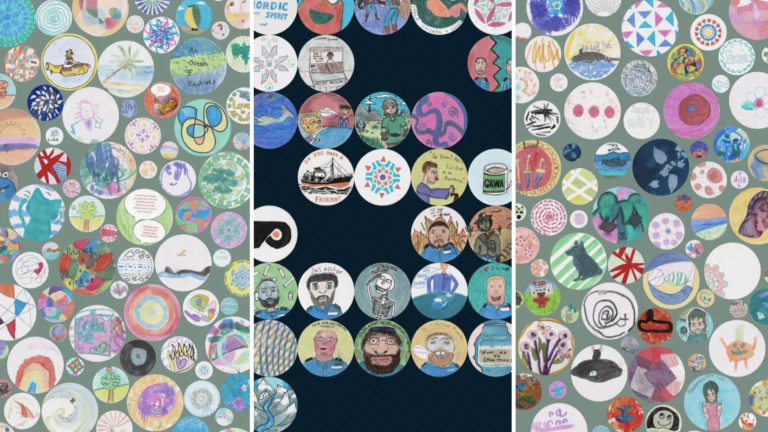
And he has. As well as the 4D immersive dive experience, he has increased the museum’s learning programmes, got cash-strapped schools to visit with the Pupil Premium scheme and upped the ante with community engagement, namely through the 40th anniversary project in 2022, Anchored in the Community.
“It was about doing the right thing. If you want to be a leading museum, you’ve got to act like a leading museum,” Jones says. “We’ve made a massive impact.”
But he wants to do even more. He’s formed the Cultural Collective with 17 other organisations across the city to help them all collaborate more effectively, and he’s brimming with ideas for pop-up exhibitions, tours and partnerships for the future, plus the Association of Independent Museums held its annual conference at the Mary Rose Museum in June this year.
Even after all that though, Jones says he still didn’t feel like a “museum person”. “People at the conference said to me they loved what we’d done here, and I said, ‘Well, I’m not really a museum person.’ And someone said: ‘Well, what have you been doing the last seven years your life? You’ve been running museums.’ And I thought, yes, I have.”
His outlook changed. And he feels as though he belongs in the museum community now. “For me, it’s about are you good at inspiring people? Can you tell stories? Can you get the best out of people? That is what a museum person is,” he says. “And I am proud to be a museum person.”
The Mary Rose Museum
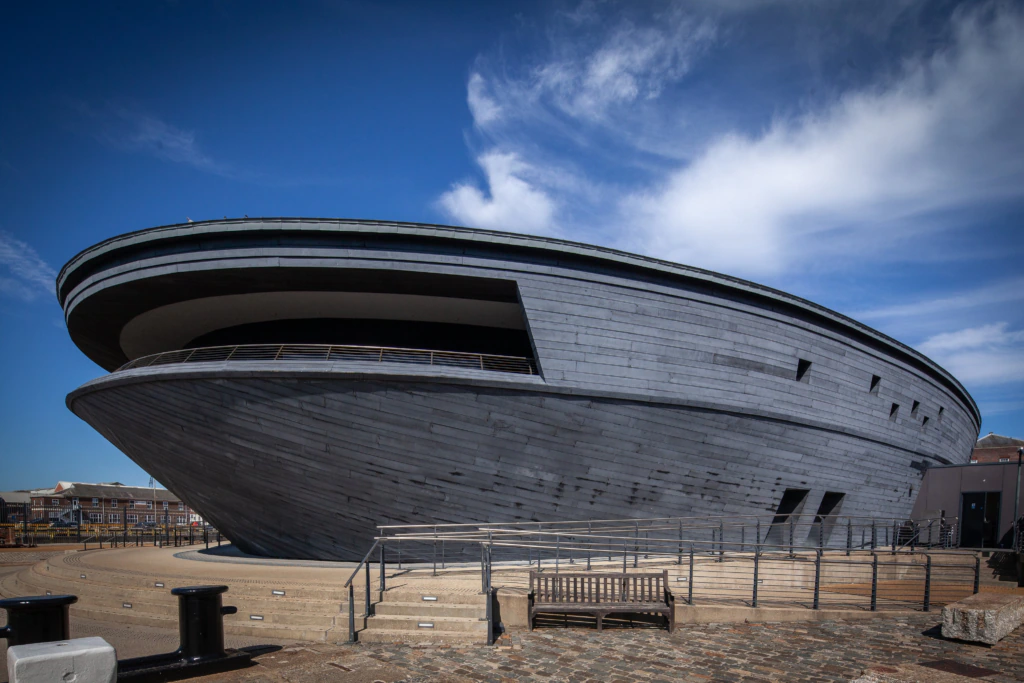
Built in 2013 to house the carcass of the Tudor warship the Mary Rose, the museum was designed by architect Wilkinson Eyre to resemble a mussel shell.
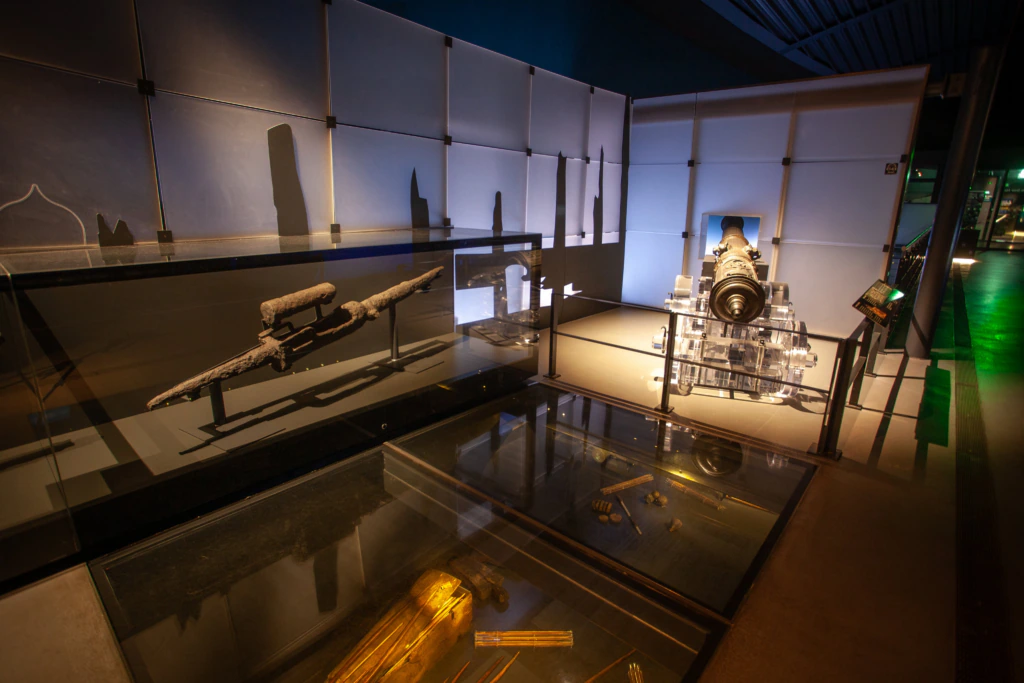
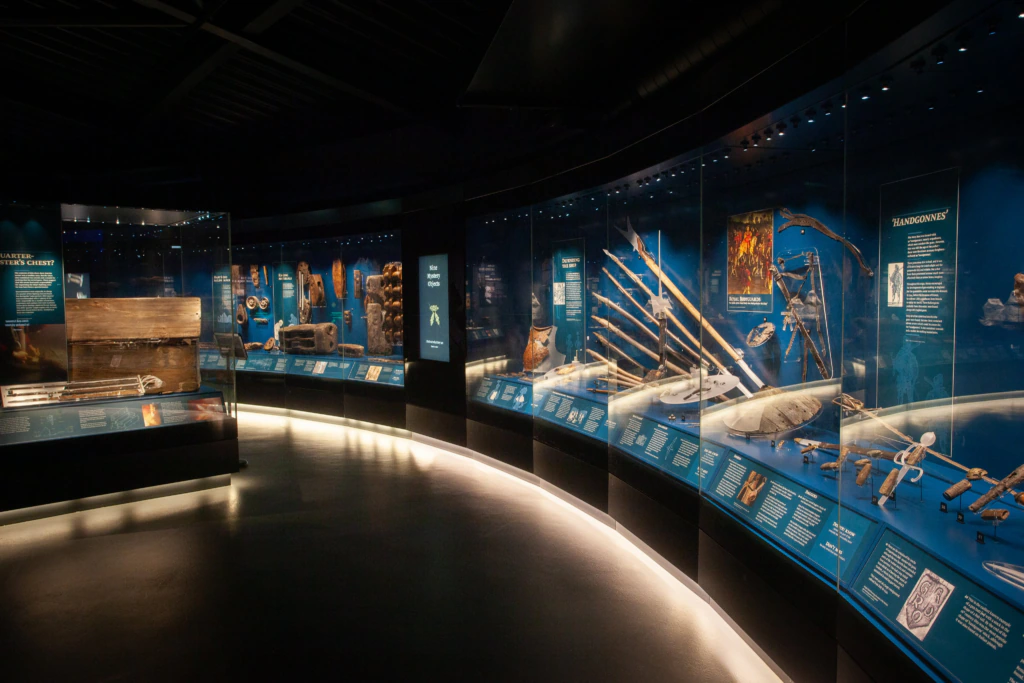
‘Britain’s Pompeii’, as Jones calls it, the museum only shows a fragment of its collection, with a further 19,000 objects stored in warehouses across Portsmouth Historic Dockyard.
The award-winning building preserves the delicate ship in specialist environmental conditions. On top of this, the building itself is engineered to effectively ‘float’ on the historic monument of the dockyard in a complex scenario of layers of heritage.
Run by the Mary Rose Trust, 84% of the museum’s money comes from ticket sales. The museum is run by 140 volunteers and 50 staff, with all offices in a nearby boat house.
The ‘new’ museum building is complicated and expensive to run with energy costs of £350,000 a year. Jones is working towards saving 20% of this with the introduction of solar film on the roof, a more elegant solution than solar panels. National Lottery Resilience funding is helping with this.