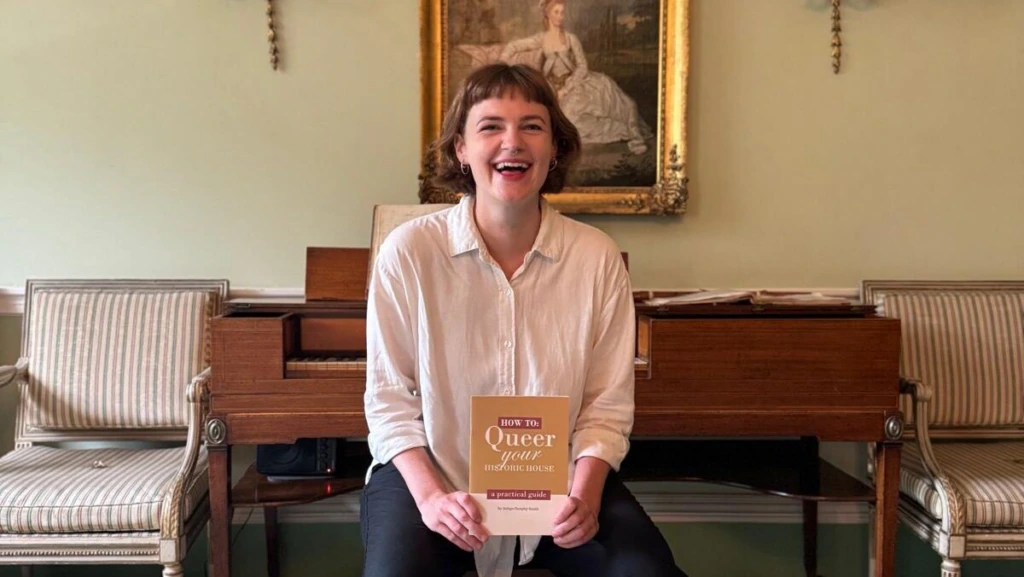
How to Queer Your Historic House was launched in May to advise heritage workers on how to explore LGBTQ+ themes in historic sites.
Created by freelance researcher, writer and heritage professional Indigo Dunphy-Smith, the guide is endorsed by Museums Galleries Scotland and supported by the Queer Heritage and Collections Network.
Dunphy-Smith started her career in Australia as a tour guide in the historic district around Sydney’s Circular Quay, before moving to the UK to work in Scotland as part of a small team at the Georgian House in Edinburgh. She is also co-chair of the LGBTQ+ Network for the National Trust for Scotland and works as a freelance practitioner under the name A Queer Was Here.
How did the toolkit come about?
How to: Queer Your Historic House emerged organically from my experiences working in heritage spaces across Australia and Scotland. Over time, I found myself increasingly drawn to exploring how collections can be used to uncover hidden stories, capture intangible histories and help visitors engage more deeply with the context of a site – from Australian First Nations histories to queer histories in Scotland.
Advertisement
This toolkit tackles the unique challenges of interpreting and implementing queer histories in heritage settings, and it does so in a very hands-on way.
I work in visitor services and welcome teams, so I know that the place of queer stories in the visitor experience can still feel uncertain or contested.
That’s why the toolkit is centred around staff and volunteers who work at heritage sites. The toolkit’s tone is practical and direct. It’s been designed to be budget friendly, with a “work with what you’ve got” attitude to fit with the everyday realities of running a historic house.
Who is the toolkit for and what does it cover?
How to: Queer Your Historic House is for anyone interested in storytelling and curious about how to make historic spaces more inclusive and reflective of the communities around them. The guide offers tools to explore broader social and cultural contexts, drawing links between historic spaces, collections, and queer experiences of the past to tell a more complete story of a historic house.
It covers some of the common challenges come up when working with queer histories, such as “but no one queer lived here” or the demand for proof.
Advertisement
It also offers a step-by-step method for connecting research to a site’s collection, and encourages exploring direct or indirect historic connections to the house and its surroundings through the residents’ social networks.
Finally, the toolkit offers practical ideas for how to embed this research into the everyday visitor experience – through trails, guided tours, updating collection records and volunteer information, or community events.
These suggestions are based on what I’ve done in my own practice, but they’re just starting points. I hope people will take the ideas further, adapt them, and make them their own.
What did you learn from the toolkit's trial at Osterley Park and House?
It was fantastic to work with the team at Osterley Park and House. I identified the National Trust property as a great place to trial the toolkit after hearing about their brilliant ceiling featuring George Villiers, a favourite of King James VI/I. I remember phoning Matt Butler, who had just started in his role as programming and partnerships officer, and essentially saying: “I’ve got an idea and a bit of funding…”
Advertisement
A real win for the toolkit is that Osterley has plans to bring collection pieces out of storage specifically because of their queer links. In almost eight years of working in historic houses, this is the first time I’ve seen a property choose to display an object solely due to its connection with queer history.
Some of the challenges we faced were very practical. Anyone who’s worked at a historic house knows that the daily reality involves juggling in-person responsibilities with online projects, all in spaces that are busy with staff, visitors and volunteers.
To reduce pressure and encourage openness, Osterley presented the work as “in progress.” I think this approach was more powerful than producing something polished. Audiences got to hear reflections in real time, which created a more honest, engaging experience.
Working with Osterley taught me a lot about what it takes to get new places involved in investigating their queer histories.
Flexibility is essential, because things rarely unfold exactly as planned. It’s individual people who drive meaningful change. Building trust is essential but takes time, and success often looks like small, steady wins.
It really proved to me that once you engage with the methods in the toolkit, all kinds of stories will organically reveal themselves to you in unexpected ways.
What role do LGBTQ+ stories play in historic houses today?
I believe exploring LGBTQ+ stories in historic houses offers a powerful way to add depth, nuance, and relevance to visitors’ understanding of a heritage site. Queer histories can bring new layers of meaning to collections and spaces, revealing different ways people have experienced relationships, culture, identity, community, and resistance across time.
They also challenge the idea that history is fixed or only belongs to certain people. Even in properties with no known direct queer residents, there’s still a role for queer histories.
The Georgian House has no recorded queer residents, yet it still has links to queer histories and makes space for these in the visitor experience. It draws on the social networks and collection to explore queerness in context, offering a more complete picture of the property’s past.
Historic houses also have a unique power as physical spaces. By creating room for more diverse stories, they can foster engagement with wider audiences.
Shortly after the toolkit launched, The Georgian House hosted a sold-out Pride bookfair, which celebrated queer literary culture past and present and helped forge new relationships with local LGBTQ+ communities and businesses, showing how a historic house can become a living, relevant space for connection and exploration, even without a direct queer figure.
How should museums approach historical figures where their sexuality or gender identity is uncertain?
To me, it’s about telling stories with care, not caution. If we only share the histories we can “prove,” queer stories remain invisible.
Avoiding discussion of someone’s sexuality or gender identity because we “just don’t know for sure” can do more harm than good and often feels like gatekeeping disguised as academic rigour.
The toolkit challenges this by rejecting the “straight until proven gay” mindset and reframing stories connected to LGBTQ+ histories as central, not marginal, to understanding the social and cultural life of a place. Queer people have always existed within wider communities and places, their lives shaped by the same historical moments, movements, and pressures as everyone else. They don’t exist in a vacuum.
When people ask for “proof,” they often mean explicit evidence of sexual acts. The toolkit encourages practitioners to also look at aesthetics, behaviours and social networks as equally valuable entry points into queer history.
The toolkit embraces ambiguity, recognising that individuals whose sexuality or gender can’t be neatly defined can still be understood as “queer.” The term’s strength lies in its ability to hold space for fluidity and describe nontraditional partnerships and unconventional lives in the past, before our modern labels existed.
Lived experience plays a vital role in how we read the past too. Queer people today, those who navigate visability, who understand the tricky position of being out in some spaces but not others, often recognise patterns others overlook: silences, signals and codes.
Gaps in the record often exist because queer people deliberately obscured their traces to survive, through destroyed letters, coded language, or ambiguous relationships. If you look at it like this, absence can speak just as powerfully as presence.