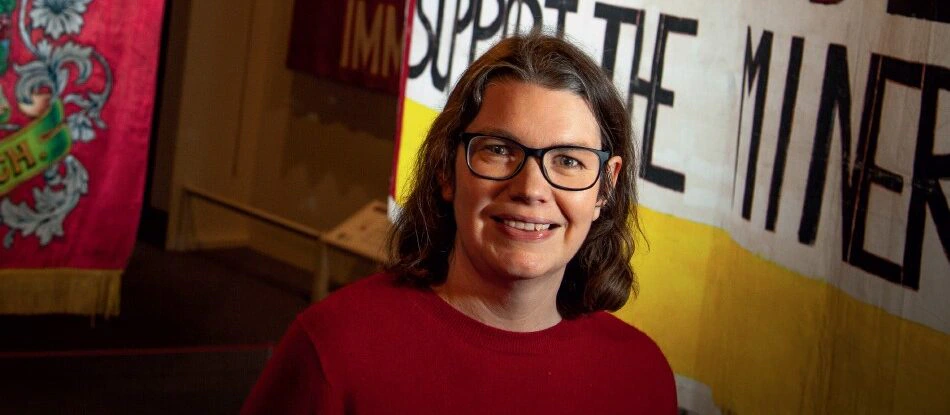
“There is nothing more inspiring than standing in our galleries surrounded by banners, posters and material that connect the people who have stood up and fought for what they believed in,” says Clare Barlow, the director of People’s History Museum (PHM), Manchester, who took up the role in January 2025.
“We tell this amazing story of solidarity and community, and it’s never been more relevant.”
In an era of Donald Trump 2.0, where the UK finds itself in a turbulent political global forum, PHM – which explores people coming together to fight for positive change in society – is more relevant than ever, particularly as Barlow describes it as “our national museum of democracy”.
Growing up gay in the 1980s, Barlow knows what it’s like to feel oppressed and unliberated. “Section 28 was in place and there was a real sense that, a) there were very few queer people and, b) that if everyone would just shut up about it, they would all go away,” she says. “Of course that’s nonsense, but I see the same arguments made today.”
Clare Barlow
The director of People’s History Museum, joined from the Foundling Museum, London, where she was director of programmes and audiences. Prior to this she held roles at Science Museum, Wellcome Trust, Tate and the National Portrait Gallery.
Barlow’s PhD, a collaborative doctoral award between the National Portrait Gallery and King’s College London, led her into the museum sector.
In 2017, she curated Queer British Art, 1861-1967, at Tate Britain, London, then moved to the Wellcome Collection where she curated Being Human, a permanent gallery that opened in 2019 and places the social model of disability at its heart.
And it’s her philosophy of shining a light on identity that has shaped Barlow’s career. “I’m always interested in unheard voices, in the voices of people who, for whatever reason, haven’t been allowed to shine or been given the platforms that others have,” says Barlow, who describes PHM in this context.
Advertisement
“One of the things that is critical to our mission is to help people find their voice.”
Barlow’s career began after she took an MA in history and then found herself not quite knowing where to go next. “My dad died, which was challenging, and because of that I hadn’t applied to do a PhD,” she says. “I didn’t really know what I was going to do next, so I went to the university careers office, and they said there was a new type of PhD just announced and a project had come up at the National Portrait Gallery.”
Barlow was accepted into the first year of the collaborative doctoral award programme and suddenly found herself working at the National Portrait Gallery (NPG) in London.
“It was just this extraordinary experience. I got to understand how to put together an exhibition from the inside. Sandy Nairne was the director at the time and remains my role model for inclusive leadership. I got to work with all the different departments at the gallery and understand the different roles across the museum. It was an incredible learning ground.”
She cites Lucy Peltz, the head of collections displays (Tudor and Regency) and senior curator 18th century collections, at the NPG as a great influence.
“She really impressed on me that what we create has to genuinely be for everyone, whether that’s the expert in 18th-century portraiture or the bored seven-year-old pulled round by their auntie,” says Barlow, who worked on the NPG’s 2008 exhibition Brilliant Women: 18th-Century Bluestockings.
Advertisement
“It looked at how 18th-century portraits of women presented them not just as equals to their male peers, but often far outstripping them in terms of talents, achievements and their contribution to society,” says Barlow.
“Finding the relevance of a subject area has been a real hallmark of my career and also what I enjoy doing – there’s a real pleasure in helping people feel connected to a broader historical community.”
Moment of pride
An important point in Barlow’s career occurred during her time London’s Tate Britain when she’d been the sole curator on the exhibition Queer British Art 1861-1967. The 2017 show explored how artists expressed themselves in a time when established assumptions about gender and sexuality were being questioned and transformed.
It featured works related to lesbian, gay, bisexual, trans and queer (LGBTQ) identities, and marked the 50th anniversary of the partial decriminalisation of male homosexuality in England.
Advertisement
“It was amazing and unbelievably moving standing with my wife next to me in Tate Britain as that exhibition opened, having just heard the London Gay Men’s Chorus sing, with queer artist Sadie Lee DJing, and thinking that this august institution could hold me and all of us from our community,” she says.
“There was this incredible moment of realisation that this was something that museums could do. They could give us this sense of belonging.”
Next up, Barlow landed a fixed-term role at the Wellcome Collection, London, as project curator on Being Human, a permanent gallery that explores what it is to be human in the 21st century. Her father – still very much in her thoughts – informed her vision as he had been a wheelchair user.
“We wanted to set the social model of disability at the heart of the collection and tell a much more integrated story about who we are in the world,” she says.
“There were three principles that underpinned the gallery we put together. One that we are all different – we all have our own perspectives – and because of this, the second principle was that we are also all valuable. And thirdly, that we’re all connected, for better or worse, and have an impact on each other. Those ideas crystallised into the gallery.”
Barlow says that the consultation process for the development of the gallery was a really important part of the project.
“The crucial thing about disability is that everyone’s experience of it is unique – no matter where you’re coming from, you need a broad range of advice and opinions to properly understand the impacts of what you’re doing and how to make it genuinely better for everyone,” she says.
“There was a lovely moment that I will never forget, which had a very profound impact on me. When we shared the object list with our steering group, one of our advisers, Tony Heaton, said, ‘Wow, there’s an awful lot of videos in here. I hate videos in exhibitions. I can never see them because there’s always a bloody bench in the bloody way.’”
Heaton is a Museums Association board member, artist and long-time disability rights campaigner. His comments were integrated into the gallery design.
“These are seemingly little nuances in gallery design that are so simple,” Barlow says. “This was a free, easy change that any museum could make, but in terms of the accessibility, it was absolutely transformative.”
Making a difference
“When we opened Being Human to the public we found that by setting the bench so that there was space for a wheelchair user to have the same quality experience of video, we’d effectively created a space on the floor where parents could sit with toddlers and where people could stand if they weren’t sure whether they wanted to fully commit to the video. It was a really lovely example of making the space more accessible, but it actually working better for all audiences.”
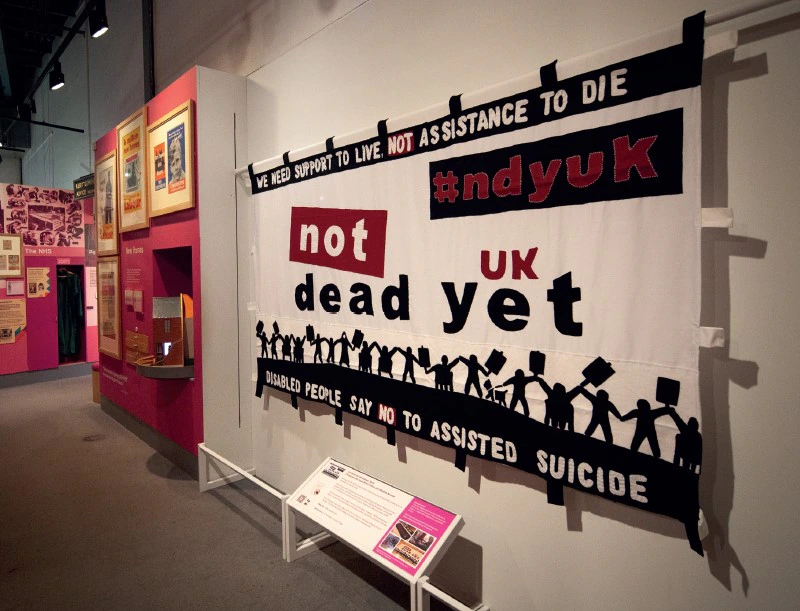
Barlow admits to being fond of big ideas, and it’s because of this she really feels she’s found a new home at PHM. “I was very lucky that in my first week we were going into our banner changeover, which we do once a year because a lot of them have quite complex conservation needs,” she says.
“We were taking one group down and putting the next group of banners up. And it was just so exciting seeing the stories change in the gallery, but still these messages coming through, messages of inclusion, of solidarity, of how we can all have an impact. That was really powerful.”
Barlow was also really impressed by the first event she attended at the museum.
“I couldn’t have picked a better one,” she says. “It was members of Lesbian and Gays Support the Miners talking about their work raising money for mining communities during the 1984-85 miners’ strike. There were ex-miners, young queer activists, and an extraordinary cross-section of ages and perspectives.
“We connect people to their sense of history, and we also help them to think about what might be possible”
“We were sitting there in the hall hearing about the incredible journey that they’ve been on. And Mike Jackson, who was one of the group, said: ‘It’s really powerful thing, but never forget, it only takes two people to start a movement’.”
Barlow says that PHM has always been an activist museum. Indeed, she says the Museums Association’s Museums Change Lives campaign has been central to her work.
“We connect people to their sense of history, we open up questions about their way of looking at the world, and we help them to think about what might be possible.
“You can see that as activist or you can see that as transformative and about helping people to understand themselves and the world around them better,” she says. “Our collections have never been more relevant. And what we can do has never been more relevant.”
People’s History Museum
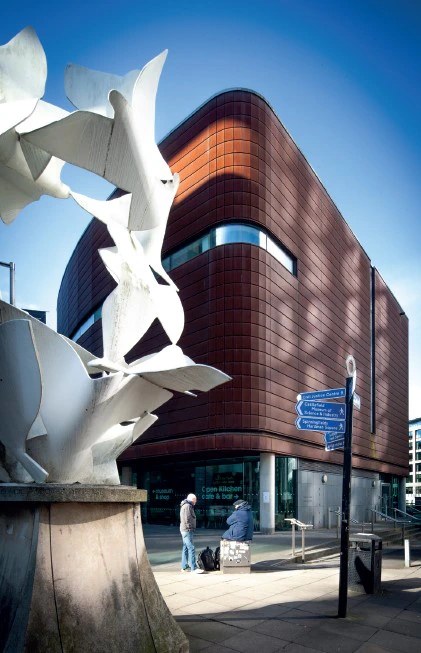
Telling the story of the development of democracy in Britain, People’s History Museum (PHM), Manchester, holds a mix of historic and contemporary objects, including banners, badges, posters, photos and more. The museum celebrates the radical stories of people coming together to champion ideas worth fighting for.
The museum runs exhibitions and events, collaborating with communities whenever possible. PHM encourages visitors to be empowered by the past to make a change for the future.
The museum is an Arts Council England National Portfolio Organisation, and has recently relaunched its venue hire offer through a National Lottery Heritage Fund Adapt to Thrive grant.
“The funding has been absolutely transformative,” says Clare Barlow, the director of PHM. “It’s allowed us to completely revitalise our venue.”