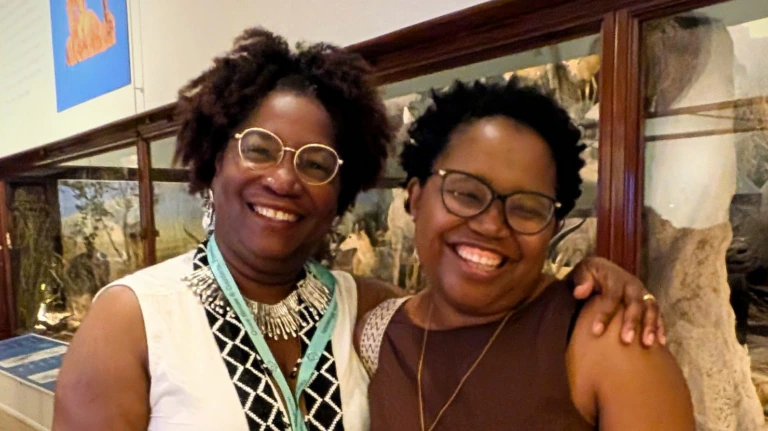
Holly Morgenroth is a collections officer at the Royal Albert Memorial Museum and Art Gallery in Exeter. The museum’s most famous exhibit – Gerald the giraffe – recently underwent a scientific reclassification.
Tell us about Gerald
He had an unfortunate encounter with big-game hunter Charles Victor Alexander Peel in Tanzania in 1901. When Peel retired to the west country, he gave his collection to the museum, where Gerald was housed in a temporary annexe for 60 years. Many Exeter residents – me included – will remember being dangled over the balcony in an attempt to touch Gerald’s head. During our redevelopment a few years ago, Gerald was laid nose down in a crate so that conservators could mend some of his seams and remove boot polish applied over the years to darken his coat. After the conservation work, he was craned out of the window into his new upstairs gallery.
Can you tell us about his secret identity?
Until recently, we thought of giraffes as one species with around 10 sub-species based on coat patterns and horn shapes – an unreliable way of distinguishing them. Last year, scientists revealed that DNA sequences show they fall into four distinct groups. Gerald is now giraffa tippelskirchi rather than a sub-species of the northern giraffe, giraffa camelopardalis tippelskirchi. It’s important in conservation terms and only a minor inconvenience to change his label and database record.
How did your museum career begin?
While doing a marine biology degree at Plymouth, I helped two geologists there sort out a recently acquired collection and really enjoyed the work. At the end of my degree, I couldn’t pursue marine biology as I had dodgy ears from diving, so I decided to do a museums studies course.
How is the cataloguing of the museum’s bird collection going?
I’m doing ducks at the moment. I’ve just finished the perching birds, which is the largest group. I’m about halfway through the project.
Do you like animals that are still breathing?
When I was young, I used to breed all sorts of invertebrates – my dad shared a study with 1,000 creatures. Now, environmental health people bring me things to identify. When I bought some dates from the shop that were riddled with maggots, I let them hatch into little moths.
Tell us about Gerald
He had an unfortunate encounter with big-game hunter Charles Victor Alexander Peel in Tanzania in 1901. When Peel retired to the west country, he gave his collection to the museum, where Gerald was housed in a temporary annexe for 60 years. Many Exeter residents – me included – will remember being dangled over the balcony in an attempt to touch Gerald’s head. During our redevelopment a few years ago, Gerald was laid nose down in a crate so that conservators could mend some of his seams and remove boot polish applied over the years to darken his coat. After the conservation work, he was craned out of the window into his new upstairs gallery.
Can you tell us about his secret identity?
Until recently, we thought of giraffes as one species with around 10 sub-species based on coat patterns and horn shapes – an unreliable way of distinguishing them. Last year, scientists revealed that DNA sequences show they fall into four distinct groups. Gerald is now giraffa tippelskirchi rather than a sub-species of the northern giraffe, giraffa camelopardalis tippelskirchi. It’s important in conservation terms and only a minor inconvenience to change his label and database record.
How did your museum career begin?
While doing a marine biology degree at Plymouth, I helped two geologists there sort out a recently acquired collection and really enjoyed the work. At the end of my degree, I couldn’t pursue marine biology as I had dodgy ears from diving, so I decided to do a museums studies course.
How is the cataloguing of the museum’s bird collection going?
I’m doing ducks at the moment. I’ve just finished the perching birds, which is the largest group. I’m about halfway through the project.
Do you like animals that are still breathing?
When I was young, I used to breed all sorts of invertebrates – my dad shared a study with 1,000 creatures. Now, environmental health people bring me things to identify. When I bought some dates from the shop that were riddled with maggots, I let them hatch into little moths.