
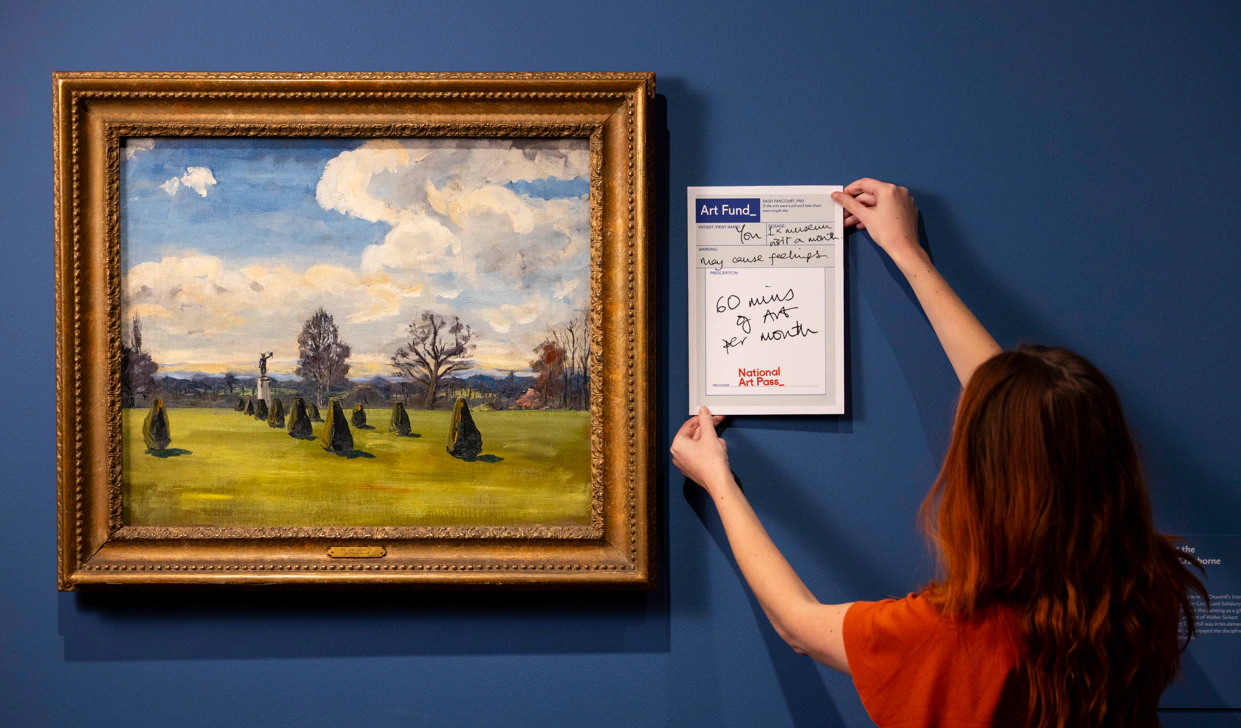
People should be encouraged to spend at least an hour in a museum or gallery each month to support their health and wellbeing, according to a report published this month.
The report, The Recommended Dose of Art: A Prescription for Health and Wellbeing, was commissioned by Art Fund, the national art charity, and produced in partnership with Daisy Fancourt, professor of psychobiology and epidemiology at University College London (UCL).
It brings together existing studies showing the wide-ranging benefits of engaging with art, including reduced stress hormones, a lower risk of developing dementia and a slow-down in physiological ageing.
Based on those findings, the report calls for a “recommended dose of art”, consisting of at least 60-minutes with art in a museum or gallery every month, to be incorporated into public health messaging to support physical and mental wellbeing.
The report suggests that public awareness of the health benefits of visiting museums and galleries is currently low. A survey 2,000 adults conducted as part of the research found that 89% - equating to an estimated 49.5 million adults in the UK – do not currently meet the proposed monthly recommendation.
Only 17% of respondents identified "supporting mental wellbeing" as a benefit of visiting museums, while just 7% recognised their potential benefits to physical health.
Advertisement
Wide-ranging evidence
The report draws on a varied range of evidence showing the relationship between cultural engagement and health at different levels, from physiological responses to effects on cognition, memory and mood.
One study cited found that people who regularly visit museums and galleries could almost half their risk of developing depression over the following decade; another found that older adults who attend museums, galleries or concerts have 32% lower odds of reporting loneliness 10 years later than those who are less culturally active.
The report also highlights evidence that engaging with original artworks in real life may have a greater effect on stress levels than looking at reproductions, citing a 2025 study that proved viewing original art in a gallery was associated with a 22% greater reduction in the stress hormone cortisol.
Further evidence indicates that cultural engagement could help people maintain their health for longer as they age, as well as aiding longevity; the report refers to studies showing that, by the age of 80, adults who have never engaged in the arts are 1.3 times more likely to be frail than those who have, and that culturally engaged people had a 31% lower risk of dying over a 14-year period.
Fancourt said regular engagement with art should be regarded as a health-promoting behaviour alongside having a balanced diet and exercising.
Advertisement
“Guidelines like eating our five-a-day of fruit and vegetables and getting our 10,000 steps have proven effective in helping us to prioritise other health-promoting behaviours in our busy lives,” she said.
“Adding regular arts engagement to this list could be a simple and joyful way of investing further in our health and wellbeing.”
Art Fund director Jenny Waldman said museums and galleries should be seen as inexpensive resources that people can incorporate into their everyday lives.
“We often think of museums and galleries as places to visit as an occasional treat, but evidence shows they are untapped resources that can be enjoyed as part of a healthy lifestyle,” she said. “With hundreds of museums across the UK offering free entry to their collections, everyone can get their recommended dose of art without spending a penny.”
Xavier Bray, the director of the Wallace Collection in London, which hosted the launch of the report last week, said museums offered opportunities for reflection and escape from the pressures of everyday life.
“An art gallery is like a sanctuary – a place where one can leave behind the worries of life, let oneself enter different worlds, and allow the imagination to take over,” he said.
Advertisement
Bray said he hoped the findings would inspire “more people to discover their own private haven in a museum or gallery, and to make visiting part of their regular lives”.
The report follows research published by Fancourt earlier this year in the journal Innovation in Aging, which found that participating in cultural activities was associated with a slower pace of biological ageing.
The UCL-led study, based on blood samples and survey data from 3,556 adults taking part in the UK Household Longitudinal Study, found that those who engaged in arts and cultural activities at least weekly, including visits to museums, galleries and heritage, sites were biologically younger than those who rarely did so.