
Museums in the UK are feeling the impact of this year’s bouts of heat and other extreme weather on income, footfall and collections.
Sector professionals at the Museums Association’s Visitor Voices: Understanding Your Audiences event this week highlighted the negative effects of the weather, with 55% of attendees saying visitor numbers at their institution fall when it’s hot outside.
Bernard Donoghue, the chief executive of the Association of Leading Visitor Attractions, told delegates at the event that the hot weather affects footfall at both indoor and outdoor sites.
“In June of last year, visitor figures fell by 9% and the indoor attractions were saying, 'Well, it was too hot. No one was coming indoors. They were all going outdoors.' And all the outdoor attractions were saying, 'No, it was too hot. No one was going outdoors. They were going into cool spaces.' Neither were correct. The real issue was that it was too hot. People weren't leaving the house; they didn't want to be four feet away from their fridge or their freezer or their fan.”
Donoghue warned that museums and the wider visitor attraction sector would have to rethink their business models and adjust their seasonal programming cycle due to more-frequent heatwaves, storms and flooding.
“If you have traditionally got 40-45% of your income during June, July, and August, and you're now facing 35, 36, 38 degrees, or in five years' time, 40, 41, and 42 degrees [..] If your business model isn't working now, it's not going to work in five years' time, let alone 10 years' time.”
Advertisement
He added that “we've always known that climate change is an existential threat to the planet, but now it's an immediate existential threat to the business models of visitor attractions”.
The impact that the weather is having this year is also evident in statistics from the Association of Cultural Enterprises, a charity and trade body for the arts, heritage and cultural sector, whose latest Commercial Performance Barometer showed that footfall to cultural venues in the UK was 3% down in the first two quarters of this year compared to 2025.
This decrease was driven by Easter storms and snow followed by the heatwave over the summer half term, according to the barometer .
Weather was by far the most stated driver of performance in May, according to the barometer, with 39% mentioning it negatively and just 7% positively.
One respondent told the survey that the “heatwave over the half term holiday decimated visitor numbers on what is traditionally a key trading period”.
Another said: “We were tracking well above [year to date] trend until the heatwave in the early part of the half term. Attendance dropped to term time levels and hit additional spend as well. We didn’t recover, and ended 2,500 visitors down on May half term 2025.”
Advertisement
The barometer has not yet accounted for the impact of subsequent bouts of extreme heat in June and July, which have seen many institutions shut partially or fully for several days at a time.
Threat to collections
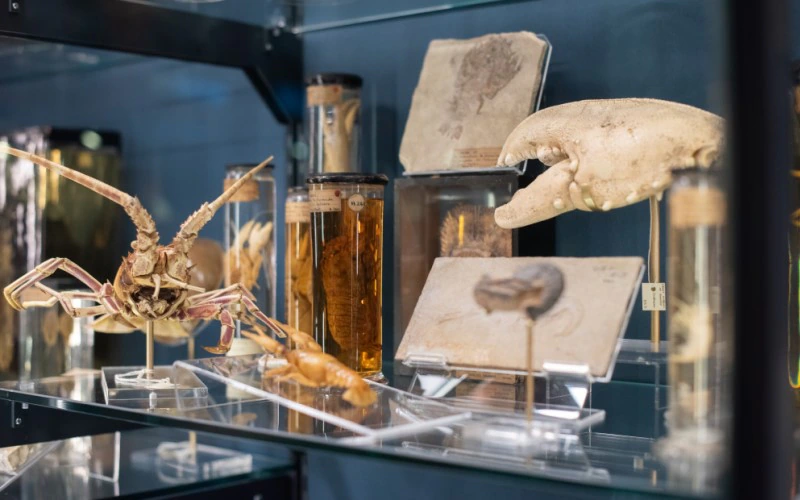
Museum collections are also at risk during heatwaves, particularly items vulnerable to heat such as specimen jars and wax models.
During a heatwave last year, a historic jar containing the fluid-preserved specimen of a bisected cat broke overnight at the University College London's Grant Museum of Zoology.
“We suspect that inherent flaws in the jar – it would have been hand-blown – together with the prolonged heat in the museum led to the glass breaking,” Tannis Davidson, the head of zoology and sciences collections at venue, told Museums Journal.
Advertisement
To mitigate against these effects, Davidson said the museum carefully monitors temperature and humidity both inside and outside cases.
“During heatwaves, we use fans and portable air conditioning units to cool the museum,” she said. “In extreme heat, we have decanted vulnerable specimens into cooler labs and potentially at-risk historic fluid preserved specimens out of the cases.”
Davidson warned that “more frequent, severe heatwaves present new challenges for museums – not only for the comfort of their staff and visitors, but also for the care of irreplaceable collections”.