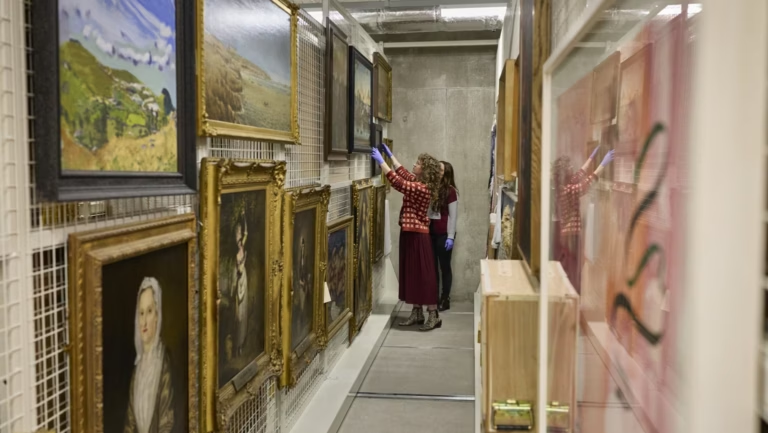

The majority of museum collections stores are full, according to a report released by the National Lottery Heritage Fund (Heritage Fund).
The research for the report found that storage capacity is “at breaking point” in the sector, with 60% of museums reporting their stores are already full and a further 24% expecting to reach capacity within five years. Just 8% said they had more than 10 years’ capacity in their stores.
Meanwhile storage conditions are often below par, with only 15% of museum stores meeting best-practice care and conservation standards.
The findings are based on evidence gathered through a UK-wide survey, which received 218 responses, as well as interviews with 15 stakeholders.
The report also identified problems with documentation backlogs, which limit resilience and access.
This is all happening at a time when collections continue to grow, while rationalisation falls behind. The report found that 83% of museums are actively collecting, 65% plan to rationalise but 47% had disposed of nothing in the past year.
Advertisement
Workforce capacity and specialist skills, such as collections care, conservation, environmental management and documentation, are insufficient in many organisations, undermining long-term resilience.
The conclusion of the report states: “This research is timely, as the museum sector recognises that stored collections and resilience are crucial concerns; if neglected, these issues will escalate into a sector-wide crisis. Museums are eager to tackle these challenges, but a collective approach with clear sector-wide leadership and support is required.”
The Museums Association’s recently updated Empowering Collections report identified storage as a key challenge for the sector.
Empowering Collections states: “We need to understand what we hold and why we hold it and yet many museums are unable to fully account for the objects they hold and their provenance. Collections information can be inadequate, and stores are often full and include items that don’t fit with current collections policies or are duplicated in collections elsewhere.
“There is an increasing urgency to address this so that museums can justify both the financial and environmental cost of collections storage.”
The Heritage Fund’s Museum Collections, Storage, Access and Resilience Research report was carried out by Heather Lomas Consulting and Emma Chaplin Heritage and Museum Services.
Advertisement
The Heritage Fund report identified key differences by museum size and type. While storage pressure is widespread, smaller, independent museums are more likely to depend on historic buildings or other non purpose-built spaces.
This often means limited and frequently inadequate environmental controls. These types of museums also frequently rely heavily on volunteers, which can make achieving and sustaining professional standards of collections care challenging.
Larger and publicly governed museums are more likely to experience high-volume storage pressures, particularly for archaeological material, bulk collections and large objects, alongside demand for managed public and research access.
Among the report’s recommendations are for storage to be treated as critical infrastructure, rather than a discretionary cost, and for more support for small museums.
It also calls for a review of how Accreditation standards interact with storage capacity, building condition and governance constraints, particularly for small and volunteer-led organisations.