
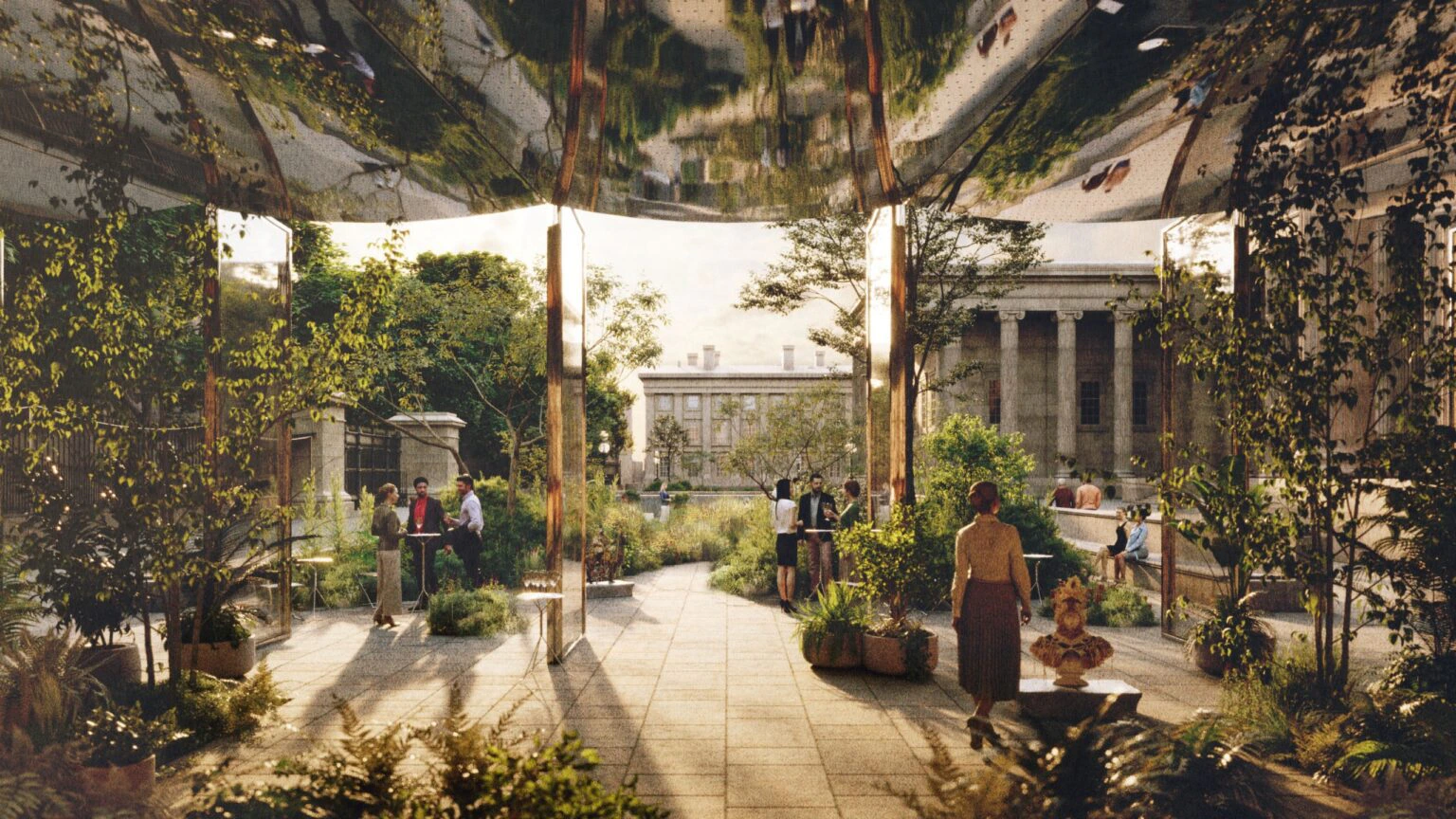
A number of conservation groups have formally objected to plans to introduce informal landscaping and two new visitor welcome pavilions in the forecourts of the British Museum.
The Georgian Group, a conservation charity focused on preserving Georgian buildings, has warned the design proposals would “cause an unacceptable level of harm to the significance of this internationally important site”.
The British Museum appointed a design team, which includes Studio Weave, Wright & Wright Architects and Daisy Froud, in 2024 to reimagine its visitor welcome areas.
Applications for planning permission and Listed Building consent have been submitted to Camden Council. These include the erection of two visitor welcome pavilions in the museum’s northern and southern forecourts; queuing and wayfinding infrastructure such as railings and seating; and new landscaping in both forecourts.
The British Museum building was designed by Sir Robert Smirke and built between 1823 and 1852, with later interventions undertaken by his younger brother, Sydney Smirke.
The Georgian Group said it had formally objected to the applications and recommended that the council does not grant permission.
Advertisement
“While we recognise the operational challenges faced by the museum and the desire to improve visitor management and access, we consider that the proposals would cause an unacceptable level of harm to the significance of this internationally important site,” the group said in a statement.
The group argued that the proposed pavilion would partially obscure views of the southern elevation from Great Russell Street, “disrupting the building’s symmetry and undermining its setting”.
Plans for new soft landscaping and plants in the forecourts would “be visually incongruous in this highly formal and restrained setting”, the charity added.
“The forecourt was deliberately designed as a formal prelude to the grand portico and colonnade, and its clarity and symmetry are central to the experience and understanding of the building.”
The objection continued: “In our view, the proposals would result in a high level of harm to the significance of the listed building, its setting, and the wider conservation area.
“We therefore consider that the statutory duties to preserve and enhance heritage assets have not been met and will continue to advocate for a more sensitive approach to this nationally important site.
Advertisement
A number of other objections have been lodged with Camden Council. The Victorian Society, which champions Victorian and Edwardian heritage, called for the southern pavilion to be moved closer to the museum's boundary railings to limit “the harm the present location has on the importance of Smirke's grand triumphal facade".
The society also expressed concern about a visual render showing “elegant professional[s] sipping from champagne flutes” at the pavilion.
Moving the pavilion to a “purely functional location next to the railings would remove the potential for the security pavilion to function, in any capacity, as a cocktail bar”, the objection stated.
Historic Buildings & Places, a charity that works to protect the built historic environment, said it was concerned about the “level of harm the proposed landscaping would have on this Grade I listed heritage asset”.
It said: “The forecourt has always been a very restrained space to balance the formality of the main elevation. The introduction of the proposed naturalistic and soft landscaping, while technically reversable [sic], would greatly alter the formal character and setting of the museum and the relationship between the building and forecourt.”
English Heritage said the plans would not significantly disturb the archaeological environment, stating in its response that there was a “relatively low potential for the proposed scheme to disturb archaeological remains from all periods except the post-medieval” and that the scale of harm “is such that the effect can be managed using a planning condition”.
The British Museum declined to comment while the planning application is under review.
The proposals are expected to come before the council's planning committee in February.
Seeing these recent objections to the proposed visitor welcome pavilions and landscaping plans at the British Museum feels like a moment for some honest sector reflection.
The proposals (which include two purpose-designed visitor welcome pavilions, landscaping, and improved queuing infrastructure) are intended to address real operational challenges, improve visitor flow and accessibility, and create a more welcoming arrival experience for all audiences.
The idea that this kind of temporary, reversible, and carefully considered intervention constitutes “unacceptable harm” to the museum or its setting does not seem grounded in the realities of contemporary museum practice. Museums are not static monuments; they are living institutions that evolve with the needs of their communities and the people they serve.
It is also worth acknowledging that while the building remains a museum, the very concept of what a museum is has changed profoundly since this façade was constructed. Eighteenth- and nineteenth-century museum architecture was intentionally formal, monumental and, in many cases, exclusionary. It signalled prestige, authority and scholarship, but it also acted as a social filter. Contemporary museums operate on a fundamentally different premise. They are civic spaces. They are democratic spaces. They are explicitly for everyone. Our thresholds should reflect that shift in purpose.
Museums should be welcoming, inclusive and accessible. Hard boundaries, overly formal threshold spaces, or antiquarian preservation arguments that prioritise a particular view of aesthetics over lived visitor experience risk signalling that museums are only “for some” rather than “for everyone.” Inclusive design and careful interventions can sit side-by-side with respect for heritage, especially when they are reversible and have minimal physical impact.
Planning objections framed primarily around notions of formal symmetry or an abstract idea of authenticity, especially without offering grounded alternatives, risk prioritising nostalgia over accessibility and meaningful engagement between communities and the collections and buildings themselves. The visitor experience is not enhanced by barriers, bureaucratic gatekeeping or privileged fantasies about who a museum is ‘for’.
We should be critiquing these plans on evidence, not on emotion or caricature (e.g., caricaturing a pavilion as a “wine bar”). If we truly care about the role museums play in 2026, serving diverse public needs, prioritising access, and evolving responsibly, then we must allow them the room to innovate while still respecting heritage values.
Constructive dialogue about heritage and access is welcome. But it needs to be evidence-based and mindful of evolving function and visitor needs.
Museums evolve; our ideas of welcome should, too.