Humans were making fire 350,000 years earlier than previously recorded, a team of archeologists and scientists led by the British Museum has shown.
The team made the groundbreaking discovery at East Farm, a disused clay pit and important archaeological site dating to the Hoxnian Stage of the Lower Palaeolithic, which is located near the village of Barnham in Suffolk.
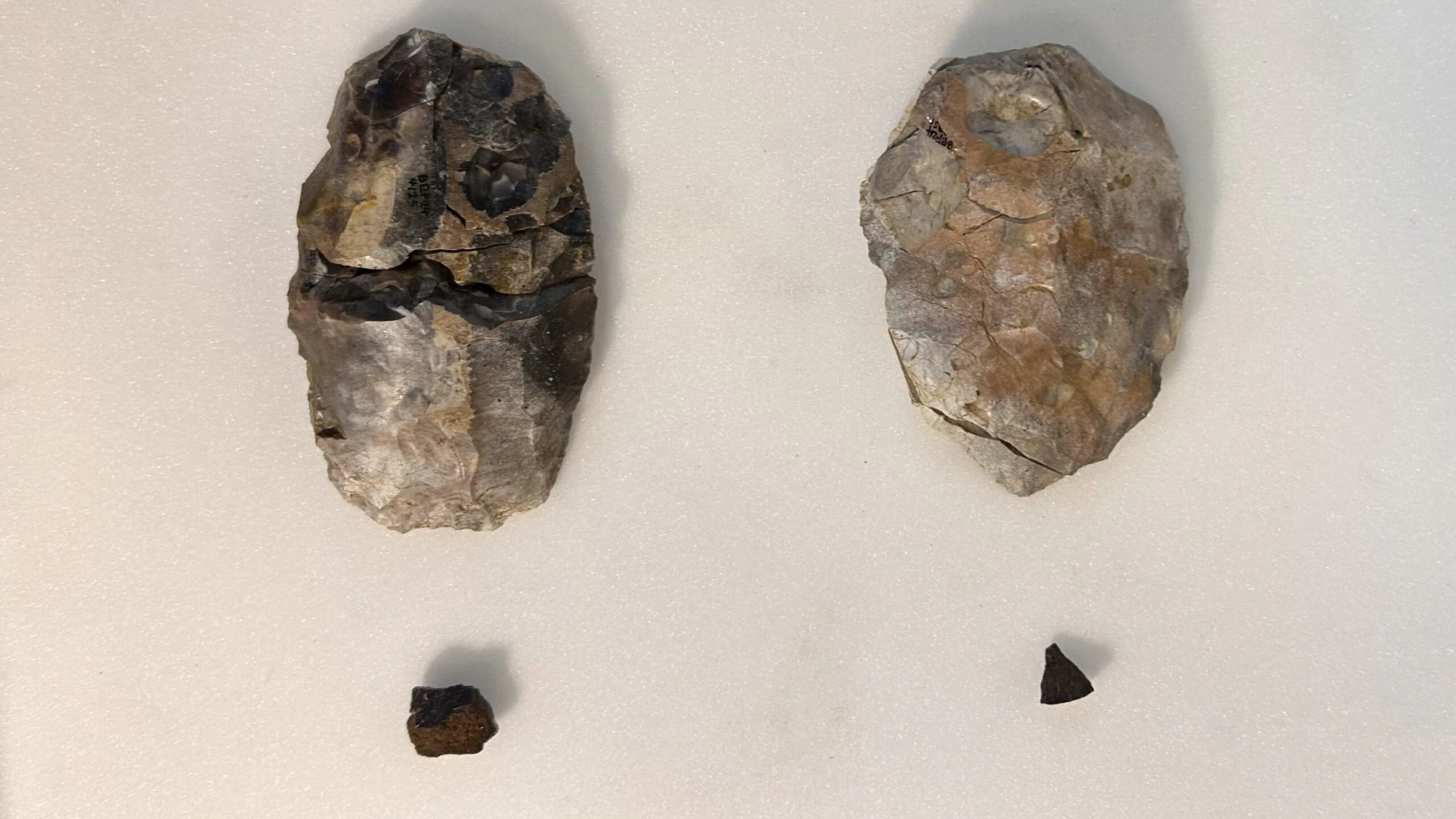
There, they successfully linked disparate fragments of the fire-starting mineral pyrite, heat-shattered hand axes, and heated clay together to prove that early humans were creating and using fire continuously 400,000 years ago.
Although sites in Africa suggest that humans used natural fire over a million years ago, the discovery in Barnham is the earliest evidence yet for the creation and control of fire. Until now, the oldest known evidence of fire-making had been dated to 50,000 years ago in northern France.
It took the team four years to demonstrate that the heated clay at the Barnham site had not been caused by wildfire. Geochemical tests showed temperatures of over 700°C with repeated fire-use in the same location of the site, indicating a campfire, or hearth, that had been used by people on several occasions.
Announcing the findings at the British Museum this week, Nick Ashton, the curator of Palaeolithic collections at the museum and leader of the team, said: “For me, it’s by far the most significant discovery of my career.
Advertisement
“I think this is a story that we can bring very clearly to a very wide audience: A group of people sitting around a hearth or campfire, chatting, eating, looking at the stars, looking deep into the embers - that’s something we can relate to.”
Early humans would have used the daylight hours for crucial survival tasks like hunting and gathering. Readily available fire would have given them significant opportunities to socialise after dusk.
“Fire becomes a hub for social interactions, for food sharing, for the development of language, for early storytelling, myth-making,” said Robert Davis, the project curator of Pathways to Ancient Britain at the British Museum, an initiative that brings together research into the human presence in the British Isles.
Fire was also significant for catalysing the evolution of the human brain, according to Chris Stringer, the lead researcher in human evolution at Natural History Museum. He said: “The increased energy coming from food by the use of fire helps to fuel the brain. Our brain is energetically very expensive so fire helps us liberate that energy from our food.”
The team now hopes to partner with international teams to re-examine sites where evidence of fire use has previously been found. They believe that the presence of pyrite, the fire-starting rock found at Barnham, can be considered a meaningful indicator of whether deliberate fire-making by humans occurred in these locations or not.
The artefacts discovered during the project will be accessioned into the British Museum’s collection. Both Ashton and Davis hope that they will generate new interest in the time period and potentially form part of public programming, either in an exhibition about the Palaeolithic era or as a starting point to explore the history of fire.
Davis said: “[Fire] leads on to fueling all the significant transitions in the human development of civilisation, from the agricultural revolution, metalworking, right up to the industrial revolution: fire’s at the heart of it.”