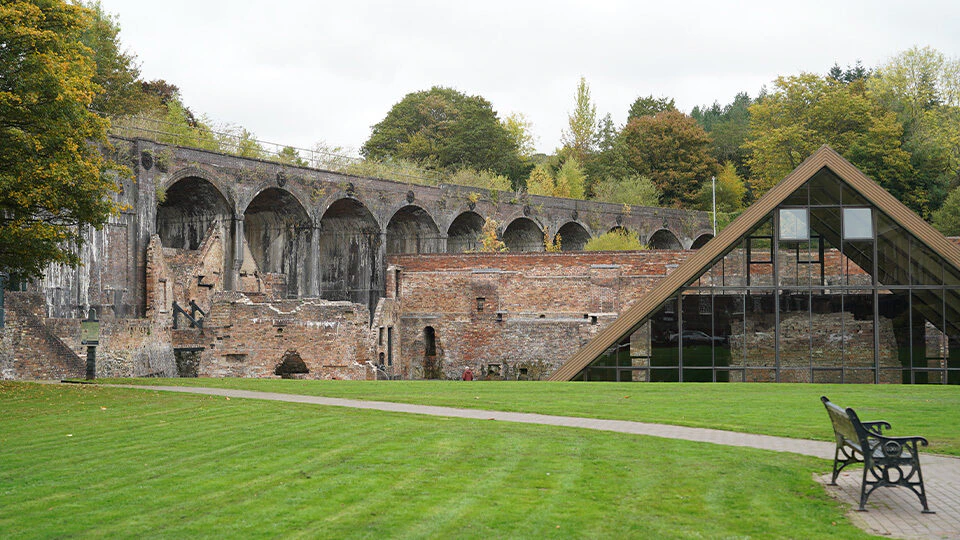
The transfer of Ironbridge Gorge’s 10 museums and 35 listed heritage buildings to the care of the National Trust was urgently required to secure the site’s future, the UK culture secretary Lisa Nandy told reporters on a site visit to announce the decision last week.
The transfer – supported by a £9m government grant – is the first time the National Trust will fully acquire a site previously operated by a museum trust.
The future of the Unesco world heritage site in Shropshire “was one of the first things that came across my desk in 2024”, said Nandy.
Recognised globally as the birthplace of the industrial revolution, the site has seen visitor numbers flatline since the pandemic from a pre-Covid high of 450,000 to around 330,000 in 2024.
Meanwhile, two of its riverside museums, the Museum of the Gorge and Coalport China Museum, have suffered serious flooding on a number of occasions, adding to the financial burden faced by Ironbridge Gorge Museum Trust (IGMT).
The trust, which has run the site for almost 60 years, was not at immediate risk of insolvency but there were serious concerns about its medium- to long-term financial sustainability.
Advertisement
IGMT was forced to close two sites – Broseley Pipeworks and the Tar Tunnel – for 2025 due to financial constraints. A third site, Darby Houses, is also closed for urgent repair and conservation work.
“Shaun Davies, the local MP, has been battering down the doors of every government minister who will listen to make sure that we grip this with a level of urgency,” Nandy said.
“And it was urgent – if we hadn't intervened and formed this partnership with the National Trust, I think it's fair to say that people who grew up coming here as children would not be bringing their children and grandchildren here in future years.”
The transfer will be completed by 2 March 2026, when IGMT will be wound down.
Asked about how the change would affect the people who work and volunteer at the site, Nandy confirmed that “difficult decisions” would need to be made.
“The National Trust will, of course, be working very carefully with the local community and with the existing volunteers to make sure that we protect and preserve that magic,” she said.
Advertisement
“They will have to make difficult decisions about how to make sure that this site not just survives but goes on to thrive for generations to come.”
A spokesperson for the National Trust told Museums Journal that the charity would work closely with IGMT to consult on any staffing changes.
“At this early stage in the process, we are focusing on the successful transfer of IGMT’s museums, collections and property at Ironbridge Gorge to the care of the National Trust,” she said.
“Looking ahead, if the transfer has any implications for people’s jobs, we will work with staff to formally consult on any proposed changes. We will work closely with IGMT to ensure all staff and volunteers are supported through this period of transfer.”
The spokesperson said staff at IGMT would not be affected by the restructure and redundancy programme currently underway at the National Trust.
“Our own redundancy programme is separate. The transfer from IGMT to the National Trust won’t complete until spring 2026, well after the National Trust’s redeployment phase has concluded,” she said.
Advertisement
Speaking at the announcement last week, the interim head of IGMT, Karen Davies, who took on the role following the departure of former chief executive Nick Ralls in late 2024, said the transfer would provoke “mixed emotions” for those at the trust.
“I am very pleased our history and culture will be protected and developed because the National Trust will be able to increase visitor numbers, it will be able to invest in our sites, but obviously for the staff and volunteers here we are moving from an independent museum to a much larger organisation,” she said.
“But it had to happen and it is the right direction for the right reasons so that this fabulous place can be protected for generations to come.”
Along with falling visitor numbers, the increase in National Insurance contributions and the National Minimum Wage had also had an impact on the trust’s finances, said Davies.
“We have been very successful in drawing down National Lottery heritage funding, with huge investment in the conservation of the estate so we are leaving it in good order, but essentially our visitor numbers were not going to fund our operational costs and our 10 sites.”
It is hoped that the move will enable the site to benefit from the strength of the National Trust’s brand and its large membership base, as well as its expertise in visitor experience.
“I think the crucial thing is that we're a large organisation,” said Paul Forecast, the regional director for the National Trust in the Midlands and East of England.
“Firstly we've got five and a half million members. I know many of those will be really interested to know that we've taken on somewhere they want to visit.
“I think in addition to that being a large organisation, we've got lots of expertise around how you curate things, in terms of the history of different objects, about how you provide a brilliant experience for people coming. So I think we bring those elements to it and bring a kind of stability and sustainability to it.
“But I would emphasise again that the IGMT have done a fantastic job. And I think, from my perspective, we are just custodians being handed over to and we will hold their baby very carefully.”
Forecast said the takeover was “one of the largest things we've ever done in our 130 years of history”.
He said the move would enable the National Trust to expand its reputation beyond just being a custodian of large country estates.
“We're very well known for our country mansions, that's kind of what we're famous for,” he said. “But we're really keen to be telling the full history of the country, the ordinary people that did really solid work, and I think this will give us that opportunity to do so.”
Shaun Davies, the MP for Telford, said work had been going on behind the scenes “for months” to safeguard the site’s future. The plan has the support of Arts Council England, Historic England, and the National Lottery Heritage Fund.
“This investment is a game-changer – and a proud moment for us all,” he said.
Nandy indicated that the UK Government is currently working on similar plans for other heritage sites.
“Ironbridge is the first of these heritage projects that we plan to announce, but it certainly isn't going to be the last,” she said.