Work has begun to transform a former hospital building in Derry-Londonderry into a new £15m museum exploring the city’s maritime, cultural and social history.
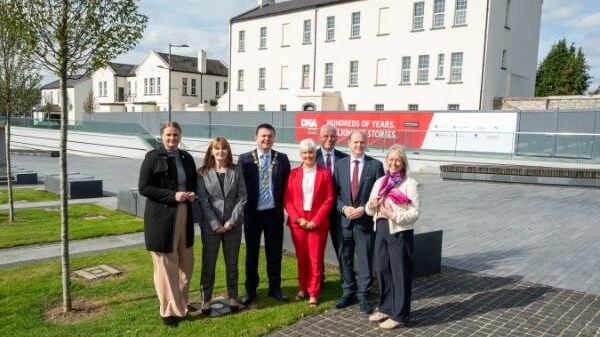
Ministers, local politicians and partners involved in the project gathered on the city’s Ebrington Square last week to officially break ground on the project, which will be called the Derry-Londonderry on the North Atlantic (DNA) Museum.
Located a short walk from the city’s famous Peace Bridge, the new museum will house artefacts and collections capturing the history of the north west of Ireland. It will be housed on the Ebrington Barracks, a military star fort dating to 1841, which served as an allied naval base during the second world war and played an important role in the Battle of the Atlantic.
First proposed in 2013 as a maritime museum, the venue’s remit has evolved over the years to have a broader focus than originally intended. It will focus on two distinct events in the city’s history: the wave of emigration from the port starting in the late 18th century, and the city’s crucial role during the second world war as the place where about 60 German U-boats surrendered in May 1945.
In addition to telling the story of these events, the museum will explore other themes relating to the people of the city.
Advertisement
Among the collections moving to the site are objects from the Armada Shipwreck – La Trinidad Valencera Exhibition, which has been a central focus of the city’s Tower Museum since 2005. On loan from National Museums NI, the collection has been taken to Belfast for essential restoration work before returning to its new home at the DNA Museum.
Other collections moving from the Tower Museum include artefacts from the Story of Derry alongside a range of corporate and private archive collections, charting the civil, cultural and social evolution of Derry, Strabane and the wider north west region.
The Tower Museum itself will cease to operate as a visitor attraction. According to the council, it will be “available for a future use which is consistent with the ambition to deliver the broader vision for the Walled City”.
The DNA Museum is the latest in a range of new attractions at Ebrington military base, which has been revitalised to become a riverside hub. An outreach and stakeholder engagement programme across the district will run in tandem with the construction phase of the project.
The project is led by contractor McKelvey Construction Ltd and supported by a range of partners, including the NI Executive Inclusive Future Fund, the National Lottery Heritage Fund, the Executive Office, Derry City and Strabane District Council, Department for Communities, Garfield Weston & Galewest Investment and the Wolfson Foundation.
“I am absolutely delighted to reach this milestone moment,” said the mayor of Derry and Strabane, Ruairí McHugh.
Advertisement
“The DNA Museum is a major strategic project within Derry and Strabane’s City Deal Plan for the wider transformation of the City and District. It will be a significant cultural asset which will really enhance the visitor experience here, and help us celebrate and promote the history and heritage of the wider north west.
“I want to thank all our partners for their support and belief in this project, and also the project team for pushing through the challenges to get us to where we are today.”
Stella Byrne, the head of investment for Northern Ireland at the National Lottery Heritage Fund, said: “We first supported the DNA Museum project in 2013, helping to shape early plans for the transformation of the historic buildings at Ebrington Square. Since then, the commitment of Derry City and Strabane District Council and the project team has been instrumental in securing nearly £3.5m of National Lottery funding to bring this ambitious vision to life.
“Thanks to National Lottery players, the DNA Museum will be a dynamic new museum space that opens up the city’s heritage in fresh and inclusive ways. It will share a broad range of stories and present existing and new collections, allowing local people and visitors to explore the unique shared history of this place.”
Work on the new museum is expected to complete by spring 2027. Once open, the museum will feature six immersive galleries, a hands-on archive discovery zone, expert genealogy advice, a rotating programme of temporary exhibitions, and a learning and events space.