
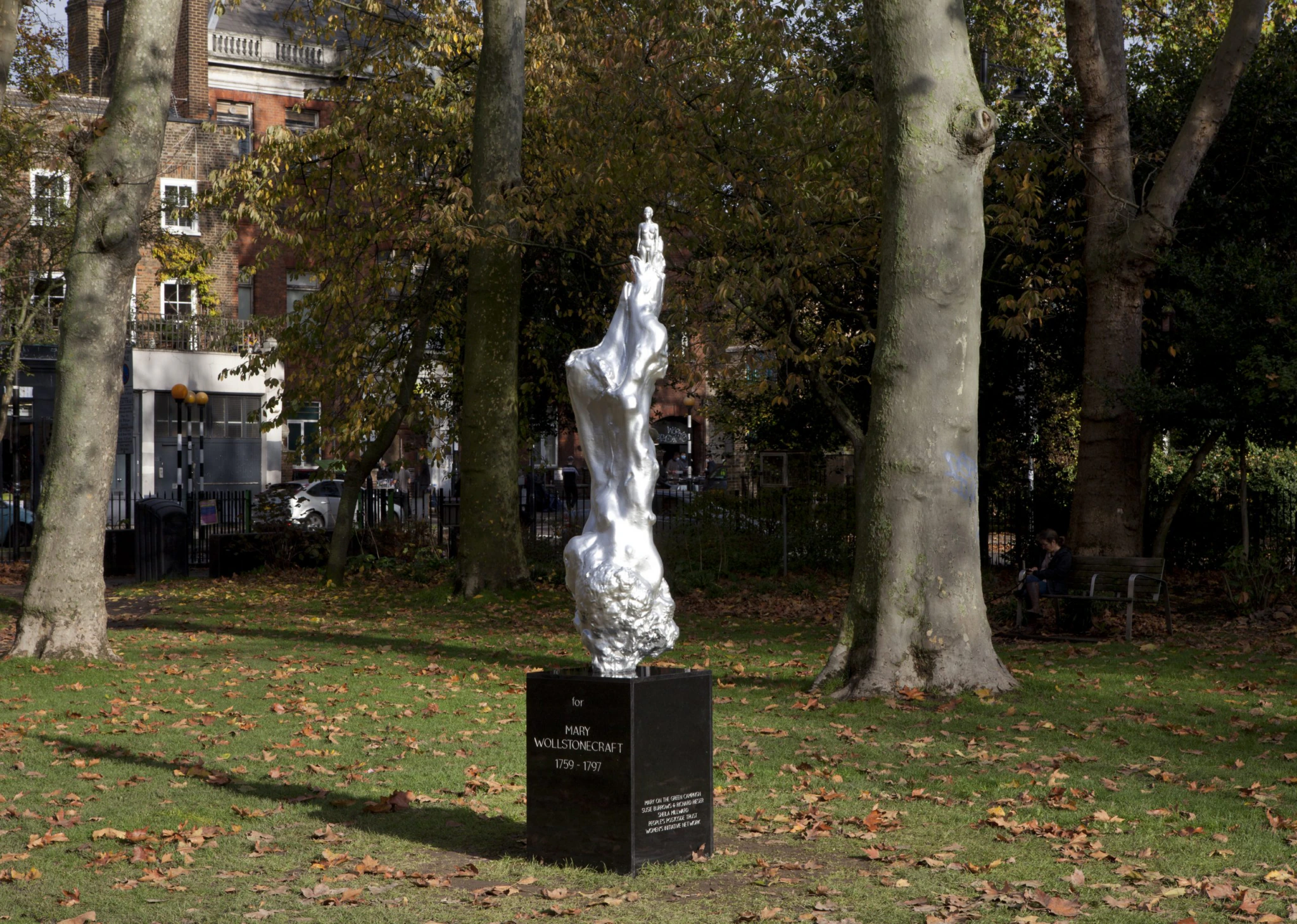
A naked sculpture dedicated to one of the forerunners of the feminist movement, Mary Wollstonecraft, has provoked a heated debate among campaigners for women’s rights.
A Sculpture for Mary Wollstonecraft, which was created by sculptor Maggi Hambling, was unveiled this week in Newington Green, London, where the 18th-century writer and philosopher founded a boarding school for girls.
The work is a culmination of a 10-year campaign to create a piece of public art dedicated to Wollstonecraft, who is known as the “mother of feminism” for her seminal 1792 book, A Vindication of the Rights of Women. The Mary on the Green campaign group raised £143,300 for the work and announced in 2018 that they had commissioned Hambling to create the sculpture.
Cast in silvered bronze, the work is not intended as a depiction of Wollstonecraft herself. According to the campaign group, it “combines female forms which commingle and rise together as if one, culminating in the figure of a woman standing free. She is Everywoman, her own person, ready to confront the world.
“As opposed to traditional male heroic statuary, the free-standing woman has evolved organically from, is supported by, and does not forget, all her predecessors who advocated, campaigned and sacrificed themselves for women’s emancipation.”
The base of the artwork is inscribed with a quote from A Vindication of the Rights of Women, which says: “I do not wish women to have power over men; but over themselves.”
Advertisement
Hambling said of the statue: “This sculpture encourages a visual conversation with the obstacles Wollstonecraft overcame, the ideals she strived for, and what she made happen. A vital contemporary discourse for all that is still to be achieved.”
However, a number prominent feminists have taken to social media over to express anger that a statue dedicated to a women’s rights campaigner should depict a female nude.
Writer and producer Tracy King, who co-ordinated the successful campaign to install a statue of Suffragist leader Millicent Fawcett on Parliament Square, wrote on Twitter: “This is exactly what you get if you let lazy art values come before the politics the statue is meant to represent. It’s a shocking waste of an opportunity that can’t be undone. But hey, tits!
“Statues of named men get to be clothed because the focus is on their work and achievements,” she added. "There is no reason to depict Mary naked unless you are trying to be edgy to provoke debate."
King's co-campaigner, the feminist writer Caroline Criado Perez, added: “What a colossal waste. So so disappointing. Sorry I can’t be supportive.”
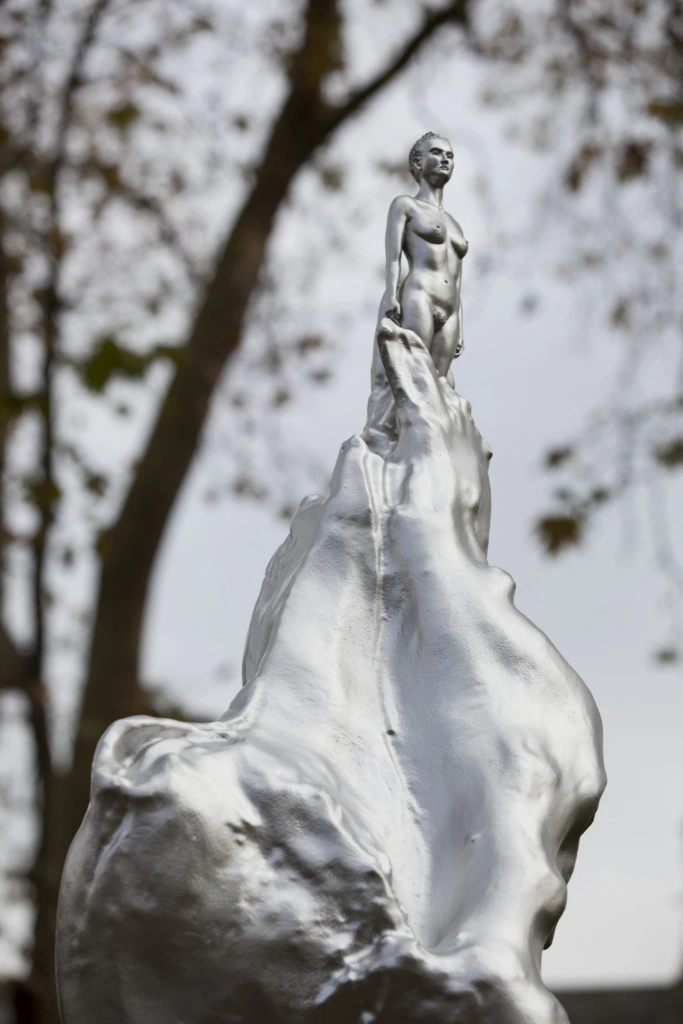
Archaeologist and historian Becky Wragg Sykes said: "I can't imagine a male cultural or political figure from that era who would be presented completely naked like this. I really don't get what the message is supposed to be.”
Advertisement
But photographer Laura Dodsworth, who is known for her film 100 Vaginas, came to the defence of Hambling, pointing out that the work is intended to be a sculpture rather than a statue. She wrote: “It's an exquisite sculpture. And why not represent an aspect of feminist thought with nudity? (Many feminists will disagree.) But representing an author and thinker with a nude ‘sculpture’ is an interesting choice. I would be interested if anyone can point out a male counterpart.”
Meanwhile, historian Fern Riddell said: "I love it because to me it’s a massive combination of themes, I love the water like a raging wave, I like the mechanical aspect of the figure, it reminds me of how women are created in images that never match their thoughts."
She continued: "I think all the women behind it worked really fucking hard to make that happen. I get why people are angry with it being nude, but FFS, [Mary Wollstonecraft] was writing a time when women’s bodies WERE their cages, and here the cage is being freed by a fucking torrential wave of feminist thought."
Hambling has hit back against the criticism, telling the Evening Standard: "She's everywoman and clothes would have restricted her. Statues in historic costume look like they belong to history because of their clothes. It's crucial that she is 'now'."
The statue’s unveiling comes amid an ongoing debate over the representation of marginalised groups and historical injustices in statues and artworks in the public realm. A 2016 study by Criado Perez found that just 2.7% of public statues in the UK depicted historical, non-royal women.


If the work is not intended to be a portrait of Wollestonecraft as such, but of her achievements, and the long and still ongoing process of female liberation of which she was an important, early part, I am going to stick my neck out and say I like this sculpture. I don’t think it particularly matters that the female figure is nude. So what? She looks strong and determined, and as if she could belong in any time or place. If the figure was clothed it would position her in time, and define her by her dress. Not that it isn’t difficult to portray feminist ideals in a figurative way. It raises the question of what constitutes a ‘feminist sculpture’, if there can be such a thing.
I’d like to add my voice to those who applaud this sculpture and the people who created it. It’s obviously right that Mary Wollstonecraft should be commemorated by some public art because she is such a feminist icon. As the artist – one of our greatest – says, it’s not a statue of Mary but an image of how women by their own efforts have risen up against the challenges of a male-dominated culture and society and I think it does that perfectly.
I am reminded of an old French and Saunders sketch, where they were both cast as lecherous fat old men watching a Miss World contest. ‘it’s all about their minds,’ they were saying until the swimwear parade started and they both started humping their cushions! No matter what people say about this sculpture reflecting the tide of feminism, and the strength of women, at the end of the day people will look at the ‘rude bits’. Isn’t it time that women were portrayed in ways other than their physical appearance? As feminists perhaps we should consider whether Wollstonecraft would approve of her ideology being depicted in this manner. I think not.
Laura Dodsworth’s question sparked a thought: Rodin’s ‘The Thinker’, although its origins suggest a representation of Dante Alighieri, in its much reproduced final form it is not a likeness, it is nude, and its purpose is symbolic: to represent poetry and intellect. I suppose the big difference is that this new Wollstonecraft inspired piece has a powerful inscription to help tie down its meaning. I am looking forward to seeing it ‘in the flesh’ so to speak, to see if it speaks.