Over the past two decades, National Galleries of Scotland has established and grown a thriving programme of events, activities and resources, created with and for people with specific access requirements.
Working closely with disabled audiences, community partners and expert consultants has given us a deeper understanding of visitors’ requirements, interests and experiences, helping us to remove barriers and ensure that art works for everyone.
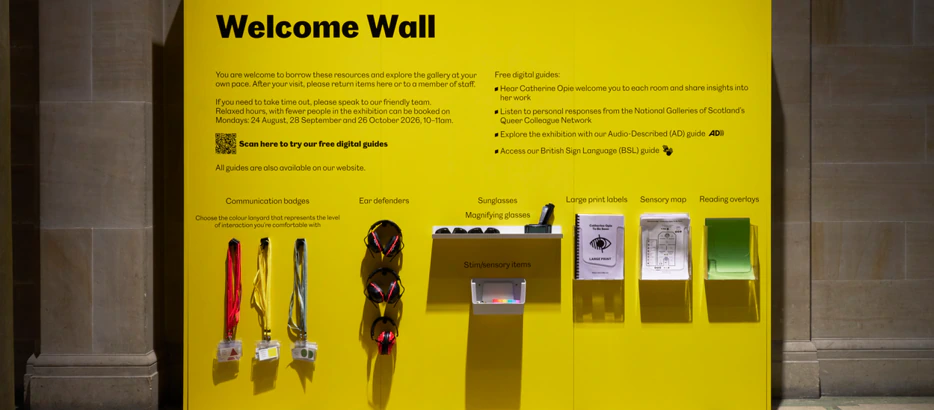
This includes the creation of a temporary Welcome Wall close to the entrance and next to the information desk at Modern One art gallery in Edinburgh to coincide with the exhibition Artist Rooms Louise Bourgeois | Helen Chadwick | Robert Mapplethorpe (from 12 July 2025 to 31 May 2026).
The wall included an open display of accessibility items for visitors to borrow, including:
- Ear defenders
- Communication badges
- Sunglasses
- Magnifying glasses
- Reading overlays
- Sensory maps
- Large print labels
Most of these items had previously been available for visitors to borrow from accessibility boxes kept behind the information desks at all our venues. But this meant visitors had to make their needs known and ask for assistance.
Advertisement
Accessibly boxes could get lost, items went missing and resources were not always restocked. We therefore started to think how we could shift this service from being a hidden exception to becoming an integrated part of the visitor experience.
Co-producing with lived experience
To create the Welcome Wall, we worked with Tzipporah Johnston from Door in the Wall Arts Access, a disabled and neurodivergent-led organisation, who had previously developed similar displays and resource trolleys and helped organisations rethink how access can be integrated.
The choice of resources was informed by years of consultation with disability-led organisations, community groups and access consultants with lived experience whose insights helped us to shape and produce our programmes and resources.
Equally important were the perspectives of our security and visitor engagement team who speak to the visitors and know what they need and the barriers they face.
Simple in appearance, the Welcome Wall consisted of an introductory text (black vinyl applied on a white wall) and a curated selection of accessible resources. Some of them, such as the communication badges and the ear defenders, were suspended from hooks, while items like the sunglasses and sensory maps were placed on small shelves and holders.
Advertisement
We chose to name it Welcome Wall (rather than Accessible Wall) because that’s how we want all our visitors to feel. We wanted to emphasise that the items were for all visitors, including individuals with specific access requirements.
The accompanying text, which was intentionally open, light-touch and non-prescriptive, encouraged all visitors to use the resources. The wall also signposted learning resources, alternative interpretation such as audio, audio-described and BSL digital guides, advice for emotionally difficult material and dedicated rooms within the exhibition where visitors could pause and reflect.
What did people think?
The feedback we received was overwhelmingly positive.
One visitor comment read: “The communication badges made the experience so calming for my daughter. What a great way to start your visit.”
Another group told us: “We were excited to use the magnifying glasses. Having these things available gave us independence to go around the gallery.”
Advertisement
We’ve heard from sector professionals too who found the wall “simple but extremely effective” and “a safe space where you don’t need to disclosure your disability”. One said: “An example of embedding accessibility at its finest.”
Similar feedback was gathered by health professionals: “I absolutely loved how integrated the access resources were, one of the best examples I've seen in a long time of tools being thought of as part of the experience as opposed to something visitors have to seek out.”
Our front-of-house colleagues at Modern One also reported feeling proud to offer information about the Welcome Wall to visitors.
“How much joy it is bringing to visitors who use the resources as well as visitors who don’t use it but appreciate it being there,” one said. “People love it. I’ve sat and watched group after group tell each other their mind has been blown, smile and grab a pair of ear defenders or a lanyard.”
What next?
The success of our first Welcome Wall led to it becoming a permanent fixture at Modern One and to the development of two further installations at the Portrait Gallery, most recently for the temporary exhibition Catherine Opie: To be Seen (closes 1 November 2026).
The Welcome Wall at the Portrait Gallery is part of a semi-enclosed welcome area, which offers visitors an element of privacy and a quieter space near the busy main entrance. It also includes comfortable, flexible seating, weighted blankets and stim/sensory items.
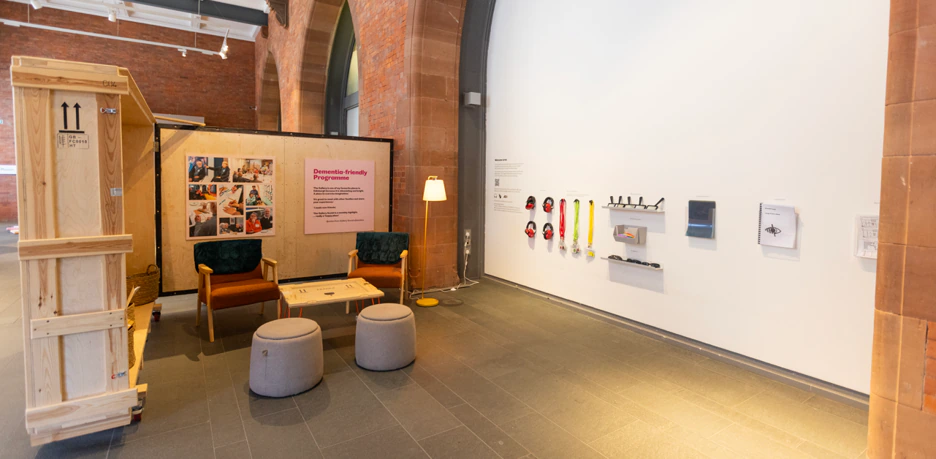
In all these venues, the Welcome Wall has had a positive impact on the visitor experience. Our front-of-house teams are now able to more easily monitor availability and restock items that are missing.
We occasionally need to replace magnifying glasses and some of the stim/sensory items – mostly the smaller ones, which can easily slip into a pocket and be forgotten about.
This of course might change at the National Gallery, where our next wall will be installed. With more than two million visitors in 2025, maintaining the wall in such busy venue may require more regular restocking.
The Welcome Wall serves as a visible and positive acknowledgement that we all learn, understand and experience in different ways and makes a significant difference to helping our visitors feel considered, included and welcomed as soon as they come through the door.
Meg Faragher and Maro Psyrra are communities and access learning coordinators at the National Galleries of Scotland