Programming in museums is often treated as an extension of exhibitions or a seasonal gesture tied to community‑specific cultural “slots” or heritage months. These moments offer passing visibility while leaving underlying power structures intact, positioning communities as museum calendar guests rather than partners.
What happens when programming is no longer an add‑on but becomes a foundation for redistributing institutional power?
The All Eyes on Her! Late, which took place on 4 September last year at the Horniman Museum and Gardens in London, was an attempt to test this question. Initially conceived in 2021 as a light‑touch event accompanying the display, it evolved, through sustained stewardship of more than 250 Egypt‑ and UK‑based Egyptian community members, into a museum takeover.
Community partners called for a shift in the museum’s role from a host to an institutional partner, sharing resources, infrastructure and space to enable communities to exercise cultural authority. This necessitated a transformation of our everyday museum practice; we became the facilitator not the commissioner, and the event’s success was no longer defined only by attendance figures but by the extent to which communities exercised meaningful authority.
Programming and curatorial authority were transferred to South-West Asian and North African partners Hekayyatna, a London‑based collective working through storytelling, lived cultural experience and dialogue, led by co‑founder Zeina Dowidar.
Budgets were redistributed to community partners with full decision‑making power, and we worked collaboratively to navigate risk management, procurement and scheduling.
Advertisement
Crucially, we adopted community rhythms in our communication and working practices – using WhatsApp, adapting staff availability and workflows, and recognising that community work unfolds in real time rather than within standard office hours.
The programme that emerged was not a representation of South-West Asian and North African cultures for audiences, but a reclamation of narrative and institutional space. As community partners reflected, this was “not a showcase, but a space of presence, refusal and joy”.
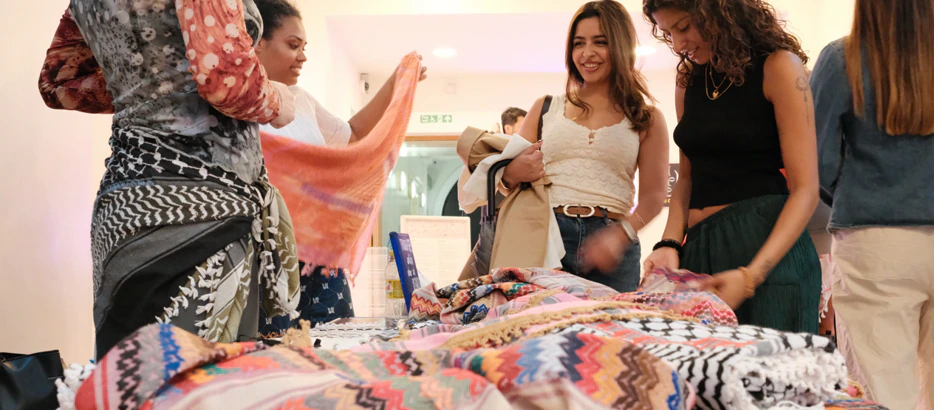
Female-led businesses such as Zaytoun and SEP Jordan offered hand-embroidered keffiyehs and fair-trade products, alongside watercolour artworks from Neem Creates, and Arabic children’s books from Liblib Publishing, all presented not simply as retail commodities but as tangible reclaims to cultural identity.
A communal yarn braiding session, led by Suzan Shedid’s Your Rouh, evolved from a participatory workshop into a collective healing practice. Jewellery making with Ray makes things and creative writing with Scribbles by Mel Sevinc transformed individual stories into a shared, visible presence in the galleries.
Alongside this, a Cultural Mocktail conversation corner, Kalam Aflam’s film programme, and live performances by YAZ and DJ Rára – filling the museum with a vibrant mix of Arabic, African and Caribbean sounds – reclaimed the museum as a site of resistance, shifting it from a space of observation to one of active solidarity and cultural presence.
Attendance was 50% higher than comparable Late events, with many first‑time visitors – predominantly younger diaspora audiences, who told us that “for the first time, the museum was ours for the evening”.
Advertisement
But the significance of this event lies less in scale than in process. It was a meaningful attempt to redistribute authority but still some institutional constraints persisted – museum frameworks still shaped decision-making, so that power was negotiated rather than fully transferred.
The Community‑Led Museum Takeover Manifesto, developed by Hekayyatna and designed by Farida Eltigi, is a central outcome of the work to create the Late. It calls for early involvement in decision‑making, equitable resource distribution, recognition of cultural labour, and long‑term commitment, positioning takeovers not as symbolic inclusion but as infrastructural change.
This work sits alongside the Horniman’s broader commitment to repairing relationships with South-West Asian and North African communities and challenging the sector‑wide tendency to confine programming to religious or heritage calendars of Ramadan and Eid.
The Horniman’s sustained engagement with South-West Asian and North African communities will see a summer Hafla (Arabic for party) at the Horniman, and a community exhibition, due to open in late 2026.
The All Eyes on Her! Late did not resolve all the tensions it challenged and exposed. But it offers a proposition for the sector, not necessarily to replicate this model, but to reconsider what power museums are willing to share, how, and for whom.
Heba Abd el Gawad is the senior curator of anthropology at the Horniman.