The David Bowie Centre opened on 13 September 2025 as a landmark addition to the V&A East campus, celebrating the life, legacy and archive of the musical icon, innovator and champion of self-expression.
The centre consists of a semi-permanent exhibition showcasing the breadth of the archive, a study centre, a learning zone and a research space. Nine rotating displays feature about 200 objects highlighting Bowie’s creative process and personas, collaborators and influences.
Interested in the latest approaches to exhibition design?
Join us at Show Time: Designing Great Exhibitions on 18 March
The project was a collaboration between the V&A team, led by head curator Madeleine Haddon, the architects IDK Architecture and ZNA lighting designers. Fieldwork Facility were the wayfinding and interpretation designers, Structure Workshop were the structural engineers and P3R were the mechanical and electrical engineers.
IDK Architecture was briefed to retain the material language and systems of the Storehouse with its metal archival racking system but to elevate this by injecting textured inserts and creating a finely layered and flexible display to create a dialogue across the vast archival content.
Lighting the archive
The lighting design played a crucial role in delivering this elevated display by creating a dynamism and a choreographed layering of luminosity across the spaces.
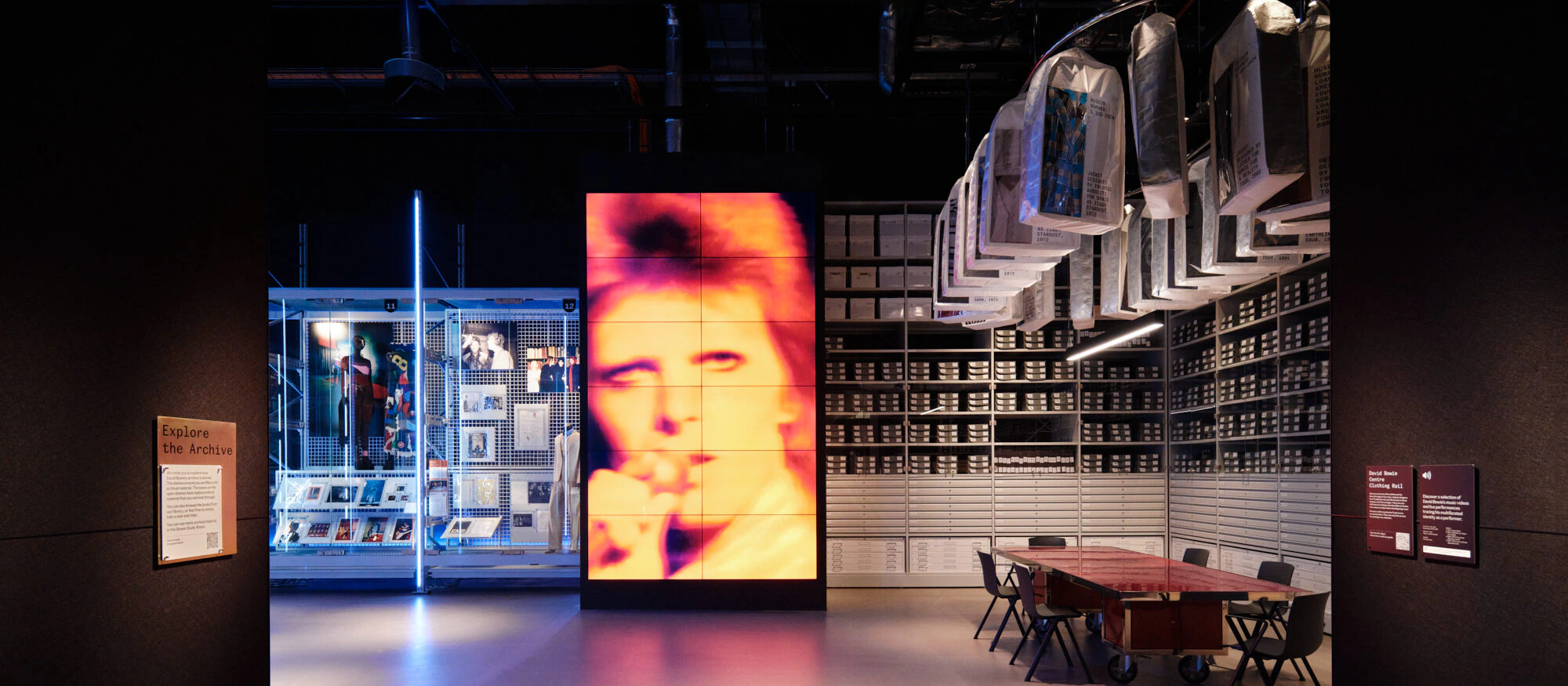
For the exhibition space, ZNA wanted to activate the room and the content, infusing the area with the performative quality suggestive of a live concert and working with the large screened AV panels showing a film of Bowie’s innovative video work and live footage.
Advertisement
We designed a perimeter light at the back of the display cases with colour-changing capacity that created an illusion of depth in what was an otherwise black box space.
Most of the work on display was subject to conservation levels of 50 lux. This backwall grazer allows the illusion of luminosity with no direct lighting of objects while still highlighting the form of the 3D objects.
This feature had a RBGW component so we could colour mix to best suit content and add a dynamic capacity for special events.
For the actual display, ZNA designed a flexible system of dynamic white linear to create a diffuse cover and where the colour temperature could be fine tuned. There was then a series of micro spots for more dramatic accents.
To the exterior of the cases, we designed on the vertical axis demarking each display zone, a pixelated LED profile. Through this you can control colour mixing and dynamic sequences.
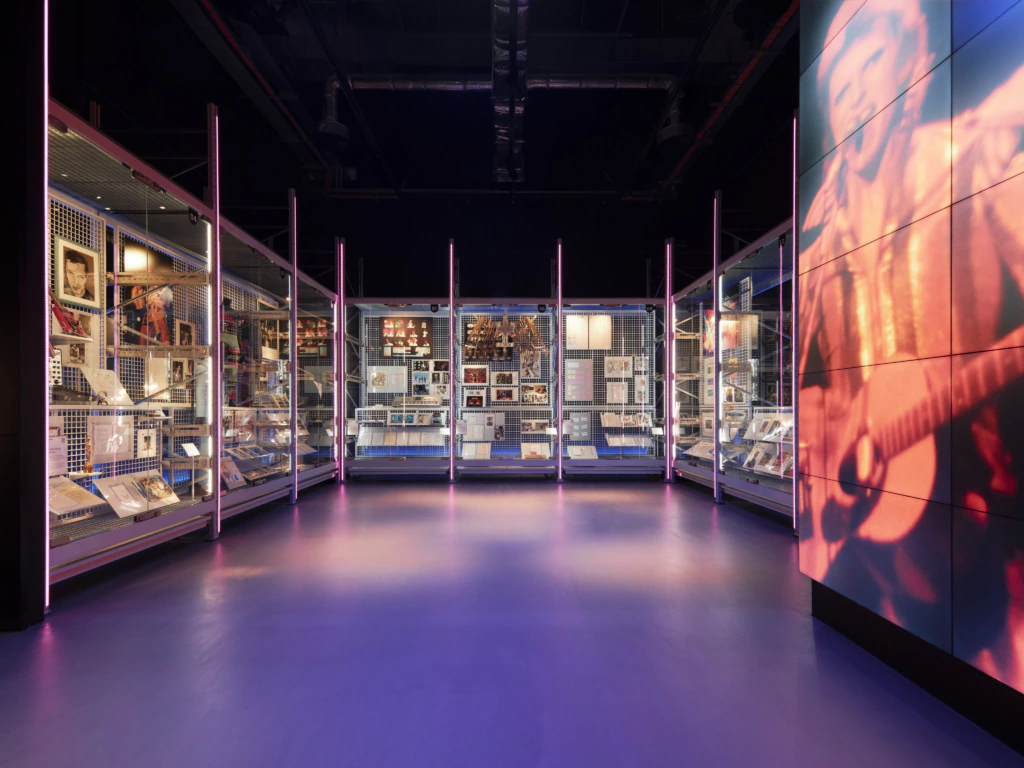
This allowed us to programme a series of scenographic shifts across the display elevations, synchronised with the audio tracks and video content.
Advertisement
The object lighting remains consistent at conservation levels but the environment shifts seamlessly to evoke the video and sonic worlds. For the normal exhibition operations, we kept this quite restrained and also programmed a low sensory scene for learning groups as needed.
For events, a fuller dynamic scene was programmed. Circulation light with a colour changing wash further allowed for a flexible lit environment. Crucially, the user interface for these scene sets was kept very simple for operations, with eight buttons created for the lit scenes on a local touch pad.
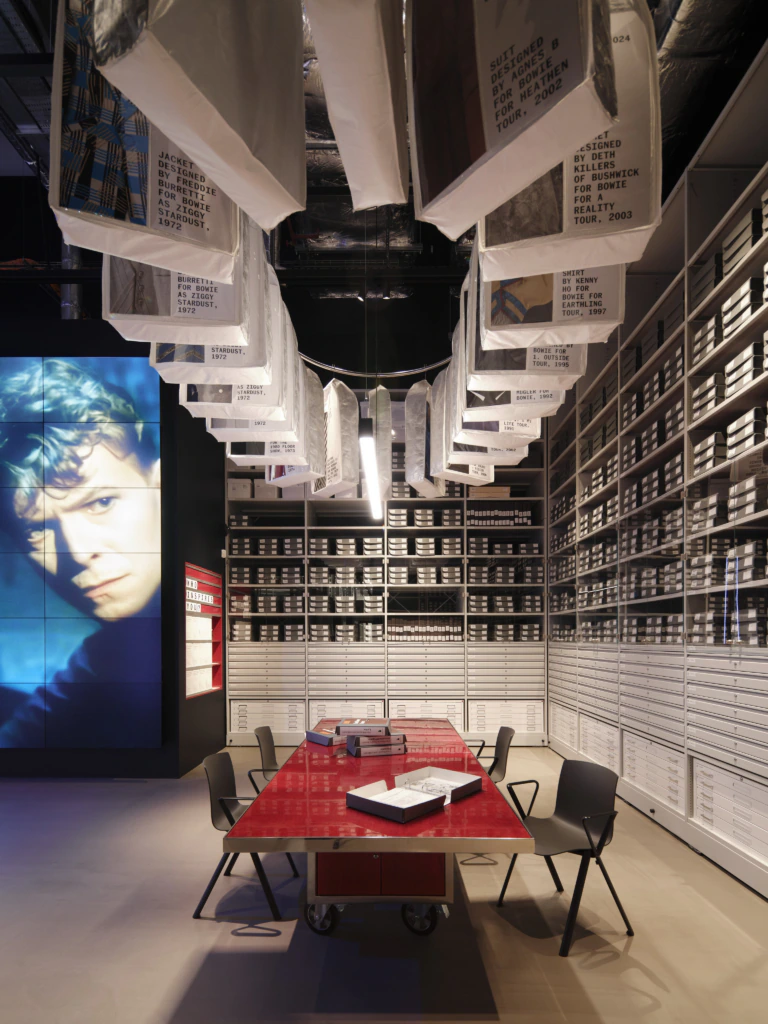
The group study area was lit with a dropped pendant, which provided task lighting to the large communal work table and also had an integrated uplight to wash the overheard costume rails so that the group felt immersed in the archive.
In the dedicated research room a series of low glare task lights over desks were designed with adjacent local control so the user could attune their environment to their task, A large suspended light box was also designed to provide shadow free lights for detailed work such as conservation checking. The general light is provided by a flexible track with diffuse and spot lighting.
The Bowie Centre is a unique and rich resource. It was fascinating to be part of the dialogue with the team client and creative teams about how to activate collections in new ways and engage wider audiences.
Our lighting design combined with a bespoke control system was designed for long-term adaptability, the scheme delivers a carefully layered approach that reveals the collection with both sensitivity and impact.
Ultimately, the lighting transforms a former black-box room into a multidimensional environment – one that adapts to showcase the full breadth of the artist’s extraordinary catalogue
Zerlina Hughes is the founder of Studio ZNA