
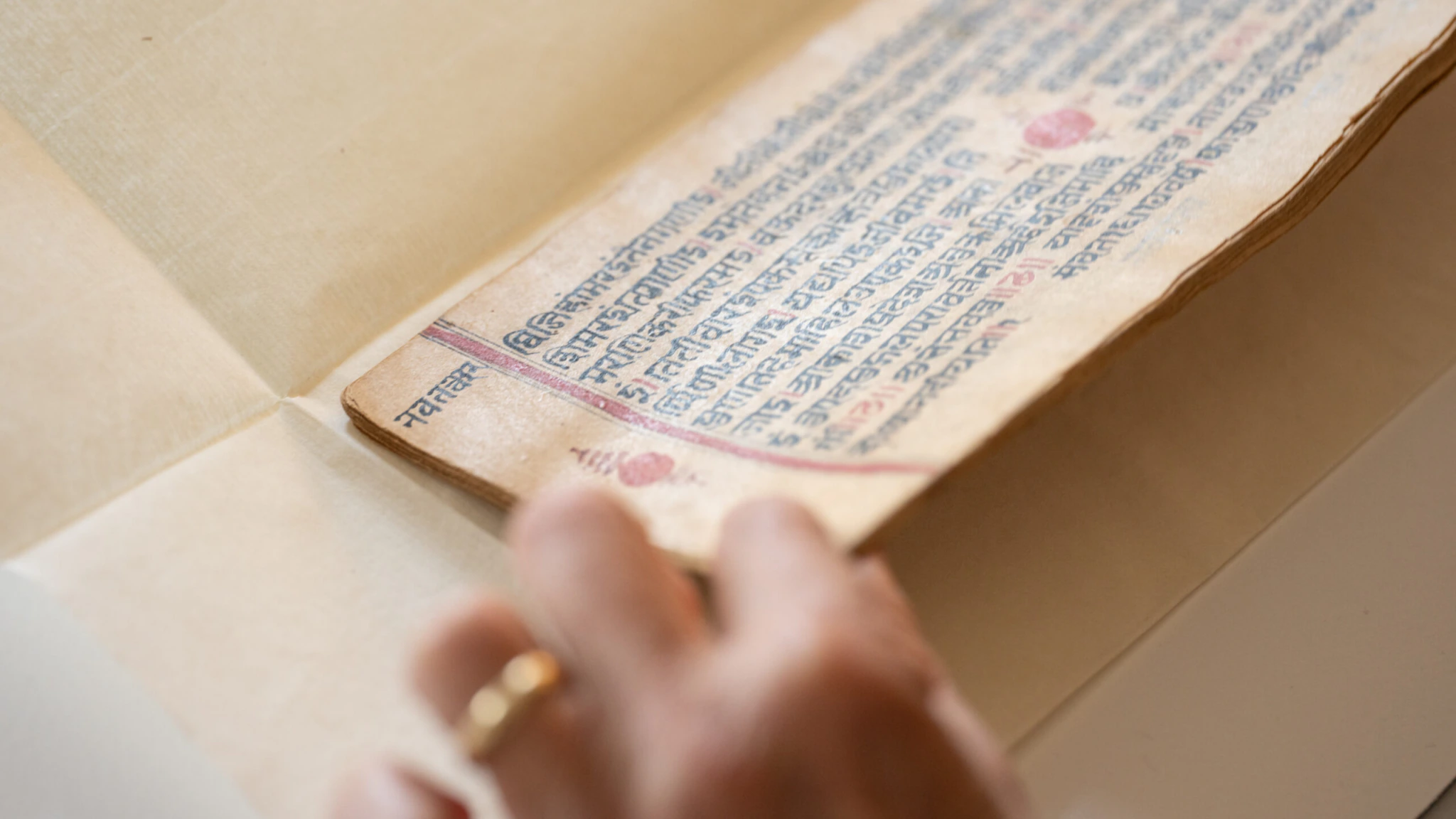
Earlier this year, Wellcome Collection, the Institute of Jainology, and the University of Birmingham jointly signed a memorandum of understanding (MOU) at a community event in the House of Commons. This sets out the framework for the return of nearly 2,000 manuscripts from Wellcome Collection to the UK’s Jain community.
The story, however, starts more than a century ago. In 1919, one of Sir Henry Wellcome’s purchasing agents visited a Jain temple in British-occupied Punjab, where he proceeded to purchase the library’s entire manuscript collection.
Shipping them to London, he wrote : "If it were in learned hands they would not part with it, at any rate not so cheaply."
The manuscripts, which were insured at many times their purchasing price, date from the 15th to the 19th century and contain everything from devotional poetry to philosophical treatises and medical handbooks, with several entirely unique texts.
I started working with Wellcome’s Jain collection in 2022, delving deeper into the circumstances of its acquisition as part of a Headley Fellowship from the Art Fund.
This work was undertaken against the background that Wellcome held what was probably the largest collection of Jain manuscripts outside of India, and already had a longstanding relationship with the Institute of Jainology (IoJ), the apex body for the UK’s 29 Jain organisations.
Advertisement
Meanwhile, the temple in Punjab is gone, the local Jain communities having migrated for the violence of the 1947 Partition of India and Pakistan.
In light of this, I had to rethink standard restitution practice, which led to a proactive, collaborative approach, one that doesn’t have to be initiated by a claims process, speaks directly to communities instead of nation states, and foregrounds the ethics of restitution as a transformative experience.
Over several years of conversations with the IoJ and their managing director, Dr Mehool Sanghrajka, and with the support and guidance of my brilliant colleagues at Wellcome Collection, what started as a rough, initial idea transformed into something actionable.
It seems an obvious thing to state, but as museums professionals and historical researchers, our eyes are often on the past. As Mehool and the IOJ repeatedly underline, emphasising Jainism’s teachings on non-violence and the multi-sided nature of reality—restitution is not limited to being a remedy for the past alone.
Restitution is about us, the living, and the future we can create together. The signed MOU sets out a framework for how the legal ownership of Wellcome’s Jain collection will eventually be transferred to the IOJ, on behalf of the UK’s Jain community, while the manuscripts themselves are moved to the University of Birmingham in service of their community-funded Jain Studies programme.
This maximises the manuscripts’ access for researchers and community members alike and unlocks their full value as precious sources of insight into humankind’s religious, scientific, and literary history.
Advertisement
As a museum professional, the experience has underlined to me that our institutional strategies must speak to the genuine interventions we want to make in the world around us.
The Wellcome Collection’s vision is to see a world where everyone’s experience of health matters, which accompanies Wellcome Trust’s overarching mission to create a healthier future for everyone.
The return of the manuscripts to the Jain community is an acknowledgement that we believe in the tangible and intangible health benefits for communities reunited with their cultural heritage and the ancient knowledge contained within it.
Increased access to the manuscripts for people best placed to understand them also facilitates research that is part of improving ethical health outcomes for future generations.
Our institutions will continue to develop and shape this collaboration for years to come. I believe that sharing our process and experience for the wider galleries, libraries, archives and museums sector is a crucial part of our work, and this brief piece is a first step in that direction.
One key learning to highlight is that restitution should not be something to fear; instead it should be welcomed as an opportunity to transform longstanding issues through understanding and collaboration.
Adrian Plau is the collections lead at the Wellcome Collection