Imperial War Museums (IWM) has set out its research priorities for the next five years, including a goal of reimagining museum practice, a broader focus on “conflict histories that matter now”, and preparations for the second world war centenary.
A new research strategy published by the organisation this week says that, in addition to its existing focus on the world wars, IWM will expand its research on the cold war, late 20th-century conflicts and contemporary warfare.
The Research Strategy 2026–2031 identifies three priority areas: “reimagining museum practice”; “understanding our collections: meaning, memory, value”; and “conflict histories that matter now”.
The third area covers research into the second world war centenary, the global cold war and contemporary conflicts. IWM intends to examine conflict across a broader chronology.
According to the strategy, IWM will “prioritise research that strengthens understanding of the cold war and late twentieth-century conflicts (1945–2000) as global, interconnected histories that continue to shape contemporary conflicts, identities, and memory”.
The museum intends to examine the cold war through its “social, political, military, diplomatic, economic, and cultural dimensions”.
Advertisement
The strategy also commits the museum to making imperial and decolonising histories more visible “through the perspectives of colonised peoples and their descendants”, with a particular focus on African countries and communities it says are currently underrepresented in its collections and interpretation.
“Diversifying these histories is essential,” the strategy states. IWM will “build on recent work on decolonisation after the second world war”.
The strategy says this approach moves beyond a primarily British military history lens, with collections research positioned within “wider chronological, comparative, and global frameworks”, allowing IWM to engage with international scholarship and collaborate with partners beyond the UK.
IWM will continue to prioritise the second world war. It will re-examine how the war is interpreted through its collections ahead of the centenary, aiming to refresh established narratives and respond to generational change. The research is intended to present the war in ways that are “historically rigorous, internationally aware, and relevant to contemporary audiences”.
The strategy says the changing public memory of the war will create opportunities for “intergenerational dialogue, international perspectives, family audiences” and collaboration with academic, museum, archive, community and creative partners.
Research into IWM's second world war audiovisual collections will be a priority as part of work on heritage science and collections care ahead of the centenary.
Advertisement
The strategy proposes expanded research into 21st-century conflicts such as Russia's invasion of Ukraine, including the effects of rapid technological change, autonomous systems and hybrid warfare.
IWM says it will investigate how contemporary wars are documented in real time through digital data, user-generated content, testimony and platform-based media, and explore questions of evidential value, privacy, consent and integrity. This will inform future collecting and curation.
The museum plans to examine the implications of displaying contemporary conflict-related digital media and to contribute to ethical frameworks around generative AI, deepfakes and synthetic media. It says it wants to help develop the “ethical frameworks and practical guidance needed to preserve trust, authenticity, and evidential integrity in the documentation and interpretation of conflict”.
The museum says it will use its 33.6 million-strong collection as a basis for research into the material, emotional, social and cultural histories of conflict.
As an Independent Research Organisation, it also intends to increase external research income and international partnerships.
Museum practice
The first priority area, “reimagining museum practice”, will see IWM investigate how AI, immersive technologies and digital storytelling can improve discovery and interpretation, and develop ethical approaches to their use in relation to war and conflict.
Advertisement
Research into participatory practice, particularly “co-creation, co-design, and co-curation”, will be strengthened, with participation made “a sustained institutional method that broadens whose knowledge shapes IWM's work and improves the relevance of our public offer”.
Research will be used to improve how traumatic, intimate and contested material in the collections is treated, citing trauma-informed and care-centred approaches as areas for development.
By 2031, IWM says it wants to see evidence that underrepresented histories, perspectives and communities are more visible in “research, interpretation, and collecting practice”.
To increase the visibility of its own research, the museum will publish an annual research report and open research outputs, and is considering an open-source research repository.
The strategy says IWM will “use research to increase public understanding of war and conflict, support informed debate on societal resilience and preparedness in the current context of world instability and geopolitical change”.
Identity refresh
The research strategy comes as IWM refreshes its organisational identity. In 2025, it commissioned the creative brand agency Johnson Banks to develop a new visual and verbal identity around a “refreshed and newly developed vision and purpose”. The rebrand is expected to roll out fully across all sites in 2027.
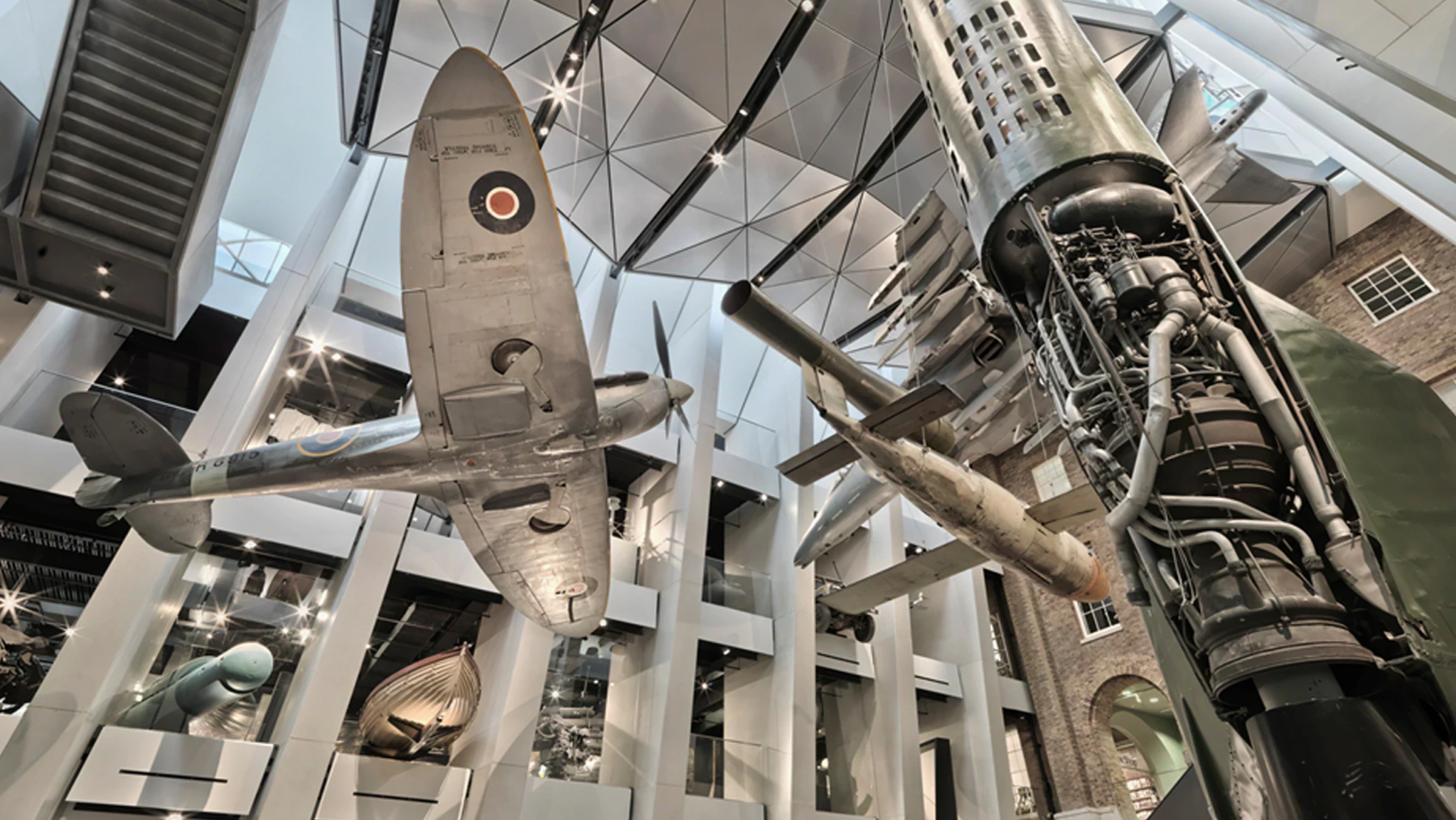
The organisation runs five sites: IWM London, HMS Belfast and the Churchill War Rooms, all in London; IWM Duxford in Cambridgeshire; and IWM North in Manchester.