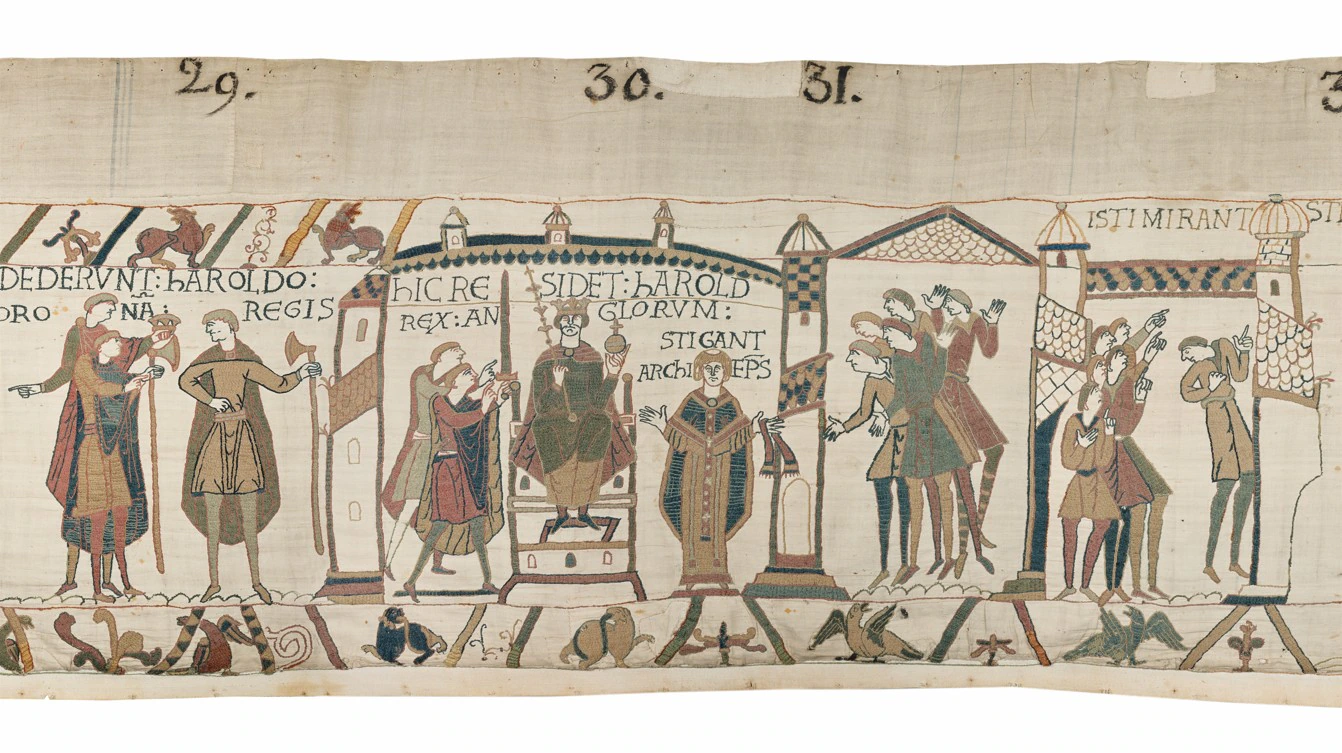
A BBC documentary is among a wide range of events and activities planned around the Bayeux Tapestry’s arrival in Britain later this year.
The TV programme, co-commissioned by BBC Arts and BBC Specialist Factual, will follow the tapestry’s journey to the UK, offering behind-the-scenes access and highlighting the expertise, preparation and conservation required to make the loan possible.
The show will air this autumn alongside a special day of content on Radio 4 devoted to the tapestry.
“The survival of this fragile artefact over more than nine centuries is miraculous, and we couldn't miss the opportunity to bring our audiences right up close to its exquisite details as the Bayeux Tapestry arrives back in Britain for the first time since the 11th century,” said Suzy Klein, the head of BBC Arts and Classical Music TV.
“This special film will reveal the secrets, scandals and stories behind one of the most significant cultural treasures of the medieval world.”
Transport debate
The Bayeux Tapestry’s journey to the UK is the subject of much debate in France, where several historians and conservators have raised concerns that the trip, which will be by lorry and train via the Channel Tunnel, could endanger the fragile embroidery.
Two dry runs have now taken place with a facsimile tapestry in a climate-controlled crate, which features shock absorbers designed to reduce travel vibrations.
Commenting on the issue earlier this month, Philippe Bélaval, the president of France’s Centre des Monuments Nationaux, said experts in France are “confident” about the transport arrangements.
“Many experts have been mobilised to ensure that its transport to London and display at the British Museum do not compromise [the tapestry’s] preservation,” said Bélaval.
“Advances in monitoring vibrations during transport, as well as climate and lighting conditions during exhibition, allow us to be confident in the feasibility of an operation that likely could not have been carried out under the same conditions just a few decades ago.”
Advertisement
The BBC documentary is part of ambitious plans to make the artefact’s return to Britain a “national moment” that engages people nationwide.
The British Museum (BM) hopes to ensure that Bayeux Tapestry-related activity is within an hour's drive of two-thirds of the UK, while digital experiences will be available to schoolchildren everywhere.
Further plans include Bayeux around Britain, supported by WorldQuant, a UK-wide partnership programme that will see more than 60 partner organisations, including museums, libraries, archives, cathedrals and heritage sites, run exhibitions and events to highlight the significance of the tapestry (see box below).
Meanwhile tapestry-related programming for children and young people includes free entry for under-16s to the BM exhibition, and special timeslots for schools, with a free packed lunch for every schoolchild provided by the museum’s catering partner Benugo.
A live digital experience, the “biggest history class in history”, will be streamed to schools around the UK on 14 October to mark the 960th anniversary of the Battle of Hastings. The broadcast is being delivered by the BM in partnership with the British Library, English Heritage and Norwich Museum Service.
“Since this loan was announced last year, we have been committed to making this a significant cultural moment for the whole of the UK,” said BM director Nicholas Cullinan.
Advertisement
“The Bayeux Around Britain programme will help ensure that this once-in-a-generation exhibition is not confined to Bloomsbury but accessible to tens of millions of people around the country.”
The Bayeux Tapestry Presented by Igor Tulchinsky opens on 10 September, with booking for individuals available from 1 July. See our Free Entry page for details on entry to BM exhibitions for Museums Association members
Bayeux around Britain programming
Hastings Museum & Art Gallery will host a special loan of a British Museum object, the Stothart Cast, which was taken from wax impressions lifted from the Bayeux Tapestry in 1816. Meanwhile the Hastings Embroidery, created in 1966 to celebrate the 900th anniversary of the Battle of Hastings, will be displayed in Hastings Town Hall.
North Lincolnshire Museum is running an exhibition featuring large scale projections of the tapestry shown alongside Norman objects from its own collection.
At Lincoln Castle, which was founded by William the Conqueror in 1068, a giant dragon named Hastings will be unveiled.
The Box in Plymouth, which is currently shortlisted for Art fund Museum of the Year, will create multimedia display offering a scaled-up view of the Bayeux Tapestry, accompanied by AV materials from the British Museum.
The transformative impact of the Norman conquest on Irish history will be explored in Carrickfergus Museum, Northern Ireland, which will present an exhibition exploring the arrival of Anglo-Norman forces in 1169 and the profound changes that followed.
Meanwhile the Great Tapestry of Scotland visitor centre in Galashiels, Scottish Borders, will unveil a new, year-long exhibition, Two Tapestries, Two Nations, in September. The centre displays one of the world’s longest contemporary tapestries, which was inspired by the Bayeux Tapestry. Families, local groups, volunteers and community participants will be invited to contribute to collaborative activities such as Scotland after Bayeux: 1000 Years of Stories.
Tewkesbury Abbey is planning an exhibition centred on a full-scale facsimile of the tapestry displayed within the abbey’s Norman nave.
The Museum of Somerset will run a year-long exhibition on the newly acquired Chew Valley Hoard, which is thought to have been buried for safekeeping during the period of turmoil immediately following the Norman conquest.