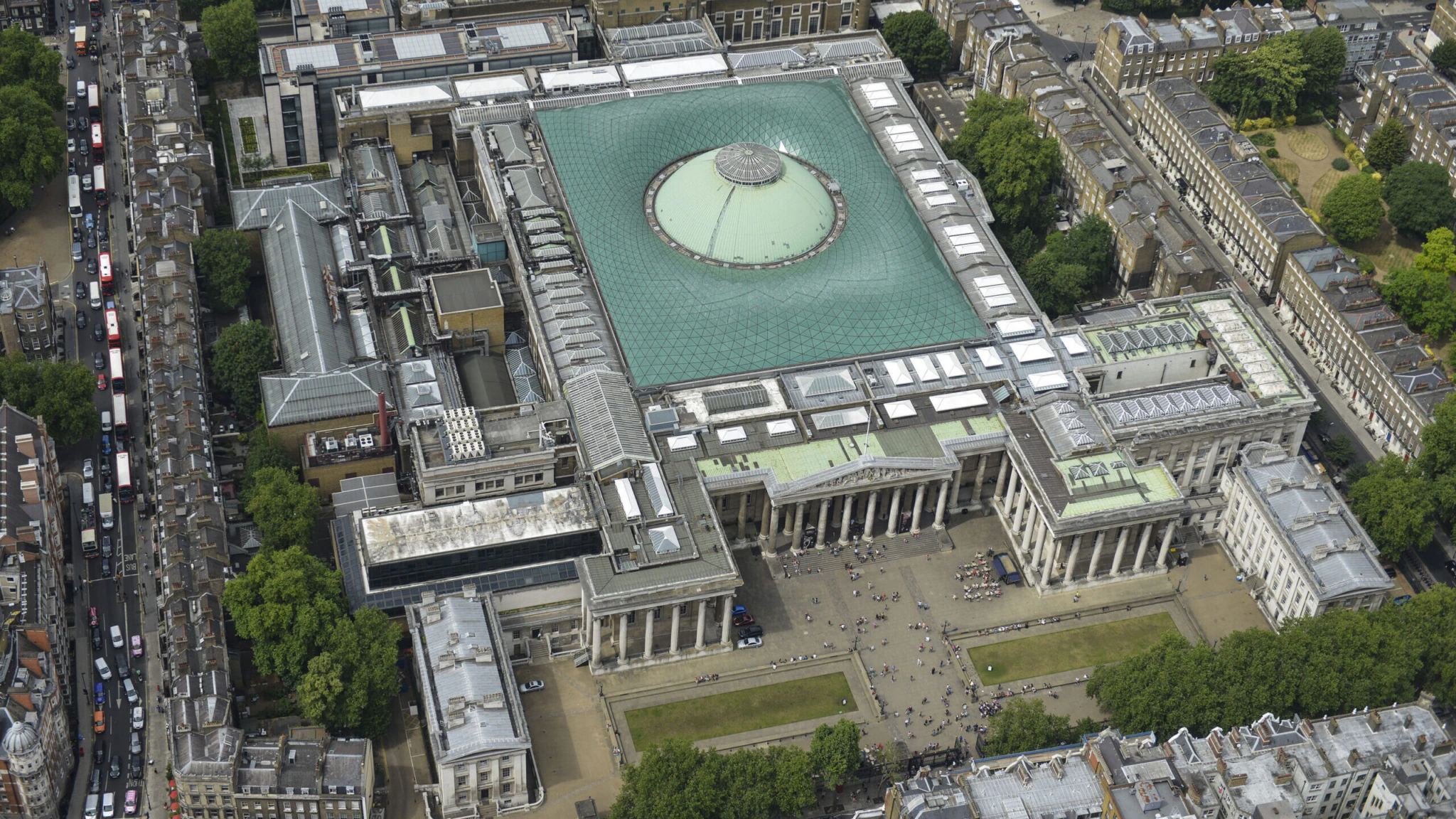
A project to revamp the British Museum’s forecourt to create a civic space and reduce visitor queues has been granted planning permission by Camden Council – despite objections that design proposals will negatively impact on the architectural merit of the 19th-century building.
Posting on Instagram, the director of the museum Nicholas Cullinan said the members of the council’s planning committee voted unanimously in support of plans to erect two visitor welcome pavilions and landscaping in the museum’s northern and southern forecourts. Additional plans to install queuing and wayfinding infrastructure such as railings and seating have also been approved, enabling the museum to create “a civic space for everyone”, according to Cullinan.
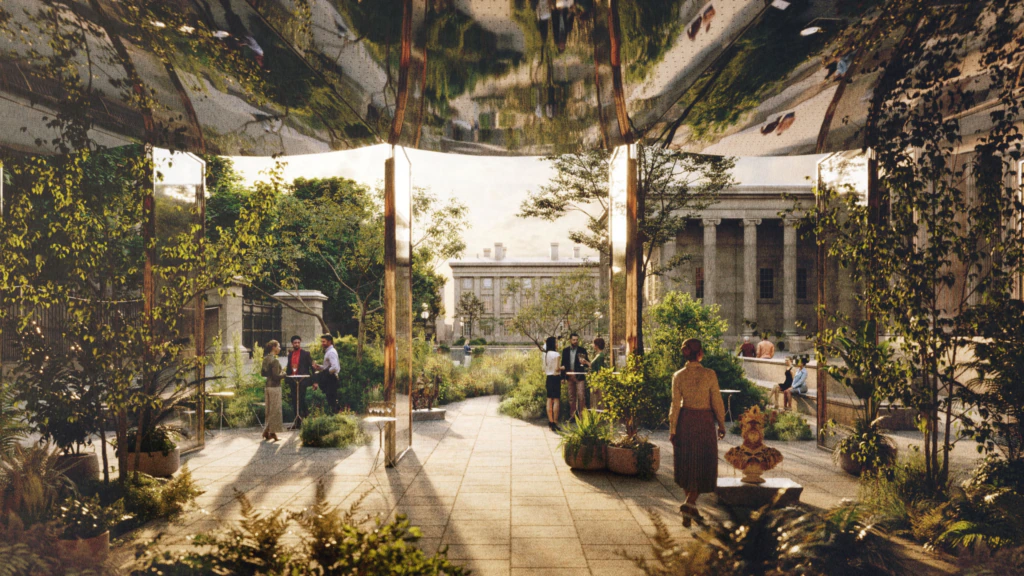
“We will remove the temporary white tents and replace them with architecturally designed pavilions and new landscaping drawing inspiration from our collection and a history of horticulture,” he wrote in the post.
“It should provide a far more positive experience for visitors that doesn’t focus on crowd control. Instead, there will be new curatorial spaces within the gardens, and I’m hoping they will become a vital piece of public green space in Camden – to be enjoyed by our visitors, school groups and the local community.”
Why did the planning committee approve the proposal?
Presenting at Camden Council’s planning committee meeting on 26 March, planning officer Neil McDonald recommended the committee approved the designs. He acknowledged that the plans would essentially change the British Museum’s “conventional 19th-century monumental setting” into something “more akin to a public garden”.
However, he said the public benefits justified the harm caused as the new design would enable the British Museum to provide security to its visitors and continue to function in the modern age.
“The design mitigates the harm that has to be caused to achieve the safe ongoing use of the museum,” he added.
Responding to McDonald, Patsy Prince, a resident of Bloomsbury and joint chair of the Bloomsbury Association, said that public engagement had been wholly inadequate.
She added that there was no precedent for the museum to have an external visitor welcome and security check, and there was no evidence that alternative solutions had been explored. She criticised plans for the informal landscaping, which represented the “banality of a suburban garden centre at best”.
“The scheme must stand or fall on its architectural merits alone…,” Prince said. “Set aside the question of public safety, and there is no discernable community benefit.”
In a right to reply, the museum’s director of estates and capital projects Claire McKeown said the plans would give it the “ability to properly, accessibly and securely welcome visitors into the museum.”
Planning permission “allows us to work with Camden Council on our long-term masterplan, which will see the area transformed into a people-focused vital public green space that is worthy of a world class museum,” McKeown said.
Advertisement
As previously reported in Museum Journal, conservation charity The Georgian Group had objected to the design proposals, which it claimed would “cause an unacceptable level of harm to the significance of this internationally important site”.
The Victorian Society, meanwhile, called for the southern pavilion to be moved closer to the museum's boundary railings to limit “the harm the present location has on the importance of Smirke's grand triumphal facade”, while Historic Buildings & Places, a charity that works to protect the built historic environment, said it was concerned about the “level of harm the proposed landscaping would have on this Grade I listed heritage asset”.
The British Museum’s visitor welcome project should complete next spring. It is considered a temporary solution, valid for 10 years only.
Studio Weave, which is leading the design team behind the plans, also shared the news on Instagram: “Our proposals will transform the relationship of the British Museum to the surrounding streets by allowing visitors into a richly planned open space on the South Forecourt and remodeling the north entrance to better integrate it with Montague Place.”
In a statement, James Hughes, director of the Victorian Society, said: "While improvements to visitor facilities are clearly needed, the scheme introduces unnecessary visual harm to the British Museum’s setting and fails to respond to the clarity and dignity of the historic design it sits within. A more sensitive and responsive solution is surely achievable.’
Campaign to save former Museum of London building abandoned after high court ruling
Meanwhile, a legal challenge to plans to demolish the former Museum of London building and rotunda on the Barbican estate has been dismissed by a high court judge.
Advertisement
The scheme will see the former museum building on London Wall and a nearby 1970s office block knocked down and three new office buildings constructed on the sites.
The high court last week rejected a legal challenge brought by campaign group Barbican Quarter Organisation against the City of London Corporation. The scheme also received numerous planning objections largely based on concerns around environmental sustainability and whether alternative schemes for the existing buildings had been considered.
“We are disappointed by [this] decision and while the outcome is not what we had hoped for, we respect the court’s process and the seriousness with which the case was considered,” the organisation said in a statement.
It concluded that it was “not in a position to take this fight further”.