A slate tablet commemorating the storage of the National Gallery collection in north Wales during the second world war has been unveiled at the London’s museum’s home in Trafalgar Square.
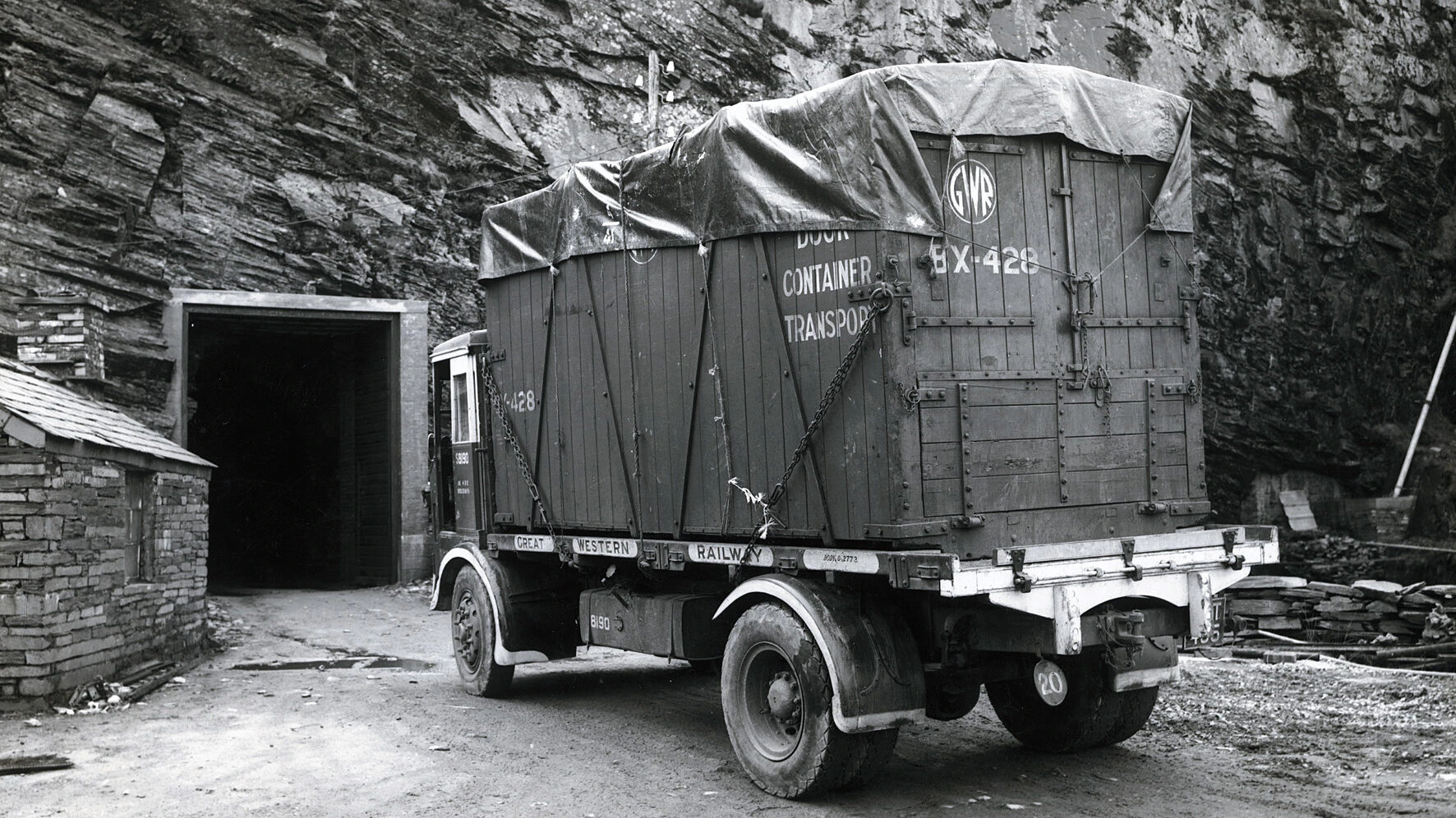
During the war, in order to protect it from German bombing of London and possibly an invasion, the National Gallery’s whole collection was moved to a disused slate mine near Blaenau Ffestiniog at Manod in Eryri (Snowdonia).
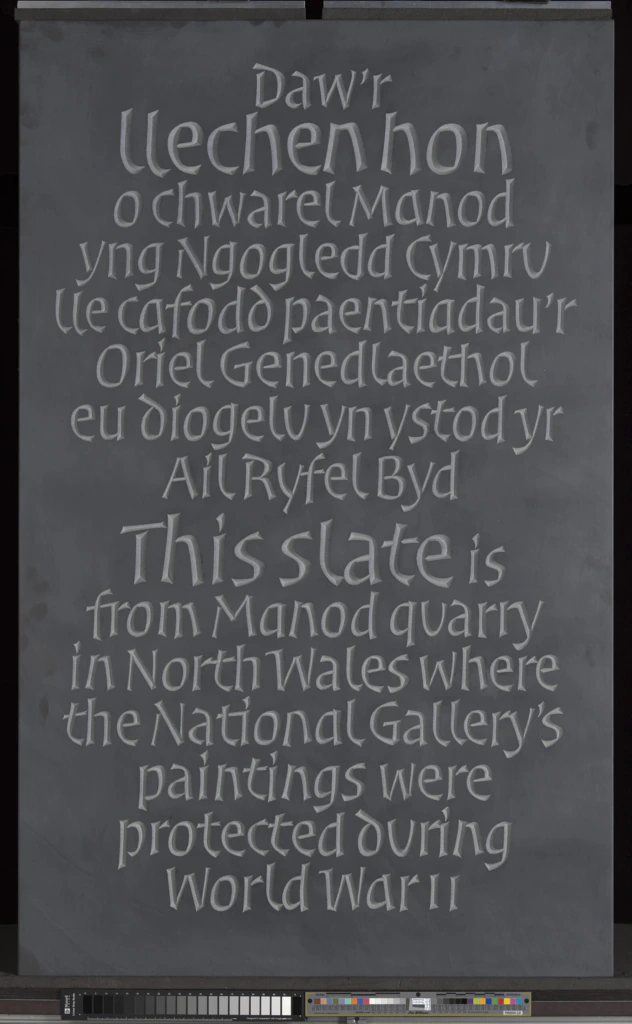
The Manod Slate Tablet was conceived by the artist Jeremy Deller and designed and carved by letter-carver John Neilson. It was commissioned by the Mostyn gallery in Llandudno, and supported by CELF, the national contemporary art gallery for Wales, a network that brings together 12 partner institutions across Wales.
The inscription in Welsh and English reads: “Daw’r llechen hon o chwarel Manod yng Ngogledd Cymru lle cafodd paentiadau’r Oriel Genedlaethol eu diogelu yn ystod yr Ail Ryfel Byd.” (This slate is from Manod quarry in North Wales where the National Gallery’s paintings were protected during World War II).
National Gallery director Gabriele Finaldi said: “The Manod Slate Tablet serves as a reminder of the crucial moment when during wartime the nation’s paintings were secreted in caves in the slate hills of north Wales to preserve them for future generations.”
Advertisement
Kath Davies, director of collections and research at Amgueddfa Cymru, said: “It is wonderful to see how the CELF network is making a real difference to the contemporary art scene in Wales.
“Through CELF we are able to support contemporary artists to make new work and encourage our audiences to engage with Welsh stories and interests. This is a fantastic project that commemorates an important historic event but also preserves traditional Welsh craft and heritage.”
The Tablet, on permanent display in the Portico Vestibule of the National Gallery, is a legacy of the Triumph of Art, a project that rounded off the gallery’s bicentenary celebrations in 2024-25.
After a year-long celebration of festivals, gatherings and art in the public realm throughout Britain and Northern Ireland the Triumph of Art culminated in a day-long public celebration in Trafalgar Square on 26 July, where the Manod Slate Tablet was first revealed.
The National Gallery’s collection in north Wales
After the annexation of Austria in March 1938 and the takeover of Czechoslovakia in September of the same year, the threatened invasion of Poland by Nazi forces brought Europe to the brink of war.
The possibility of war led Kenneth Clark, the director of London’s National Gallery, to consider the evacuation of the collection. Plans were finalised during 1938 and when the Munich crisis threatened to trigger a full-scale war, 50 paintings were transported to Bangor in Wales.
This happened on the 30 September 1938 – the very day the Munich accord was signed by Neville Chamberlain and Adolf Hitler. With the immediate danger of war averted, the paintings were able to return to London the same day.
Barely a year later, the complete evacuation of the gallery happened for real. By late August 1939 war was inevitable. As widespread bombing of London was predicted, the National Gallery removed all its paintings during the 10 days that preceded the declaration of war on 3 September 1939.
The paintings were distributed to various north Wales locations – the University of North Wales at Bangor; the National Library of Wales in Aberystwyth; Caernarvon Castle; Trawsgoed (Crosswood); and Penrhyn Castle.
A few paintings also went to Gloucestershire. These locations were only temporary homes while the longer-term future of the collection was considered.
By the summer of 1940, the outlook seemed bleak for the allies in mainland Europe, and the invasion of Britain looked imminent. It was decided that the National Gallery collection could not remain scattered in various locations around Wales.
One serious proposal was for the paintings to be evacuated by ship to Canada. But the vulnerability of the ships to U-boat attack worried Clark. He went to see UK prime minister Winston Churchill who immediately vetoed the idea: ‘Hide them in caves and cellars, but not one picture shall leave this island.’
As the paintings were now going to stay in Britain for the duration, a new secure location needed to be found. The conditions in their temporary homes were far from ideal. There was always a chance they might get hit by a stray bomb during air raids on the Liverpool docks.
A disused slate mine near Blaenau Ffestiniog at Manod fitted the bill perfectly. High explosives were used to enlarge the entrance in order to accommodate the largest paintings. Several small brick “bungalows” were built within the caverns to protect the paintings from variations in humidity and temperature. By the summer of 1941, the whole collection had been reunited in its new subterranean home.
Although all the paintings had left Manod by the end of 1945, the caves were reserved for further use during the Cold War. They were still available to the government until the early eighties.
This text is adapted from The Gallery in Wartime on the National Gallery’s website