Items from a rare bronze age hoard of weapons acquired by National Museums Scotland will go on display next summer in a new exhibition exploring conflict and warfare in prehistoric Scotland.
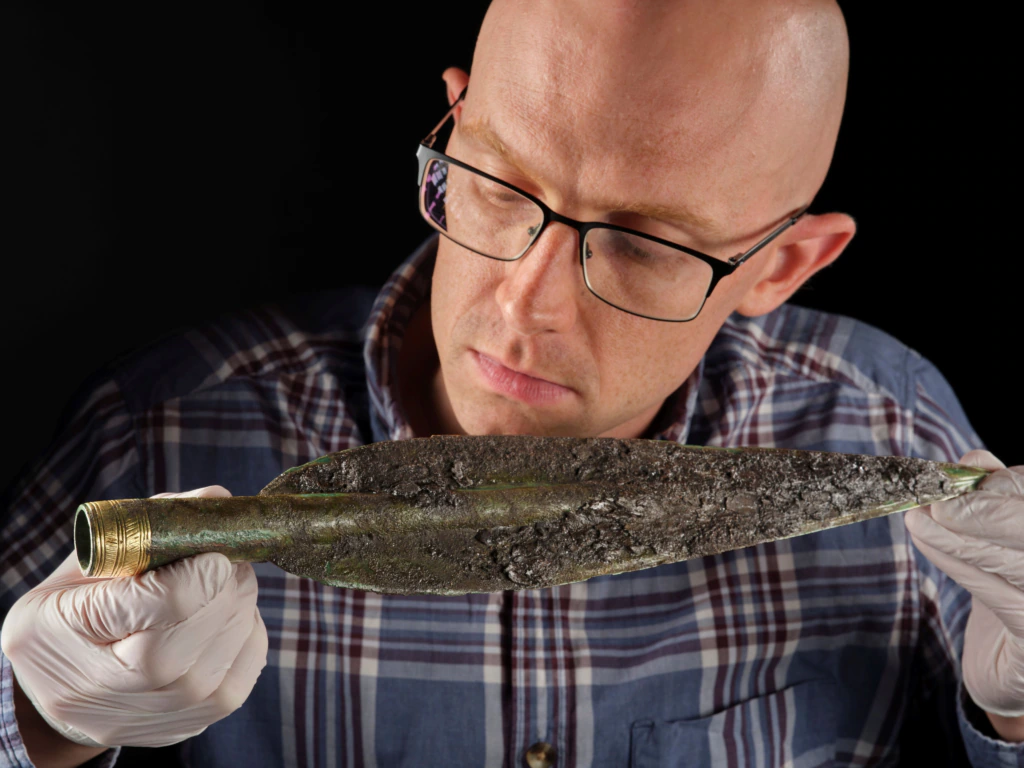
The hoard was found in 2016 by Guard Archaeology near Carnoustie, ahead of the area being developed into football pitches. Among the items unearthed was a rare spearhead decorated with gold and a bronze sword with an unusual lead-tin pommel, still sheathed in the remains of a wooden scabbard, dating from around 1120-920 BC.
The hoard was deliberately placed near a bronze age round structure, which the museum says hints at the existence of a local warrior elite in the Angus area over 3,000 years ago.
The hoard will go on display at the National Museum of Scotland as part of Scotland’s First Warriors exhibition, which opens on 27 June 2026 and runs until 17 May 2027.
The show brings together more than 250 objects spanning thousands of years, to explore the origins and impact of conflict and warfare in prehistoric Scotland.
Advertisement
“This is the first time we’ve encountered weapons buried at a settlement where people lived,” said Matthew Knight, NMS’s senior curator of prehistory.
“It forces us to reconsider relationships between people and these objects and enriches our picture of life in bronze age Scotland.
“On top of that we have the exceptional survival of wood, textiles and animal skin that express how much these objects were valued. After hours of painstaking conservation, I can’t wait to for visitors to see the hoard for the first time in our new exhibition Scotland’s First Warriors.”
A spokesperson for NMS said it was currently discussing display plans for the Carnoustie Hoard beyond 2027.
The hoard was acquired by NMS in May 2024, along with pieces from more than 155 prehistoric pots excavated from the same site. As the hoard was professionally excavated as part of a commercial development, it was not eligible for a finder’s fee.
It was declared to the Treasure Trove Unit, which allocated it to NMS through the Scottish Archaeological Finds Allocation Panel.