
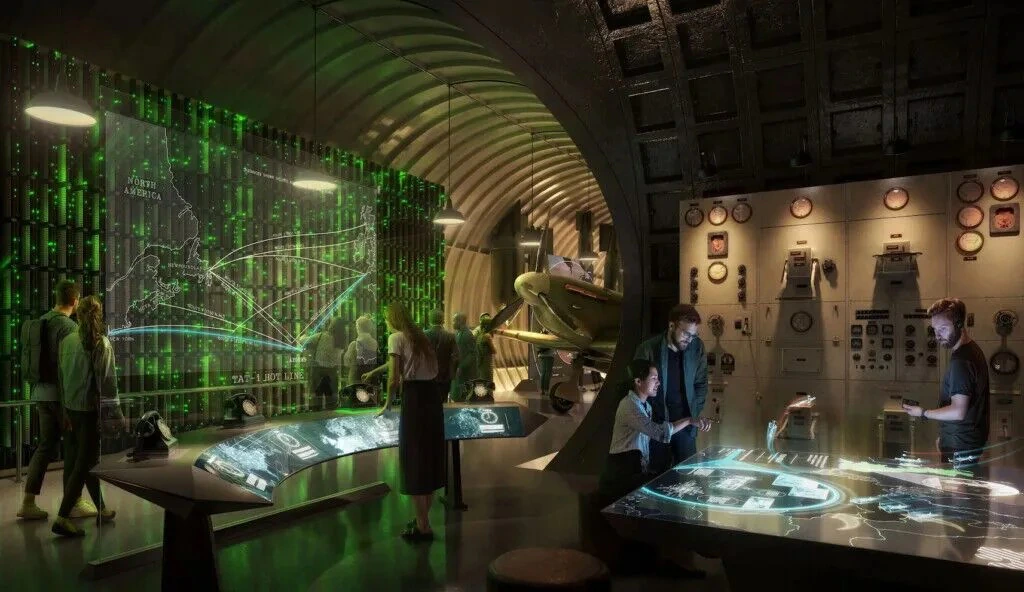
A new museum of military intelligence is to be created in a series of underground tunnels built to shelter Londoners during the Blitz.
The Kingsway exchange tunnel complex, under High Holborn in the City of London, was constructed between 1940 and 1942 in order to protect people from aerial bombardment, but due to the changing nature of the war it was never used for its original purpose.
The complex instead housed the Special Operations Executive, a clandestine organisation established by prime minister Winston Churchill in 1940 to conduct espionage and sabotage in Nazi-occupied Europe. The tunnels are believed to have inspired the Q Branch in Ian Fleming’s James Bond novels.
The project is being led by The London Tunnels company, which has announced a new partnership with the Military Intelligence Museum in Chicksands, Bedfordshire, to create a heritage attraction on the site exploring the history of military intelligence.
The Military Intelligence Museum, which is located on a military base and only open to the public for advance bookings, will use its collections and expertise to help develop the "world's most authoritative" spy museum in the London tunnels.
The new attraction will include original artefacts, equipment, weapons, documents and images, and will feature stories from the Battle of Britain and D-Day, as well as espionage in the Cold War and the Falklands, and terrorist threats in the 21st century. A special exhibition will be dedicated to the Special Operations Executive.
Advertisement
Jim Hockenhull, commander of strategic command and colonel commandant of the Intelligence Corps, said: “The UK has long been at the forefront of military intelligence.
“Skills developed over centuries by thousands of brave, imaginative and determined men and women, have defended Britain and the world from those who threaten us. They continue to protect us today and will do so in the future, but their exciting and fascinating operations have remained hidden. It is time that, where we can, we allow our forebears to tell their story.
“I am delighted that, through a partnership with The London Tunnels, we can now do so and will see in London the world’s most authoritative permanent exhibition of military intelligence. The tunnels will provide a dramatic and historic backdrop for an exciting new approach to telling the story of the past, present and future of military intelligence.”
The trustees of the Military Intelligence Museum said: “This partnership with The London Tunnels marks a new chapter in the museum’s history. In a long-term partnership with such a historically significant and evocative location, we are not only preserving the legacy of military intelligence but also bringing it to life in a way that will captivate and educate future generations. We are thrilled to create a space where the public can engage with the rich history of intelligence operations in a truly inspiring setting.”
Angus Murray, CEO of The London Tunnels, said the exhibition would provide access to an “important and unique collection which has until now been largely hidden”.
He said: “The tunnels, built and designed to protect Londoners during the Blitz, are the ideal backdrop to tell the remarkable, and untold, stories of the men and women who played a vital role in protecting Britain then, and the role of the armed services protecting Britain today.”
Advertisement
The exhibition will be part of a wider subterranean development that aims to “offer a combination of historical heritage experiences and a cultural, beautifully designed, multi-sensory, digital experience”, as well as an underground bar billed as the UK’s deepest licenced premises.
The proposals have received full planning permission from the City of London Corporation’s Planning and Transportation Committee, and the attraction is scheduled to open to the public in 2028.
The London Tunnels believes the site could draw up to two million visitors a year.
Its website says: “The tunnels’ historical significance, expansive scope, and prime position where London’s West End meets the historic Square Mile could position them as one of the most thrilling global destinations. They have the potential to significantly contribute to enhancing the capital’s cultural and heritage allure, potentially drawing up to two million visitors annually.”

If this does go ahead I hope that the museum brief will include the spying that occured by the secret sevices on British citizens throughout the 20th century. https://www.spycops.co.uk/ The spycops activities (SDS) were closely associated with MI5 and, together with special branch, they both carried out surveillance on British left-wing, environmental groups, animal rights, and trade unions. They had undercover officers but they also conducted surveillance on thousands of British citizens by postal intercept, telephone listening devices etc. This was a massive operation to scrutinize people who were not violent and hadnt broken the law. If this aspect of the intellengence services activities is not included, the museum will be a ‘disneyfication’ of what actually happened, and is still happening. Museums should be a reflection of reality – do not let the intellegence services brush this aspect of their activities under the carpet just because its not convienent for them to have it included in the story of British military, cold war and 21st century surveillance.
While the subject of surveillance of the UK population may be interesting it will undoubtedly fall outside the remit of this museum. Gathering of information on UK residents for security purposes is the remit of the Security Service and the Police. The Security Service was originally MI5 because it originated in the War Office at the beginning of the 20th Century. It is completely separate from Military Intelligence, which is the domain of the Defence Intelligence Staff. The Military Intelligence Museum was formerly the Intelligence Corps Museum, the Intelligence Corps task being to acquire and interpret information on the country’s external enemies in order to support military operations. The exception was the 20th Century Troubles in Northern Ireland when the Armed Forces were called upon to act in aid of the Civil Power. The Armed Forces have neither the remit nor the capability of collecting information on residents in Britain.
Your reply is interesting but there are a couple of points that I would like to respond to. If the museum is solely concerned with Military Intelligence then I would like to suggest that the name ‘spy museum’ shouldn’t be used, even as a strapline or informal name. Using the word ‘spy’ in the context of state surveillance clearly implies a much wider public meaning than simply military intelligence.
Certainly, MI5 is seperate from Miliary Intelligence. MI6 and ‘Q’ branch, as mentioned in the above piece, are active in gathering and analysis of foreign intelligence and while MI6 and MI5 have respective responsibilities for foreign and domestic intelligence gathering they swap information and communicate closely with each other when necessary. I have seen letters from MI6 in files in The National Archives MI5 files.
I cannot see how you could accurately draw a firm line between the two, especially during the cold war but also in the decades after. For example, the cambridge ‘spies’ were employed by MI6 but they represented a domestic threat so how can you actually talk about one without the other? The museum is being presented as having a far wider remit that the technical one you are suggesting.