
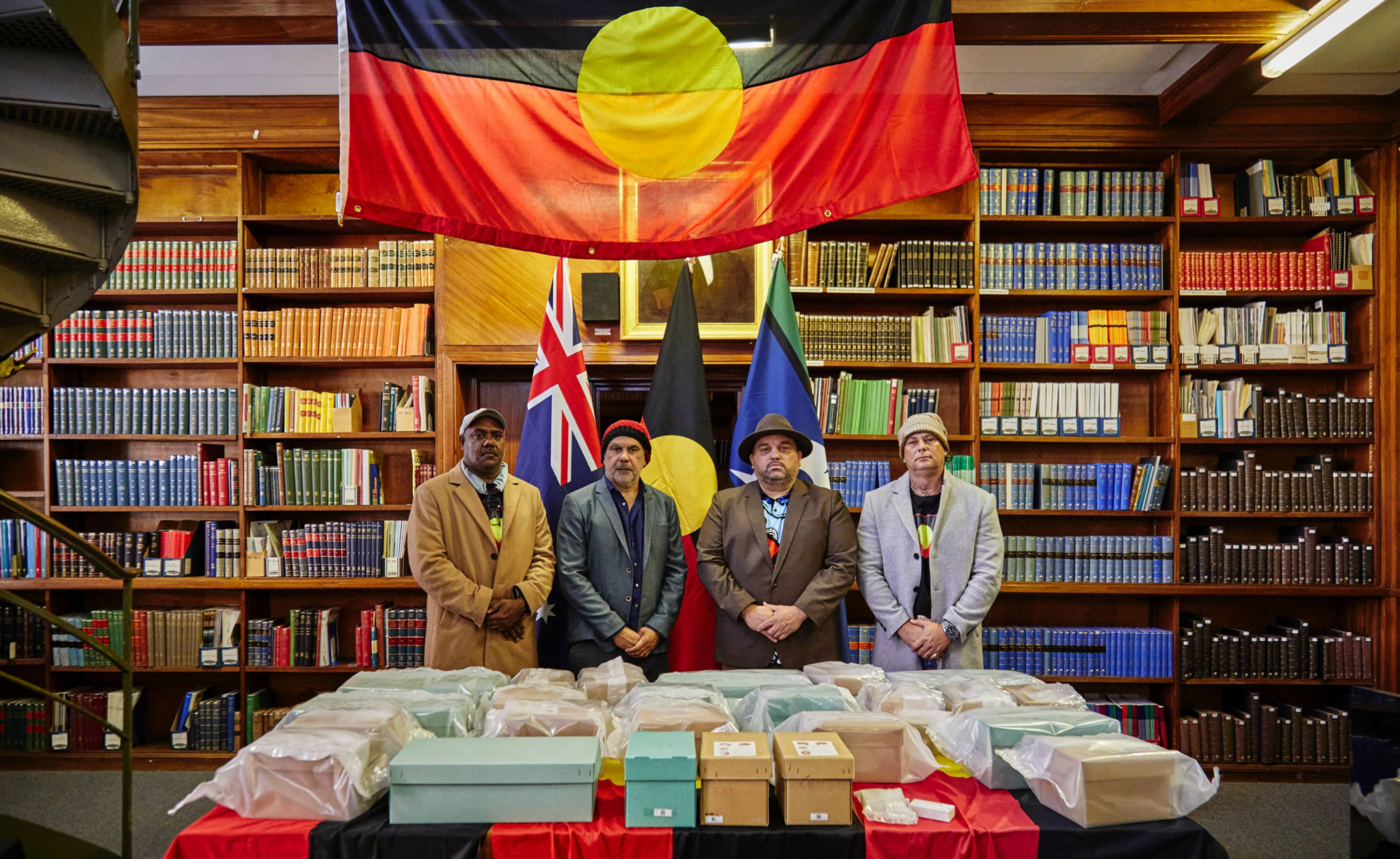
London's Natural History Museum (NHM) held a ceremony on 10 April to mark the return of ancestors to communities in Queensland, Australia.
The ceremony, hosted with Australia’s Department of Infrastructure, Transport, Regional Development, Communications and the Arts, Queensland Museum and Traditional Custodians from Queensland communities, involved the return of 36 First Nations ancestors.
Six of the ancestors’ bodies were returned to four Queensland communities – the Woppaburra, the Warrgamay, the Wuthathi and the Yadhighana.
The Australian government will take care of the remaining 30 ancestors’ remains until their traditional custodians can be found.
The remains originated from different sources and were often in other institutions before being transferred to the NHM.
This repatriation marks the fourth return of ancestors from the NHM to Australia. According to the Australian government’s arts office, it brings the number of First Nations ancestors returned from around the world to 1,775, with more than 200 coming from the NHM.
Advertisement
NHM director Doug Gurr, said: “It was a privilege for the Natural History Museum to host Traditional Custodians from the Warrgamay, Woppaburra and Wuthathi communities, alongside colleagues from Queensland Museum and the Australian government and High Commission. The special ceremony was a deeply poignant moment, following close collaboration with the Australian government to reunite the communities with their ancestors.”
Australia’s National Cultural Policy, Revive, acknowledges the importance of respecting and promoting the rights of First Nations people to repatriate their ancestors back to their homelands.
The Australian Government has been supporting the return of First Nations ancestors from collecting institutions and private holders overseas to Australia and their Traditional Custodians, where known, for more than 30 years.
Woppaburra representative Wayne Blair, an actor and filmmaker, said: “Repatriation of our ancestors is an eternal flame, the eternal healing is both spiritual and physical, for our Elders and Community. The repatriation of ancestor’s remains, is the embodiment of reconciliation and healing, for First Nation communities across Australia. Domestic and overseas, you are not returning science specimens, you are returning ancestors to their families, their descendants, whose eternal pain of loss brings healing.
"Repatriation and the return of ancestors, is the only open door for reconciliation to truly begin healing for injustices of the past, for First Nation Elders and communities across Australia.”
There has been such a change in attitude at the NHM. Around 20 years ago I represented the MA on the government’s Human Remains Advisory Committee. The then director of the NHM was also a member of the committee and there seemed no way he was going to agree to returning human remains. So it’s wonderful that the museum is now more open, empathetic and collaborative