
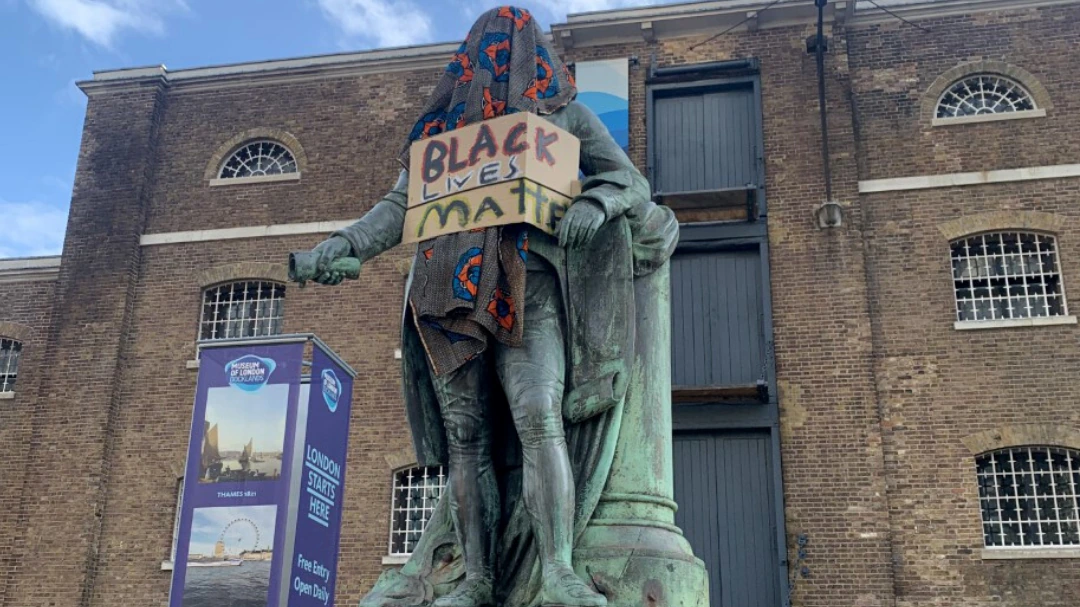
The Museum of London has acquired a bronze statue that was taken down from outside its east London site during the Black Lives Matter protests of June 2020.
The sculpture of slave trader Robert Milligan previously stood on West India Quay at the entrance to the Museum of London Docklands. It was removed by the authorities in Tower Hamlets following the toppling of the statue of Edward Colston in Bristol.
The landmark, which was first unveiled in 1813 and had been outside the museum since 1997, was taken down after a petition signed by more than 4,000 people called for it to be removed from public view. A consultation found that 76% of people were in favour of the statue being presented in an exhibition.
At the time of its removal, the museum said it recognised that the monument was “part of the ongoing problematic regime of white-washing history”.
The toppling of Colston led to an intense debate about statues in the public realm. Former culture secretary Oliver Dowden went on to develop a “retain and explain” policy prohibiting the removal of contested monuments.
The Museum of London's acquisition follows a public consultation, in partnership with Tower Hamlets Council and landowners Canal & River Trust, which concluded that the statue should be housed in a museum where it can be fully contextualised.
Advertisement
The majority of those consulted were in favour of the statue being displayed with context about Milligan’s involvement in the creation of the docks, his links to the slave trade, and information on the Black Lives Matter movement.
It will be held in storage while the museum consults further with local communities about how best to present it.
A Museum of London spokesperson said: “The West India Docks, championed by Milligan using wealth from the slave trade, are a visible reminder of how this history has shaped our city. It is right and important that we acknowledge this in the statue’s story. We will now take time to consult with the local community to decide how best to take this forward as part of our collection.”
Ros Daniels, director for London & South East at the Canal & River Trust, said: “We want to thank everyone who took part in the consultation. Although views were mixed about the treatment of the statue, many were united in feeling we should not shy away from telling all aspects of our history. In line with preferences indicated in this survey, we’re pleased to offer this statue to the Museum of London Docklands.”

On the matter of the display of the statue of the slave trader Robert Milligan, I am wholly in favour of the display of the statue with suitable historical explanation of his heinous practices. it is vitally important that current and future generations are able to obtain the full story of such practices in our past.
I was hugely impressed, on visiting Berlin, how the Germans are trying very hard to educate all that visit their city, including their own citizens, of the atrocities of their Nazi past by even putting up large display boards along their streets telling of their evil past. I feel this is a great credit to the German attempts to come to terms with their past. We should learn from this and, certainly with regard to slavery, not ‘sweep it under the carpet’ in any way. Your decision for the Milligan statue is one way to do the right thing in this regard.
Best wishes to the Museum and all who work in it.
Patrick Hagglund, NW London resident since 1976
In collaboration with Tower Hamlets Council and property owners Canal & River Trust, the Museum of London acquired the statues after holding a public consultation. The statues will be used as historical exhibits. word wipe