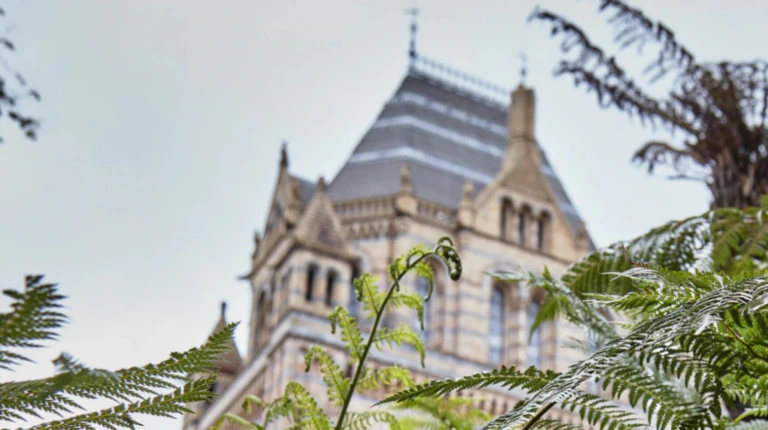
Organised by Survival International (SI), a non-governmental organisation supporting tribal peoples, the protest was aimed at the museum's involvement with DTC (the Diamond Trading Company), part of the De Beers Group and a sponsor of the exhibition.
SI claims that several Kalahari bushmen have been evicted by the Botswana government to make way for the mining of diamonds by De Beers.
Both De Beers and the Botswana government have denied the allegations. A statement from the Botswana government's Ministry of Foreign Affairs and International Cooperation claims that the bushmen were encouraged to relocate voluntarily 'purely to alleviate poverty'.
'It is shocking that the NHM would accept sponsorship from De Beers but not include this issue in the exhibition,' said Miriam Ross, a spokeswoman for SI. 'Both sides of the story should be told if the museum is to fulfil its function as a public educational institution. You can't help but wonder if De Beers's sponsorship through DTC influenced the decision not to include this.'
Michael Dixon, the director of the Natural History Museum, said: 'We always insist that sponsors get no editorial input into an exhibition, and all sponsorship is subject to an ethical review. It is a matter of protecting the museum's brand.
'We do a lot of research ourselves, and we found this issue to be extremely polarised. Neither side can substantiate their claims. We have engaged with SI, we have links to their website on our website, and we have tried to be balanced.'
As well as the protest, the opening of the exhibition also coincided with the announcement of London winning the 2012 Olympics bid, the bomb attacks in the city centre, and the G8 summit's focus on African poverty.
'The significance of the G8 meeting was raised after we decided on the date of the exhibition opening,' said Dixon. 'But the timing probably didn't work ideally.'
The exhibition focuses on the mineralogical aspects and user end of the diamond trade, although it does dedicate a panel to 'conflict diamonds'.
'We recognised that there were going to be socio-economic issues, but we are not a political organisation so don't normally concentrate on those areas,' said Dixon. 'We are always constrained by space, but we decided early on that the issue of conflict diamonds could be presented as a complete story.'
Caitlin Griffiths, the Museums Association's adviser on professional issues, said: 'Museums have an ethical requirement to ensure that a well-balanced view is presented.
'Whilst we appreciate that it is not always possible to cover all aspects with equal measure, it is disappointing that the museum was unable to use this as an opportunity to explore further the social and economic impact that diamond mining has.'
Patrick Steel
SI claims that several Kalahari bushmen have been evicted by the Botswana government to make way for the mining of diamonds by De Beers.
Both De Beers and the Botswana government have denied the allegations. A statement from the Botswana government's Ministry of Foreign Affairs and International Cooperation claims that the bushmen were encouraged to relocate voluntarily 'purely to alleviate poverty'.
'It is shocking that the NHM would accept sponsorship from De Beers but not include this issue in the exhibition,' said Miriam Ross, a spokeswoman for SI. 'Both sides of the story should be told if the museum is to fulfil its function as a public educational institution. You can't help but wonder if De Beers's sponsorship through DTC influenced the decision not to include this.'
Michael Dixon, the director of the Natural History Museum, said: 'We always insist that sponsors get no editorial input into an exhibition, and all sponsorship is subject to an ethical review. It is a matter of protecting the museum's brand.
'We do a lot of research ourselves, and we found this issue to be extremely polarised. Neither side can substantiate their claims. We have engaged with SI, we have links to their website on our website, and we have tried to be balanced.'
As well as the protest, the opening of the exhibition also coincided with the announcement of London winning the 2012 Olympics bid, the bomb attacks in the city centre, and the G8 summit's focus on African poverty.
'The significance of the G8 meeting was raised after we decided on the date of the exhibition opening,' said Dixon. 'But the timing probably didn't work ideally.'
The exhibition focuses on the mineralogical aspects and user end of the diamond trade, although it does dedicate a panel to 'conflict diamonds'.
'We recognised that there were going to be socio-economic issues, but we are not a political organisation so don't normally concentrate on those areas,' said Dixon. 'We are always constrained by space, but we decided early on that the issue of conflict diamonds could be presented as a complete story.'
Caitlin Griffiths, the Museums Association's adviser on professional issues, said: 'Museums have an ethical requirement to ensure that a well-balanced view is presented.
'Whilst we appreciate that it is not always possible to cover all aspects with equal measure, it is disappointing that the museum was unable to use this as an opportunity to explore further the social and economic impact that diamond mining has.'
Patrick Steel