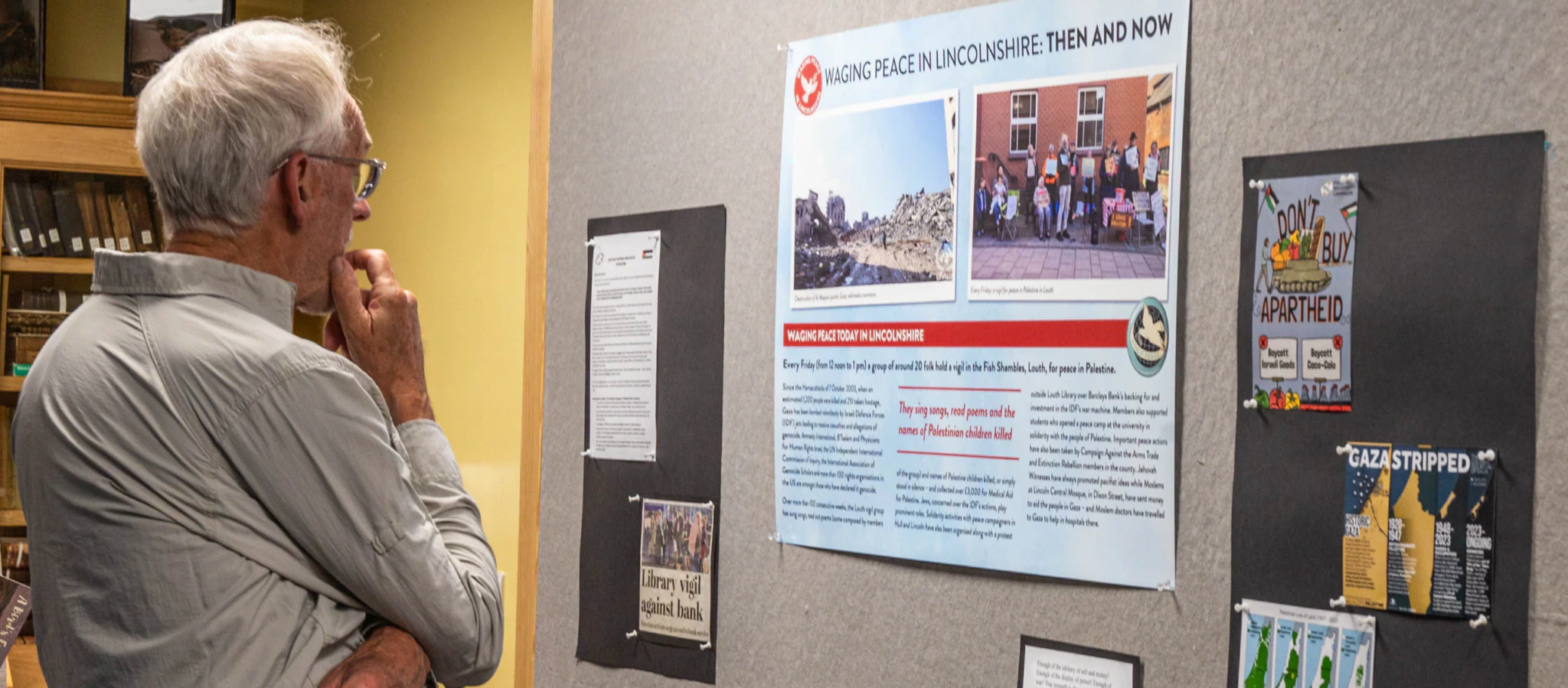
As a volunteer at Louth Museum, I have organised a unique exhibition highlighting the role of the peace movement in Lincolnshire – better known as “Bomber County” – from the early 20th century to today. Waging Peace in Lincolnshire; Then and Now opened 1 July and runs until 31 October.
There are many reasons that Lincolnshire tends to be associated with the military. There’s the building of the first tanks in Lincoln during world war one, and there’s the famous Lancaster planes that flew from the 27 bomber command bases in the county during world war two. No wonder several museums in the county focus on some aspect of warfare.
I have long been engaged in the peace movement so I wanted this exhibition to throw the spotlight onto those who bravely campaigned for peace, often at grave personal cost. Is it not time Lincolnshire also became known as “peace county”?
Louth Museum was founded in 1910 and is famous for housing a beautifully back-lit reproduction of William Brown’s remarkable Panorama of the town dating from mid-19th century, as well as the largest collection of carvings and paintings by woodcarver and artist Thomas Wilkinson Wallis.
The museum organises two specialist exhibitions every year, and Waging Peace in Lincolnshire is the second of 2026 with a budget of about £300.
Interpretation | pulling out stories of peace
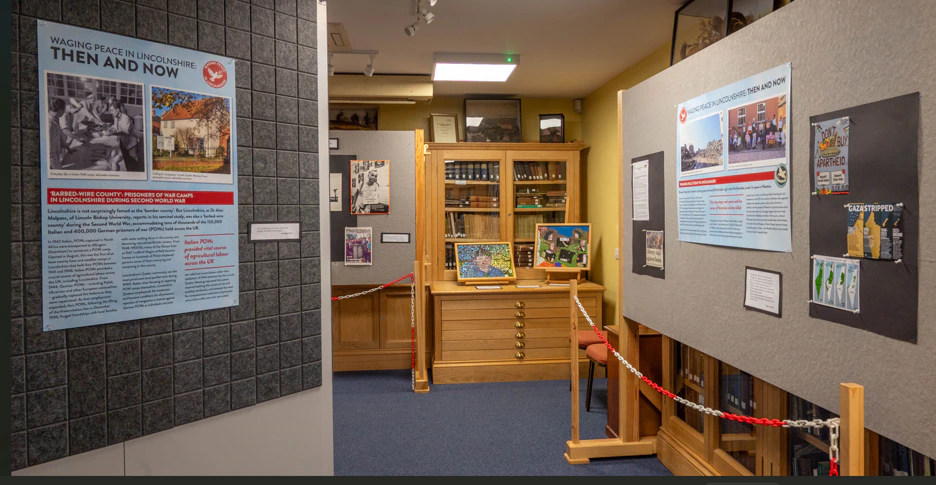
Each of the nine interpretive panels in the exhibitions has about 300 easily-read words, but the emphasis is striking images. They capture some remarkable stories, such as Louth man Albert West who, in 1903, met Mohandas K. Gandhi, then a relatively unknown lawyer, in a Johannesburg restaurant.
Advertisement
The two men became great friends and West went on to edit Gandhi’s newspaper, Indian Opinion. Gandhi visited Louth in 1906 to meet West’s family in Aswell Street and again in 1909 when he brought the son of another friend to begin attending Louth’s Edward VI Grammar School on Albert’s recommendation.
West’s wife, mother-in-law and sister also played crucial roles at Gandhi’s Phoenix Settlement in Durban – and descendants of West, still living in the Louth area, were keen to lend items such as a passport and newspaper cuttings for display.
Elsewhere, the exhibition sheds light on the fact about 20,000 Lincolnshire men refused to fight in the first world war on moral/religious grounds. Fenner Brockway (who went on to become a prominent Labour politician and leader of the World Disarmament Campaign) was held in solitary confinement in Lincoln prison as punishment because of his anti-war stance.
During the 1930s and 1940s, a group of conscientious objectors set up a peace farm near the villages of Holton cum Beckering and Legsby. One of the founders of the farm, Roy Broadbent, was the father of Jim Broadbent, the celebrated Hollywood actor, who grew up on the farm.
To entertain themselves, the objectors formed the Holton Players, and the Broadbent Theatre in the village of Wickenby continues to honour their memory.
Advertisement
Other parts of the exhibition look at the spread of prisoner of war camps across the county and the compassionate responses of pacifists to them, and the many creative activities of peace groups during the cold war.
It concludes with a panel on the vigils held currently every Friday in the centre of Louth calling for peace in the Middle East.
Challenges
Oneof my main challenges was to convey the vitality and creativity of the peace movement.
We held a public meeting in May at the local library to publicise the exhibition, and invited three academics to give talks on Albert West, Fenner Brockway and prisoner of war camps.
We also put on a 15-minute section of the play Conchies by local playwright Ian Sharp about the peace farm at Legsby, and the event ended with the community singing of a peace song.
Advertisement
A much longer, dramatised reading of Conchieswas staged at an open-air theatre in the centre of the town on 13 June.
Included in the exhibition are paintings by Lincoln-based, award-winning Quaker artist Graham Lewinton, and a video, produced by one of our museum volunteer Bob Maddens, showing the Friday peace vigils as well as parts of the open-air dramatised reading of Conchies and interviews with activists.
Dotted throughout the display panels are quotations from the likes of Virginia Woolf, Gandhi, Martin Luther King, Vera Brittain, Pope Leo XIV and so on, which will hopefully inspire visitors with the ideals of peace.
Lessons
- It’s important to be deeply immersed in the central topic of the exhibition. My close personal contacts with the following were crucial for gaining information – and items to display, including activists in the current peace movement and folk who grew up on the Lincolnshire peace farm.
- Don’t be tempted to cram too much text into the main display panels. Around 300 words is quite enough.
- Draw attention with striking, colourful images. We provide more information on A4 leaflets accompanying the exhibition.
Comments from visitors suggest that Waging Peace in Lincolnshire is putting the spotlight on an aspect of the county’s history that is too often ignored.
Richard Lance Keeble is a volunteer at Louth Museum