
The first Asia Pacific Triennial of Contemporary Art opened in 1993 at the Queensland Art Gallery (QAG) in Brisbane, Australia, at a time when many nations across the Asia-Pacific region were undergoing, or emerging from, major social, economic and political shifts. Living through these changes, artists in the region were shaping young movements of contemporary art while seeking to internationalise their practices and networks.
At the time, Brisbane, Australia’s third-largest city, was itself emerging from decades of staunchly conservative government, while the nation’s federal government was fervently, and in many ways for the first time, positioning itself as part of the Asia-Pacific region. These political and cultural forces were coming to broad public attention when QAG and the Queensland State Government agreed to partner for a series of three exhibitions focused on contemporary art of the Asia Pacific, with Australia as a vital and connected part.
The gallery began by engaging external advisers to develop the Asia Pacific Triennial series, as well as hosting a conference, live performances and opportunities for artist exchange. The triennial became a critical point of connection, often enabling artists and organisers from neighbouring countries to exhibit alongside each other for the first time. This fostered regional dialogue at a formational moment, enriching the small number of other museums, exhibitions and initiatives gaining momentum in the region — notably the Fukuoka Art Museum’s Asian Art Show, the Festival of Pacific Arts and the Artists Regional Exchange, along with new platforms such as Gwangju Biennale and Singapore Art Museum.
All this activity ignited critical new thinking for how the region could position itself globally, including how to reconcile localised notions of “tradition” that were still present in contemporary art and, significantly, how new art and discourse could be shaped without reliance on Euro-American paradigms.
Across three decades, the Asia Pacific Triennial series has responded to great shifts in arts ecologies of the region. Over time, the event — now developed in-house and held across two buildings: the Queensland Art Gallery | Gallery of Modern Art (QAGOMA) — has held onto some key methods in its approach: ongoing attention to First Nations perspectives and customary practices; maintaining an interest in art from outside major centres; and platforming artforms rarely seen in major international exhibitions.
Through a collaboration between QAGOMA and the Victoria and Albert Museum (V&A), Rising Voices: Contemporary Art from Asia, Australia and the Pacific (until 10 January 2027) reflects the guiding principles of the Asia Pacific Triennial and its sustained engagement with the art of this region. This significant exhibition celebrates key artistic figures and art movements that have shaped cultural contexts in this ever-changing part of the world.
Advertisement
Rising Voices is marked by artists’ responses to social and political events, beginning in the 1990s with works by Svay Ken (Cambodia), Mathias Kauage (Papua New Guinea), Brenda Fajardo (the Philippines), and Montien Boonma (Thailand), whose heralded installation Lotus sound will be travelling internationally for the first time.
The exhibition also addresses histories of colonial contact and explores artists’ rewritings of these narratives through works by Pala Pothupitiye (Sri Lanka), Aline Amaru (Tahiti), and Elisabet Kauage (Papua New Guinea).
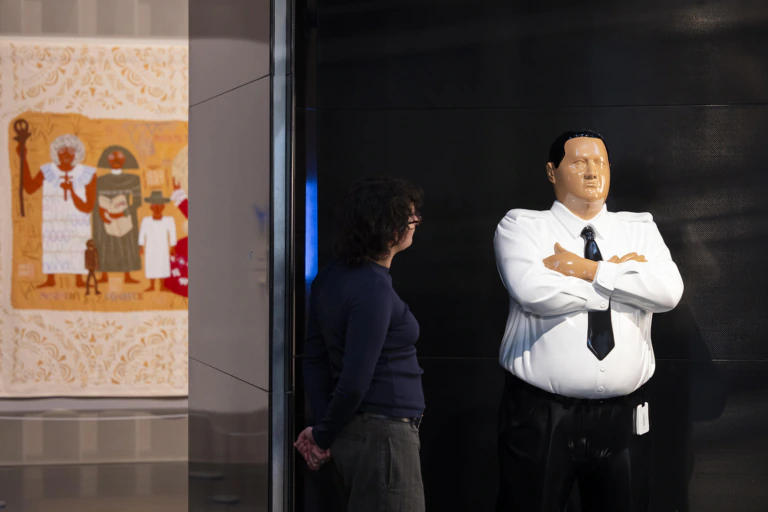
Other artists in the exhibition consider the legacies of these histories and how they inform concepts of race and identity today, as shown through Michael Cook’s Majority Rule series and Michael Parekowhai’s Kapa Haka (Whero) — a life-size Māori figure that stands guard at the exhibition’s entrance.
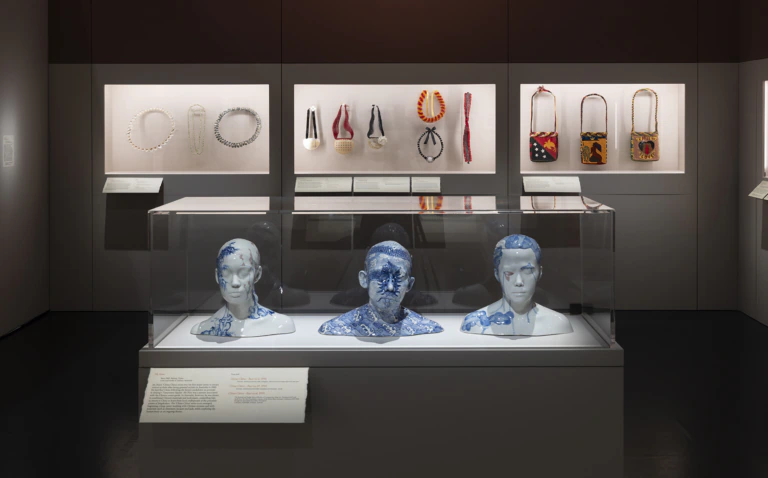
The key roles played by objects, techniques and materials in cultural practice and ancestral knowledge are also essential to Rising Voices, including the inclusion of jewellery and body adornment, such as Lola Greeno’s necklaces created through the generations-old practice of collecting king maireener shells in Tasmania, or Mele Kahelepuna Chun’s exquisite Hawaiian featherwork.
Judy Watson’s paintings similarly tie culture, community and place together with delicate symbolism, conjuring connections to the bold designs on barkcloth created by three generations of artists from Omie province in Papua New Guinea.
Advertisement
Rising Voices showcases this material richness across the region, especially highlighting art forms with long histories that have maintained crucial positions in contemporary practice: artworks from Pakistan, Iran and Australia that draw on South Asian miniature painting techniques; Mongolian zurag painters that uphold Buddhist painting traditions; and contemporary porcelain created by Chinese–Australian artist Ah Xian in the ancient kilns of Jingdezhen.
As a curatorial collaboration, the exhibition has also been shaped to speak to the context of the V&A, its audiences, collections and history. Many of the artists — and the vast majority of works included — are being presented outside the region for the first time, allowing visitors to consider practices that may have been overlooked in this context or simply have been less accessible to audiences outside of the Asia Pacific.
In doing so, Rising Voices seeks to foster understanding of the Asia-Pacific region, its vast societies, histories and perspectives, and reflect the many ways its contemporary cultures are maintained, expressed and shared.
Tarun Nagesh is the curatorial manager the Queensland Art Gallery of Asian and Pacific Art in Brisbane, Australia