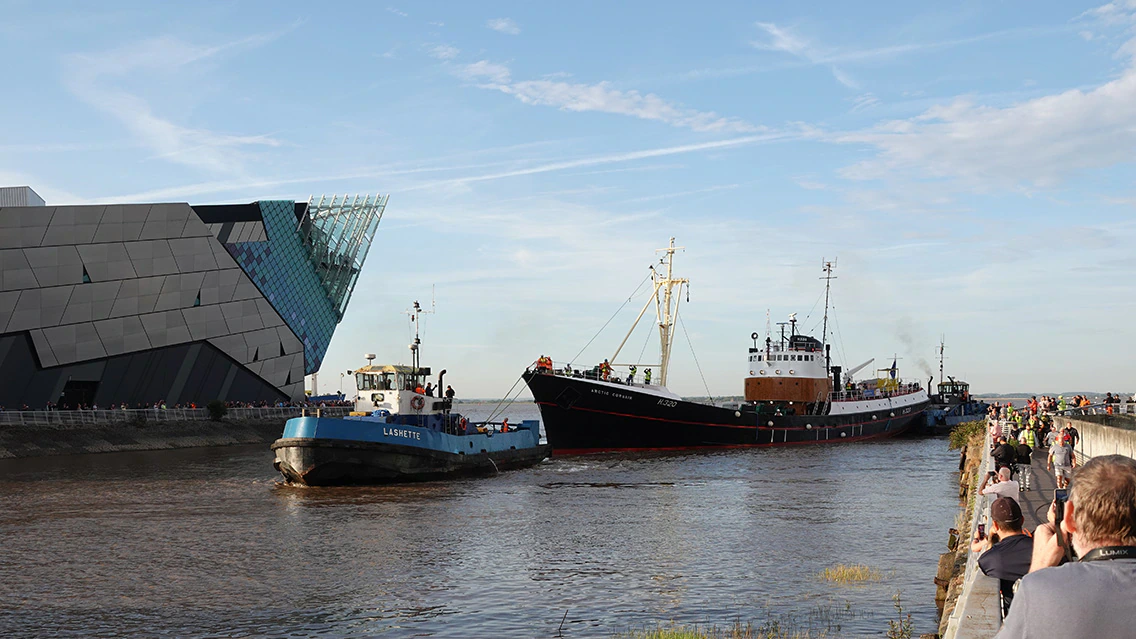
The historic sidewinder trawler, the Arctic Corsair – which is managed by Hull Museums and its project Hull Maritime – has reached its final destination. She has been dry berthed at the city’s North End Shipyard, having been sailed from her previous berth on the River Hull, next to Streetlife Museum, which is also run by Hull Museums.
Built in Beverley in 1960, the Arctic Corsair is Hull’s last surviving sidewinder trawler. She was part of the city’s deep-sea fishing fleet for many years, and an important vessel in the nation’s trawling industry.
The move to her new dry dock has been made in order to preserve the vessel as well as provide a visitor centre to improve the experience for audiences.
Moving the trawler was a complex operation and involved close coordination between multiple agencies, bridge operators and maritime specialists.
The move has taken place following an extensive restoration by local ship repair company, Dunston Ship Repairs, who also lent their expertise to move her. She was moved by three tugs, as the Corsair no longer has an engine.
A spokesperson for Hull Museums said: “The relocation of the Arctic Corsair to her new home was a highly complex and meticulously planned operation that required extensive coordination between internal teams and a range of external partners, including the Environment Agency.
Advertisement
“To enable the vessel's journey, a carefully choreographed sequence of infrastructure movements was required. The Millennium Footbridge, Myton Bridge, Scale Lane Footbridge and Drypool Bridge all had to open at precisely timed intervals, alongside the operation of the tidal barrier and other key assets, to create a safe navigational route.
“The move was further complicated by environmental factors, with the programme dependent on favourable tidal patterns, weather forecasts and river conditions. The vessel's passage relied on a narrow high-tide window to provide sufficient water depth and allow her to be safely manoeuvred into dry dock at North End Shipyard.
“Measuring 58 metres in length, the Arctic Corsair presented a significant navigational challenge. At points along the route, the trawler was wider than the river itself, making precision planning essential. Navigating the vessel through the waterway and into the tight dock entrance required the specialist expertise of tug masters, whose skill and experience were critical to the success of the operation.
“The successful relocation of the Arctic Corsair is a testament to the expertise, dedication and collaborative efforts of everyone involved. Through detailed planning, effective partnership working and careful management of both operational and environmental constraints, the project secured the future of one of Hull's most treasured maritime heritage assets in its new permanent home.”
With the trawler now in place in the dry dock at North End Shipyard, the next phase of work will focus on installing the walkways and bridges that will physically connect the visitor centre to the Arctic Corsair. These access structures are a vital step before the attraction can open to the public, enabling visitors to safely board the vessel.
Hull Maritime is a major UK City of Culture legacy project, made possible through funding from Hull City Council and the National Heritage Lottery Fund.
Advertisement
Eilish McGuinness, the chief Executive at the National Lottery Heritage Fund, said: “It is wonderful to see this exciting milestone of the Hull Maritime project take place and the Arctic Corsair move to its new home. The vessel is an incredible beacon of Hull's rich maritime heritage and we’re excited it’s a step closer to reopening.
“The Arctic Corsair is incredibly important to the people of Hull and we’re proud that thanks to National Lottery players we have been able to support its restoration, ensuring its rich story is preserved and shared with visitors near and far for generations to come. This work is a fantastic celebration of the city’s maritime heritage and contributes to the ongoing cultural regeneration of Hull.”
During her time at sea, the Arctic Corsair travelled huge distances, took part in the Cod Wars and recorded a world record catch. She was retired in 1987 after a long and successful career despite the decline of the local fishing industry. In 1998, the Arctic Corsair moved to a berth on the River Hull, next to Streetlife Museum, and was opened to the public in 1999.