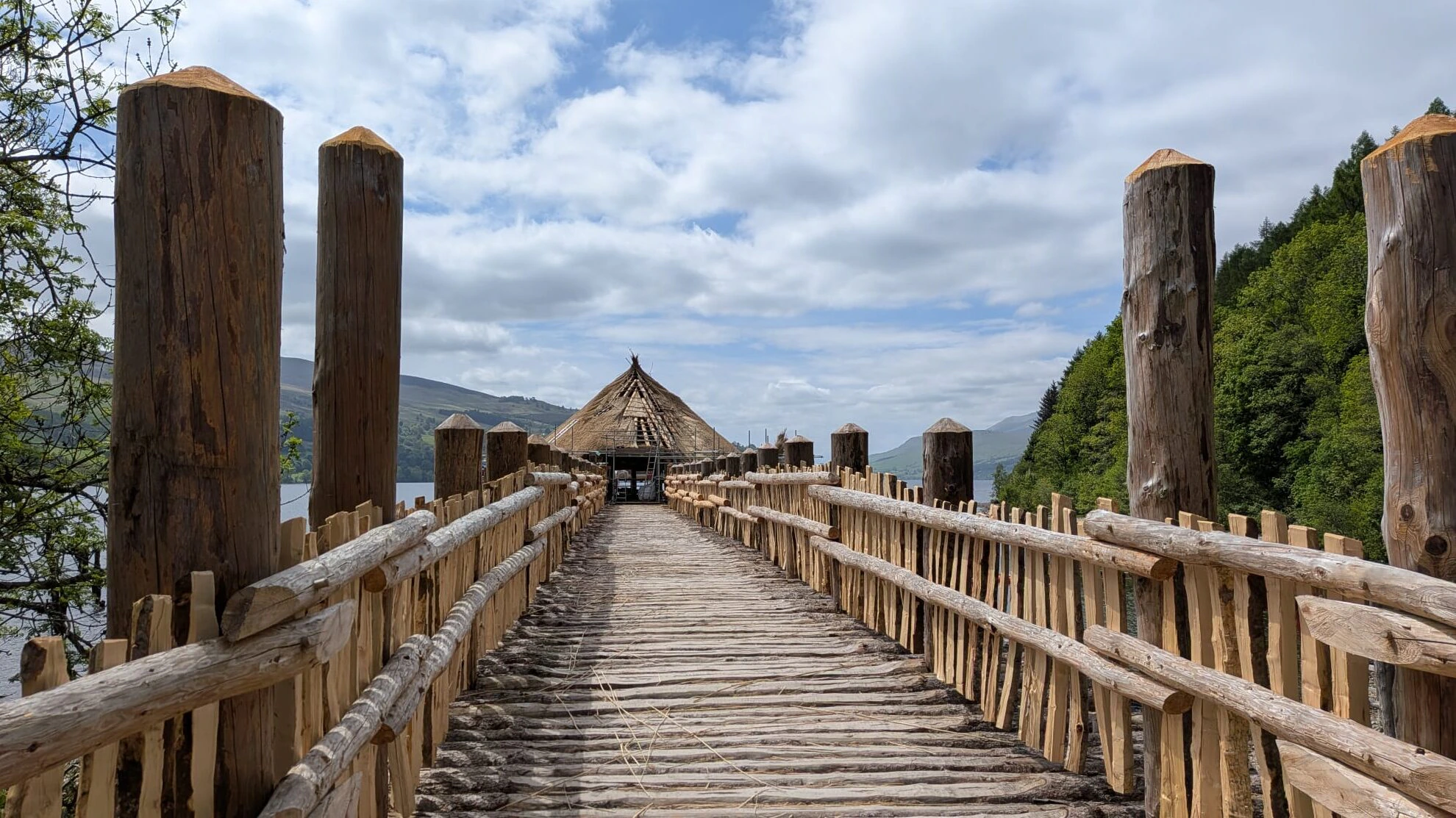
The Scottish Crannog Centre, Perthshire, has opened its first crannog since a devastating fire ravaged the site in 2021.
The crannog – a domestic building constructed on stilts in estuary water or lochs dating from the Neolithic period on – was opened by Scotland’s first minister John Swinney last Friday. It was built by a team of specialist craftspeople and apprentices, with eight of them working in two teams on the structure at any one time.
Swinney unveiled the new crannog while also presenting the centre with a plaque that recognises the Scottish Crannog Centre as a "nationally significant collection". This was awarded by Museums Galleries Scotland on behalf of the Scottish Government.
The reconstruction of the iron age crannog began in October 2024 once the Scottish Crannog Centre had relocated to the other side of Loch Tay earlier that year.
The new site is 12 times bigger than the previous one. The move cost £5m, with the new crannog costing another £700,000. Funders of the crannog include the National Lottery Heritage Fund; Perth & Kinross Council; Historic Environment Scotland; Forestry and Land Scotland; Gannochy Trust; Northwood Charitable Trust; Patersons Quarries; and public donations.
The crannog was built with 300 European Larch trees acquired from Scottish woodland suppliers.
The craftspeople reconstructed the building using modern tools and equipment to meet construction site standards, while employing a range of traditional skills. These included roundwood timber framing, hazel coppicing, hurdle making and thatching.
Advertisement
Volunteers worked alongside the professionals, with individuals and groups giving up to 1,000 hours to help rebuild the replica crannog.
The structure is in keeping with a dwelling place that would have been inhabited by prehistoric people.
Crannog vital stats
- The crannog has a diameter of 15 metres.
- At 48 metres in circumference, the central island construction includes a walkway around the roundhouse, which is around the size of a small circus tent.
- Timber posts were driven one metre into the loch bed.
- The floor of the crannog is 6m above the average waterline (measured in April when the water is neither at its highest or lowest).
Mike Benson, director of The Scottish Crannog Centre, said: “The opening of the new crannog signifies that we have now completely recovered from the fire. Since the blaze, we’ve been a bit like a Van Gogh museum without any Van Gogh.
“Although we relocated to a larger site and built a new visitor centre, museum and Iron Age village within three years, constructing a new crannog, as you might imagine, was a much more ambitious project.
“The crannog is an incredible structure but it’s not just a building: it’s part of our community. As well as the centre’s staff, we have committed volunteers and interact regularly with a range of charities and the people they support. Many consider our centre a home and a place of sanctuary.
Advertisement
"People come to learn about the past and find out what role it can play in our future. Aside from the crannog itself, we have a number of thatched buildings in which our team demonstrates traditional skills, such as weaving, blacksmithery and woodworking to our visitors, keeping these crafts alive and introducing them to new generations.
“Our museum too is very much living and thriving. It houses an amazing collection of items belonging to the crannog dwellers who lived only a few yards away and we invite people from different backgrounds and countries regularly to examine the objects, share their stories and give their own cultural perspectives on their possible uses.
“With our new crannog people will not only be able to see and experience what such an amazing building is like, but we now also will have more space to expand the diverse activities of the centre.
“Today [Friday 22 May; when the crannog was unveiled] is a testament to the hard work and dedication of our staff, and the wider team involved in the build, who have pulled together to help make the new crannog a reality. In short, it’s a remarkable achievement of which we are all extremely proud. Do come and visit!”
In 2021, it took just six minutes for the much-loved reconstruction of an Iron Age crannog on the banks of Loch Tay in Perthshire to burn down. The centrepiece of The Scottish Crannog Centre had been carefully created by archaeologists 25 years before the fire. It was a bitter blow for all staff members and volunteers, not to mention visitors.