Ceremonies have been taking place in Scotland and South Africa this week to mark the return of ancestral human remains unethically acquired by the Hunterian at the University of Glasgow in the 19th and 20th centuries.
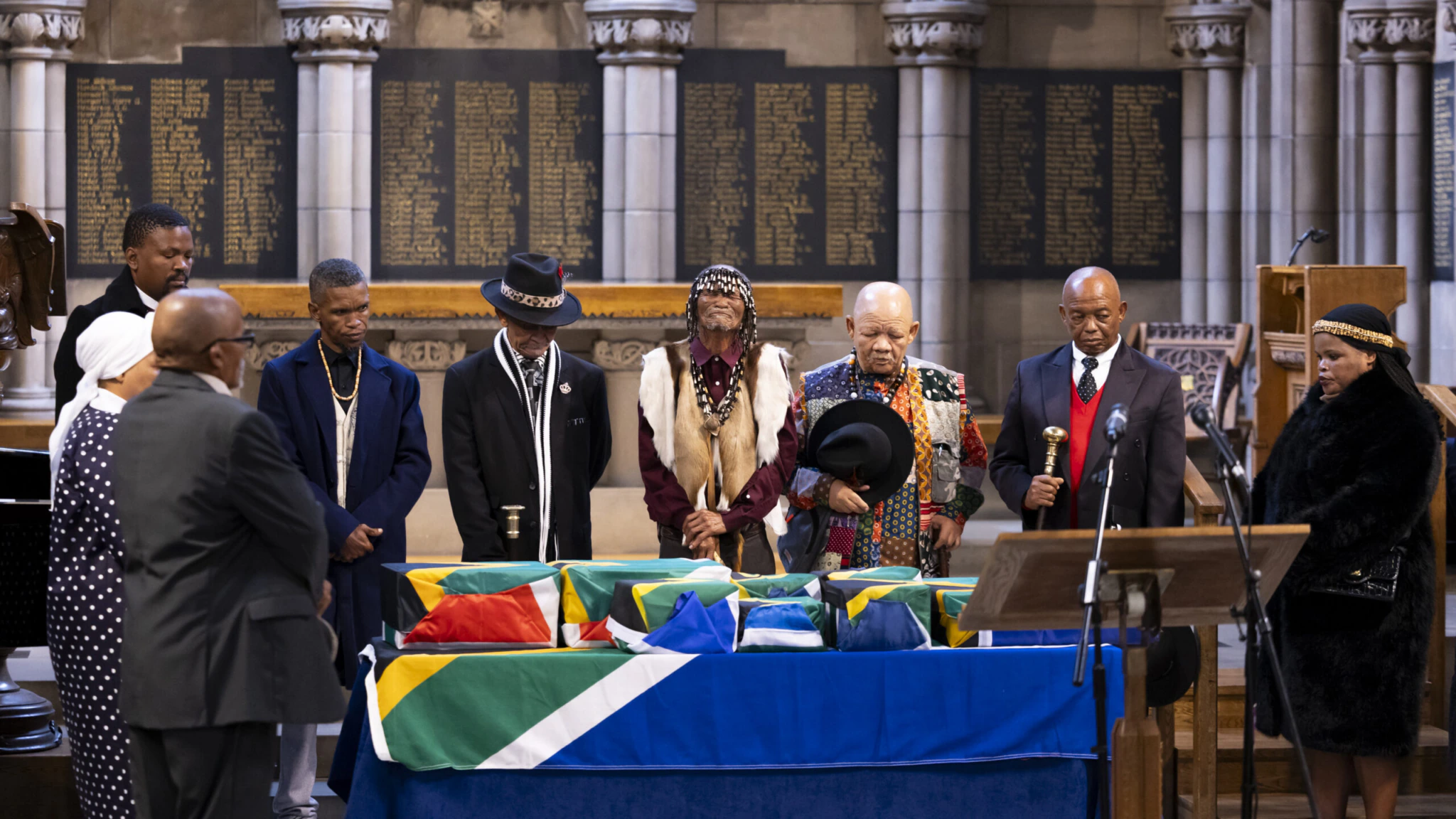
The partial remains of six individuals were flown back to South Africa after a handover ceremony at the Hunterian on 13 October, along with two plaster face-casts and a soapstone smoking pipe excavated from a burial cairn.
Upon their arrival in Cape Town, community representatives conducted a private cultural ritual to receive their ancestors before the remains were brought to Iziko South African Museum.
The remains and objects were unethically exhumed in South Africa between 1868 and 1924 and given to the University of Glasgow by alumni and other donors.
Five of the individuals, and the smoking-pipe, originate from the Northern Cape and are claimed by descendant members of the San, Nama, Griqua and Korana populations.
The sixth individual originates from the Western Cape and is of Khoi San origin. The remains were unethically excavated from within a cave and are thought to be considerably older than the other remains. The origin of the two face-casts is unknown, but they are thought to have been purchased in Edinburgh.
Advertisement
The return came about thanks to South Africa’s recently endorsed National Policy on Repatriation of Human Remains and Heritage Objects, which has created a structured framework for coordinated country-to-country repatriation and set a foundation for a “more inclusive and state-led redress process”.
The project was led by Iziko Museums of South Africa and guided by extensive consultation with affected communities and first indigenous Khoi and San leaders.
A homecoming ceremony will be held at the Iziko South African Museum today (17 October) featuring cultural observances, formal addresses, and the ceremonial handover of the remains.
Delegates from the Northern Cape, South Africa’s culture minister Gayton Mckenzie and the leadership of the Hunterian Museum are due to speak at the event.
Petrus Vaalbooi, the cultural custodian of the Northern Cape San and Bushmen, said: “This long-overdue process marks a critical step toward healing, respect, and the restoration of dignity to our ancestors.
“The moment carries profound cultural and spiritual significance, as it allows for the return of our ancestors to the earth with honour — where traditional healing rituals and ceremonies may be observed in accordance with custom.
Advertisement
“This reburial is not merely the return of physical remains; it is a symbolic act of reclaiming heritage, confronting historical injustices, and restoring the dignity of a people. It represents the reconnection of communities with their cultural and spiritual lineage, and the beginning of a healing journey that spans generations.”
McKenzie said: “We stand at a solemn crossroads of memory and justice—a moment to honour those whose stories were silenced by history, and to return them home with dignity.
“This reburial represents more than a physical return. It is an act of remembrance and respect, acknowledging the profound trauma caused and taking a step toward restoring the dignity of a people and providing respect for the dead that has been long-standing demand in the struggle for justice.”
Hunterian director Steph Scholten said he was “glad that we can continue to honour our commitment to work with affected communities in an equitable way, returning human remains and culturally significant items to their rightful communities with dignity and care”.
The Hunterian said in a statement: “This repatriation will form part of the restoration of dignity to the communities affected and contribute to bringing closure to the trauma that resulted from numerous violations, such as unethical exhumations.
“Ancestral human remains, predominantly of Khoi, San and other indigenous origins, were unethically collected during the late 19th and early 20th centuries by institutions in southern Africa and around the world. These remains were acquired without consent, often through illicit trade, unauthorised exhumation and grave robbing, to further race-based and pseudo-scientific research.
“For over a century, they were held in institutions, including the Hunterian and Iziko Museums of South Africa, as a result of colonial and apartheid-era practices that treated them as objects of study and display. The Hunterian has acknowledged its colonial legacy and welcomes repatriation claims, prioritising the return of non-British human remains and culturally significant heritage items.”
Project partners included the Hunterian, South Africa’s Department of Sport, Art and Culture through the implementing agencies, Iziko Museums of South Africa and the South African Heritage Resources Agency, and the Northern Cape Reburial Task Team, which represents the first indigenous Khoi and San communities (Nama, Griekwa, Korana and San/Bushman) impacted by the historical unethical displacement of ancestral remains.