The MA’s Learning and Engagement Manifesto underpins National Museums Liverpool’s (NML) Framework for Learning & Participation, helping to articulate our work around placemaking, wellbeing and learning. The manifesto launch was incredibly relevant and timely, inspiring our learning and participation team to address the fundamentals at the core of our work.
The social justice manifesto point, dedicated to reducing inequalities in access to provision and aspiring to create socially-conscious museum and gallery learning programmes, spoke loudly to our values as a team.
With the redevelopment of the International Slavery Museum and Maritime Museum on Liverpool’s iconic waterfront, the manifesto resonated with our work with communities most affected by legacies of transatlantic slavery, striving to overcome challenges of exclusion and achieve equality of outcomes.
The manifesto helps us approach engaging a wider range of people in heritage, and facilitating better access to participate and contribute equally to our museum programmes.
We continuously seek the experiences of educators through an educators’ steering group, convened to discuss narrative and interpretation of our new learning spaces and museum redevelopment. Meetings are quarterly with representation sought from primary and secondary schools, higher and further education providers, SEND, home-schooling and alternative provision, including creative and community practitioners.
The group is co-chaired by NML’s head of learning and participation and a community education specialist. It creates a safe space for collaborators to debate and reflect on current learning practice and explore opportunities to address the inequalities children and young people face (particularly those from global majority communities).
Advertisement
A key goal is the National Centre for Teaching Black History, which will have its physical home within the redeveloped International Slavery Museum (due to open in 2028). Listening to our learning and community partners, a new teaching pedagogy that is anti-colonial and anti-racist at its very core is required of us.
Using NML’s collections, the National Centre seeks to expand learning of transatlantic slavery, colonialism and empire through collaboration with stakeholders locally, nationally and internationally.
The National Centre also aims to influence change across the UK by making the curriculum and museum learning more relevant to global majority children and young people, as well as more reflective of Africa’s global contribution to the world’s development.
The intended audiences for this project have been mapped through research and development and a Theory of Change logic modelling exercise.
The educators’ group was convened through existing networks and connections, but also through working with partners who have a greater reach and engagement with audiences currently underrepresented in the project. Greater insight and understanding into our audiences through targeted customer relationship development and analysis of our data and visitor profile has helped identify gaps.
Through the Theory of Change process and associated workshops, we began to identify priority audiences who would benefit from activities delivered through the National Centre, thereby creating long-term outcomes and social change. Target audiences include local, national and international stakeholders including primary and secondary schools, teachers, adult learners, young people aged 16-24, and communities.
Advertisement
A co-production framework was developed with the Research Centre for Museums and Galleries (RCMG) at the University of Leicester. This process resulted in a framework and internal toolkit which both supports the team working on the museum redevelopment and embeds the principles of co-production in the design of the National Centre.
Social justice as a guiding principle runs through all our interactions and collaborations, by redistributing power that the museum has traditionally held in terms of decision-making, access to heritage and our opportunities and privileges as a colonial institution.
Individuals’ contributions to the museum redevelopment through participation in the steering group are recognised and valued through our co-production framework and principles. These principles include: protect, inclusive, trust, visible, impactful, decentralise, equitable, transparent and reflect.
The Learning and Engagement Manifesto helps to align our words with real, transformative actions. There has been a demonstrable shift in how we connect and contribute through reciprocal relationships between the museum and its learning and community stakeholders.
Diane Garrison, the co-chair of our educators’ steering group, said: “National Museums Liverpool is taking a bold step by embarking on a journey to address the legacy of slavery and racism that is endemic in education systems, institutions and minds globally.
“As an educator and co-chair of the educators’ steering group, it is my privilege to collaborate with museum staff in the collective endeavour that focuses on the development of an education facility that centres opportunities and narratives that more accurately reflect the rich historical tapestry of Indigenous African communities across the diaspora.
Advertisement
“We are also beginning to explore and challenge questions about knowledge and histories beyond the dominant Western Eurocentric discourse. These are exciting times.”
Claire Benjamin is head of learning and participation at National Museums Liverpool.
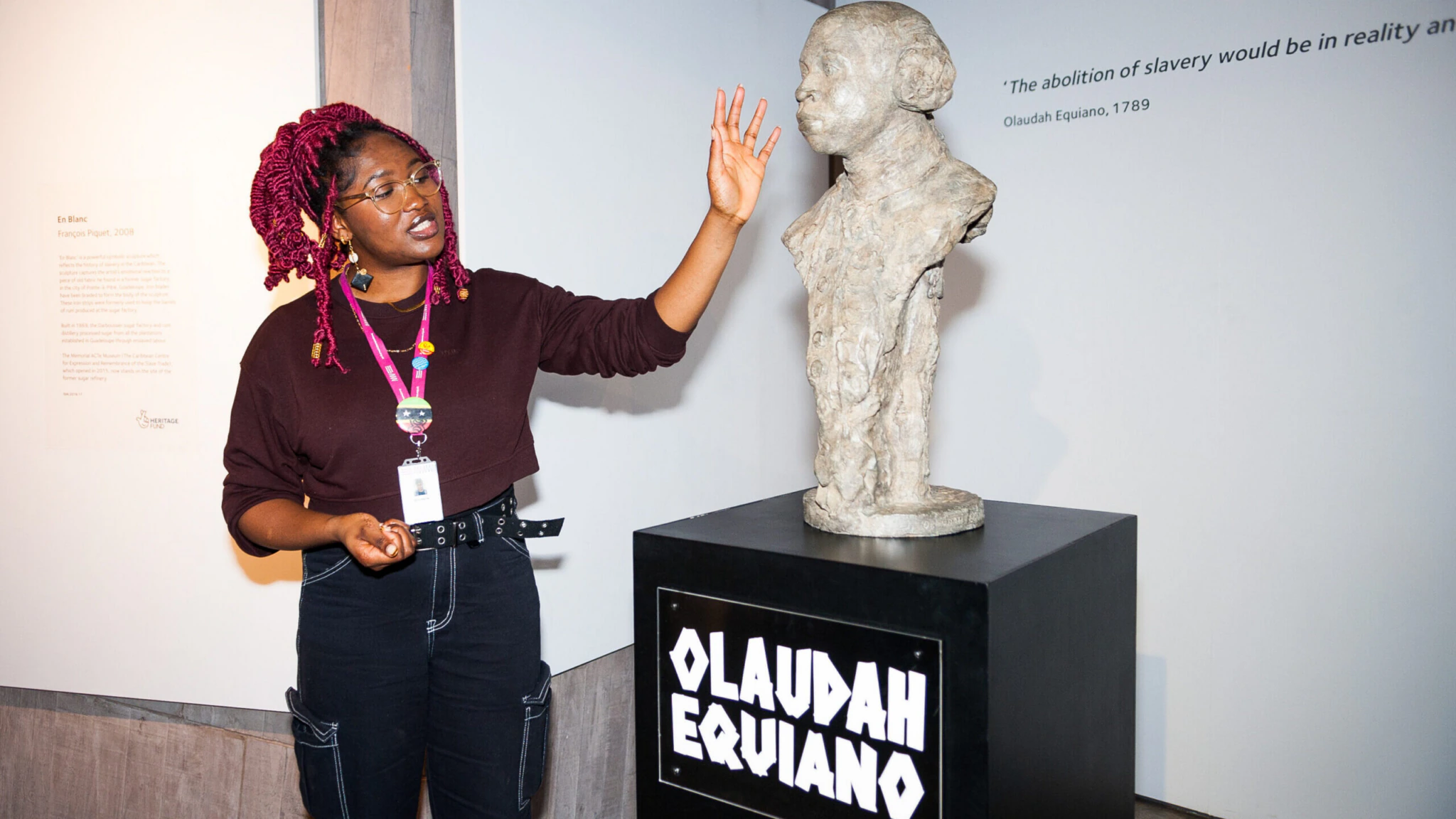
Image: Live interpretation of a bust on display at NML, with the plinth reading Olaudah Equiano